What payables outsourcing actually covers
A full-service provider runs the same invoice-to-pay steps your in-house team would, end to end. Most cover all of the following, and you can outsource part or all of it.
Invoice intake and capture. Collecting bills from email, mail and portals, then extracting the data without you keying it.
Data capture and coding. Reading line items and assigning the right general-ledger codes.
Matching and validating. Checking each invoice against the purchase order and goods receipt, two-way or three-way.
Approval routing. Sending validated bills through your internal approval hierarchy before payment.
Payment execution and reconciliation. Remitting funds by ACH, transfer, virtual card or cheque, then reconciling the records.
Reporting, supplier queries and controls. Monthly dashboards, vendor query handling, fraud checks and audit-ready trails.
What payables outsourcing costs
Cost is usually the first question, and the honest answer has two layers: the headline rate, and the real all-in number. Start with the models.
Pricing model | Typical range | Best for |
|---|---|---|
Per invoice, with automation | $2 to $6 an invoice | Full-service AP with variable volume |
In-house per invoice (your baseline) | $10 to $20 an invoice | The cost you are comparing against |
Monthly retainer | $500 to $2,500 a month | Predictable, lower volume (50 to 500 invoices) |
FTE or managed team | Custom, per dedicated head | High, stable, largely manual volume |
Outcome or SLA based | Custom | AI-led managed AP priced on results |
The headline per-invoice rate understates reality. Once you add onboarding, exception handling, quality control, management overhead and change fees, the true all-in cost runs 40 to 60 percent higher.
What sits inside that gap, and rarely shows up on the first quote:
Onboarding and transition. Mapping your process, connecting your ERP and running in parallel before cutover, usually a one-time fee worth several months of service.
Exception handling. The invoices that do not match on the first pass, billed per exception or at a higher rate. In real accounts payable a meaningful share never matches first time, so this is the line that moves the total.
Quality control and management. The provider's supervision, sampling and account-management layer, either folded into the rate or added on top.
Change requests. A new entity, a new approval rule or a new report, each often a chargeable change once the contract is signed.
Rush and off-cycle payments. Urgent or out-of-band payment runs, typically at a premium.
In practice, a mid-sized firm processing about 1,500 invoices a month spends roughly $45,000 to $90,000 a year. Enterprise deals are custom and rarely published. As a rule of thumb, outsourcing starts to pay off above about 200 to 300 invoices a month.
In our years running multi-country AP, the cost that surprised finance teams was never the per-invoice rate, it was the exceptions. A provider quotes a clean rate, then bills extra every time an invoice does not match, and in real accounts payable a meaningful share never matches on the first pass.
In-house, outsourced, or agentic managed AP
The decision is no longer just build versus buy. There are three real options, and your volume plus control needs point you to one.
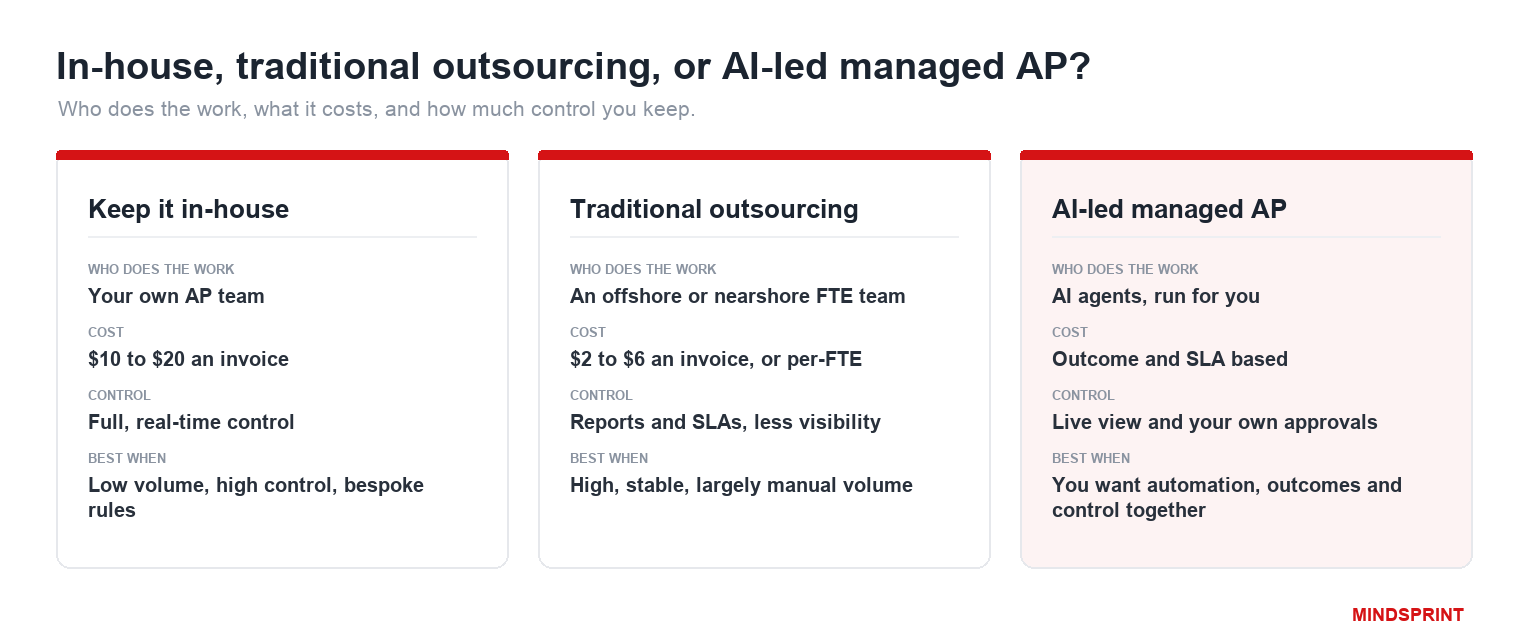
In our experience the breakeven is less about a magic invoice count and more about exception load. A business with clean purchase orders automates cheaply; one with messy, non-PO spend is exactly where a managed operation earns its fee, because exceptions are what agents and specialists absorb.
The benefits and risks, honestly
Payables outsourcing is a genuine trade, not a free win. Here is both sides, so you can weigh it for your own team.
What you gain
Lower cost. Automated, outsourced AP at $2 to $6 per invoice undercuts a manual in-house cost of $10 to $20.
Scale without hiring. Volume spikes are absorbed by the provider, not by a new hiring cycle.
Expertise and compliance. A specialist stays current on tax and payment rules and keeps clean, audit-ready records.
Fewer errors and less fraud. Automated capture and duplicate detection catch what a stretched team misses.
Focus. Your finance staff moves off data entry and onto analysis and vendor management.
What to watch
Loss of control and visibility. Reporting on the provider's schedule, not in real time, and slower cross-border approvals.
Data security. Sensitive vendor and banking data leaves your perimeter, so certifications and controls matter.
Hidden fees. Setup, exception handling, custom reports, rush payments and termination penalties add up.
Integration hurdles. Connecting a provider's systems cleanly to your ERP is real work, not a given.
Quality and continuity. Offshore turnover, knowledge loss and lock-in can make quality drift or switching hard.
The 2026 shift: traditional BPO versus agentic managed AP
This is the change that matters most in 2026, and it is why the old warning about losing control no longer has to be true. Payables outsourcing has split into two very different delivery models, shown side by side below.
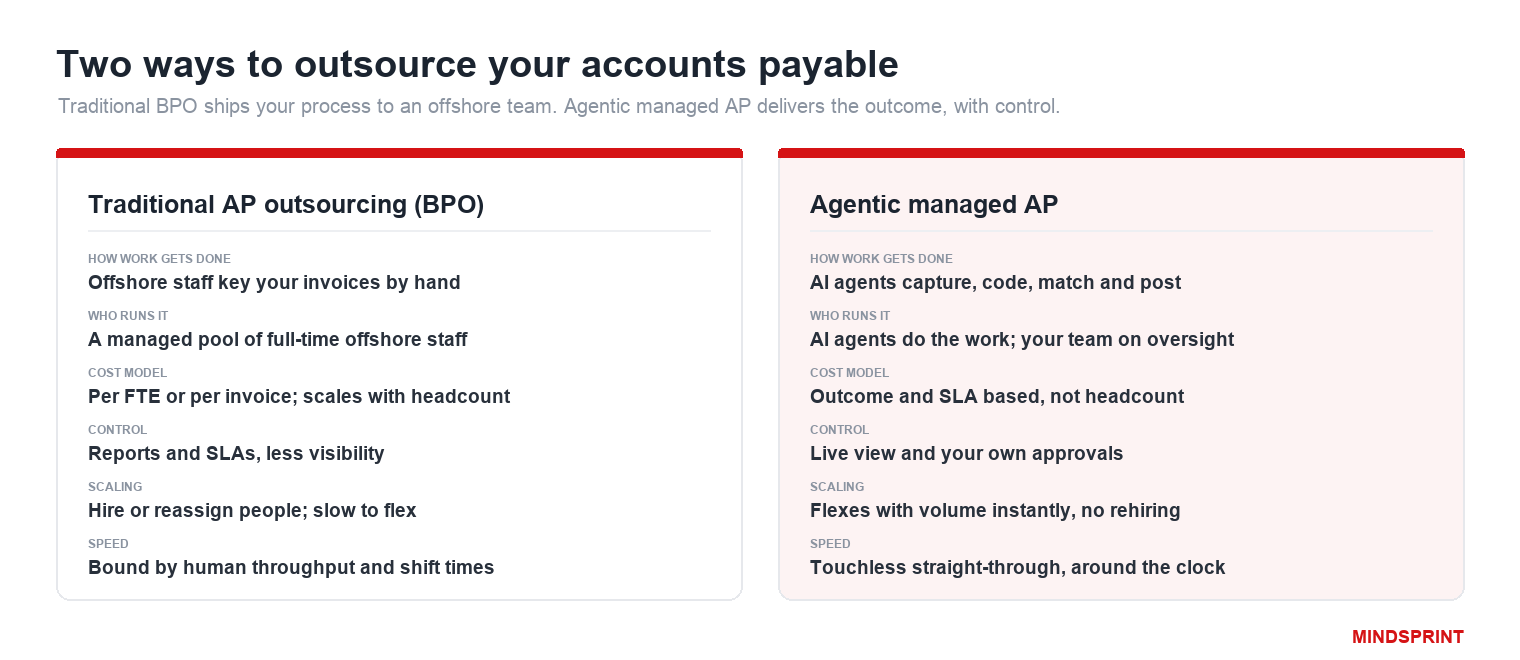
Traditional outsourcing is labor arbitrage: an offshore or nearshore team of people processes your invoices by hand, priced per full-time employee or per invoice. It is cheaper hands, with the classic trade-off of less control and visibility.
Agentic managed AP is different. A network of AI agents captures, codes, matches, resolves exceptions and posts invoices, with your team validating only the genuine judgment calls. It is priced on outcomes and service levels, not headcount, and you keep your controls, your audit trail and live visibility.
This is not fringe. Even a traditional enterprise BPO like Genpact now reports 65 percent touchless AP using a network of AI agents (Genpact case study). AI-native managed AP goes further still, running most invoices with under 5 percent manual intervention.
In that Genpact programme, a set of AI agents cut invoice cycle time from as long as 29 days to under 14, lifted first-pass match yield from 67 to 85 percent and on-time payment from 60 to 95 percent, drove near-zero duplicate payments, and grew captured early-payment discounts from $35 million to $44 million (Genpact case study).
One honest note: agentic managed AP is still a third party touching your financial data. It removes the labor trade-off, not the need for diligence on security, integration and exit terms.
How to choose a payables outsourcing provider
Whichever model you lean toward, the same questions separate a safe choice from an expensive mistake. Ask each one before you shortlist. Having sat on both sides of these contracts, the one we would push hardest is the first: does the provider own the outcome, or only supply hands?
Do they own the outcome, end to end? A provider accountable for touchless rate and cycle time beats one that just supplies hands.
Is the pricing transparent? Get every fee in writing: onboarding, exceptions, reports, rush payments and exit.
Will it integrate with your ERP? Confirm clean, two-way integration with SAP, Oracle, NetSuite or whatever you run.
Do you keep control and visibility? Look for live dashboards and your own approvals, not month-end reporting only.
How is your data secured? Check certifications, segregation of duties and audit traceability.
Is it people or automation? An FTE pool scales with cost; an agentic operation scales with software.
Which payables outsourcing setup fits your volume, ERP and vendors
Before you shortlist, three questions decide what actually fits: how many invoices you process a month, which ERP you run, and whether your vendors are mostly domestic or international. A fourth, full or partial outsourcing, sets the scope.
By monthly invoice volume
Under 500 a month. Usually cheaper to keep in-house or on light automation, because outsourcing overhead rarely pays back below this.
500 to 5,000 a month. The sweet spot: enough volume to clear the overhead, enough complexity to want specialists or agents.
Over 5,000 a month. Enterprise territory, where touchless rate and autonomous exception handling drive the savings and a managed agentic operation earns its place.
By your ERP
QuickBooks, Xero or Sage. Most providers connect out of the box, so integration is rarely the blocker.
NetSuite, Sage Intacct or Dynamics 365. Mid-market ERPs need real, two-way integration and multi-entity handling, so confirm it before signing.
SAP or Oracle. Enterprise ERPs demand deep, controlled integration, so favour a partner that is genuinely ERP-agnostic rather than one that forces a workaround.
By domestic or international vendors
If your vendors are mostly domestic, a single-country provider on standard payment rails is enough. If you pay international vendors, weight cross-border payments, multiple currencies and multi-country tax heavily, because that is exactly where cheap offshore-FTE outsourcing quietly struggles and an automated, multi-language operation pulls ahead. In India specifically, that tax burden shows up as GST e-invoicing and TDS on vendor payments, so confirm any provider handles GSTIN validation, GSTR reconciliation and TDS deductions end to end.
Full or partial outsourcing
You do not have to hand over everything. Many teams outsource only high-volume capture and matching while keeping approvals and vendor relationships in-house, then widen the scope once trust is proven. Agentic managed AP makes partial scope easy, because you can automate one stage without shipping the whole process out.
The 2026 payables outsourcing provider landscape
The India payroll and HR firms that dominate some search results are a different market. The global finance and accounting outsourcing market these providers compete in runs into the tens of billions of dollars, and its fastest-growing slice is AI-led delivery.
For global mid-market and enterprise AP, the real landscape sorts by delivery model: traditional labor-led, automation-forward hybrid, or AI-native managed. Here is the map. For a full, ranked provider-by-provider comparison, see our accounts payable outsourcing companies guide.
Provider | Delivery model | Best for | Note |
|---|---|---|---|
Genpact | Hybrid, AI-led | Enterprise transformation at scale | Reports up to 65% touchless AP with AI agents |
Accenture Operations | Hybrid | Large-enterprise F&A | Control-centric outsourced finance |
Capgemini | AI-led, hybrid | Enterprise F&A | Agentic F&A focus; analyst-recognised in FAO |
Deloitte | Hybrid | Enterprise managed services | Global GBS and F&A; analyst-recognised |
WNS | FTE-led, hybrid | Enterprise transactional F&A | Standardised, high-volume processing |
Auxis | Hybrid, nearshore | Mid-market to lower enterprise | Automation-forward LatAm nearshore |
Corcentric | Hybrid | Mid-market to enterprise | AP and AR outsourcing plus payments |
Personiv | FTE-led | Mid-market | Dedicated high-volume AP teams |
AvidXchange | Tech-led | Mid-market | AP automation and supplier payments |
BILL, Ramp, Rippling | Software, self-serve | SMB | AP software, not a managed operation |
Mindsprint SprintAP | AI-native managed | Mid-market and enterprise | Agentic managed AP, outcome and SLA based |
Analyst recognitions from Everest and ISG shift year to year, so confirm a provider's current standing before you shortlist. The pattern that matters is the direction of travel: the enterprise incumbents are all racing from labor-led toward agentic delivery.
A few are worth knowing specifically: AvidXchange, the mid-market AP-automation name, went private in late 2025 and now pushes embedded AP-as-a-service; Corcentric pairs AP and AR outsourcing with a payments and financing layer; and BILL, Ramp and Rippling are SMB software you run yourself, not managed operations.
Common mistakes when outsourcing accounts payable
Having sat on both sides of these deals, the failures rarely come from a bad provider. They come from how the deal was set up.
Choosing on headline price. The lowest per-invoice rate usually hides the highest exception fees.
Outsourcing a broken process. If your workflow is messy, you are only paying someone to run the mess faster, so fix the obvious bottlenecks first.
Skipping the integration test. Confirm the two-way ERP write-back on real invoices before you sign, not after.
Ignoring the exit. Know how you get your process and data back before you hand them over.
If you want the software to run AP yourself rather than a managed service, see our guide to AI in accounts payable. If you want the operation run for you, this is where Mindsprint SprintAP fits.
Where Mindsprint SprintAP fits
SprintAP is deliberately both a service and a software business. That matters here, because it separates us from traditional BPOs that simply license someone else's tool, and from software vendors that leave you to operate the tool yourself.
As a managed operation, SprintAP runs your AP with a network of autonomous AI agents that orchestrate the invoice-to-pay process end to end. Document intelligence reads invoices in 100 languages, including handwritten ones, and an agentic helpdesk handles supplier queries on its own, across multi-country tax rules. It is priced on outcomes, not headcount. SprintAP commits to targets for touchless rate, cycle-time reduction and exception rate at 30, 60 and 90-day milestones.
On its own deployments it reports over 50 percent cost savings, 70 percent faster cycles, under 5 percent manual intervention and full audit traceability; treat those as its figures, and test them against your own baseline.
It is ERP-agnostic, goes live in about 6 to 8 weeks, and keeps 100 percent audit traceability as standard. Because we ran multi-country AP ourselves for two decades before productising it, the conversation starts with your process and your numbers, not our feature list.
To be honest about scope, SprintAP is still a third party in your financial process, so security, integration and exit terms deserve the same diligence you would apply to any provider.
It is not a cheap offshore labor pool, and it does not remove people entirely: your team still validates the genuine exceptions. What it removes is the old trade between automation and control.