Accounts payable outsourcing providers at a glance
The eight providers compared by model, fit and pricing. The full breakdown, with pros, cons and a bottom line for each, follows further down.
Provider | Model | Best for | Pricing | G2 rating |
|---|---|---|---|---|
Genpact | Labor-arbitrage BPO | Automation-led enterprise AP | Per-invoice / per-FTE | |
Accenture | BPO plus consulting | Global AP standardisation | Custom | |
Mindsprint SprintAP | Agentic managed service | Agentic AP for multi-entity enterprises | Consumption / outcome | New |
WNS | Labor-arbitrage BPO | Governed enterprise AP | Per-FTE / per-invoice | Not on G2 |
GEP | Software plus services | AP inside a source-to-pay relationship | Custom | |
Auxis | Nearshore BPO | Nearshore mid-market AP | Per-FTE / per-invoice | Not on G2 |
IBM | BPO plus consulting | ERP-integrated AP | Custom | Not on G2 |
Capgemini | Labor-arbitrage BPO | Multi-country AP | Custom |
G2 ratings shown where the provider has a public G2 listing. Several enterprise BPOs are reviewed on Gartner Peer Insights rather than G2, and SprintAP is a newer product. Ratings are point-in-time; confirm before publishing.
What accounts payable outsourcing services include
A full-scope AP outsourcing engagement covers the whole invoice-to-pay cycle. Most providers let you outsource all of it or just the parts that hurt.
Invoice processing. Capturing, digitising and coding incoming invoices, by OCR and increasingly by AI, from email, portals and paper.
PO and three-way matching. Validating invoice details against the purchase order and goods receipt, and routing only the mismatches for review.
Payment execution. Scheduling and remitting payments by ACH, cheque or virtual card, on terms, timed to capture early-payment discounts.
Vendor management. Onboarding suppliers, answering their inquiries and resolving billing disputes, so AP is not buried in vendor email.
Reconciliation and reporting. Matching payments to the ledger and bank, and reporting cost per invoice, cycle time and touchless rate.
Who evaluates AP outsourcing, and the pain that drives it
Outsourcing AP is a decision made across the finance team, and each role arrives with a different pain and a different right answer. Find your row before you weigh providers.
Who you are | The pain that drives the search | What they actually need |
|---|---|---|
CFO or VP Finance | The cost of the AP function, close-cycle risk, and audit exposure across entities and geographies | Outcome accountability and lower cost, not more headcount |
Finance Controller | Exceptions, duplicate or fraudulent payments, and month-end bottlenecks | Tight controls, a live view, and clean, matched, audit-ready invoices at close |
Shared-services or GBS lead | An existing captive or offshore AP team with a high cost per invoice and a low touchless rate | A higher touchless rate and lower cost without losing SLAs, often an agentic layer on top |
Mid-market finance manager (500 to 5,000 invoices) | A team drowning in manual entry and matching that cannot justify more headcount | Automation for the clean invoices and a partner for the exceptions |
Small-business owner (50 to 500 invoices) | Just wants bills paid and the books clean without hiring | Software, not outsourcing, at this volume |
Outsource, automate, or hybrid? The decision by invoice volume and ERP
Before you compare providers, work out whether you should outsource at all. The right model tracks your invoice volume and the ERP you run more than anything else. Find your row.
Your profile | The right model | Why |
|---|---|---|
Small business, under ~500 invoices a month, on QuickBooks or Xero | Automate with software, do not outsource | At this volume a SaaS tool plus a few internal hours beats the cost of a service |
Mid-market, 500 to 5,000 a month, on NetSuite or Sage Intacct | Hybrid: automation plus outsourced exceptions | Software captures and matches; a partner absorbs exceptions and vendor onboarding |
Enterprise, 5,000+ a month, on SAP or Dynamics | Full managed service, agentic or BPO | Global vendor management, multi-entity compliance and mass payments are the real problem, which software alone does not own |
Geography shifts it too. A single-country, one-entity business can usually automate and stop there. A global, multi-entity operation, with multi-currency, cross-border payments and tax that varies by country, is where a managed service or BPO earns its keep, because vendor management and compliance, not tooling, are the real problem.
Offshore-heavy and India operations have historically leaned on labor-arbitrage BPOs on cost; the agentic model is the emerging challenger there, because it removes the per-headcount cost floor.
The three models of AP outsourcing
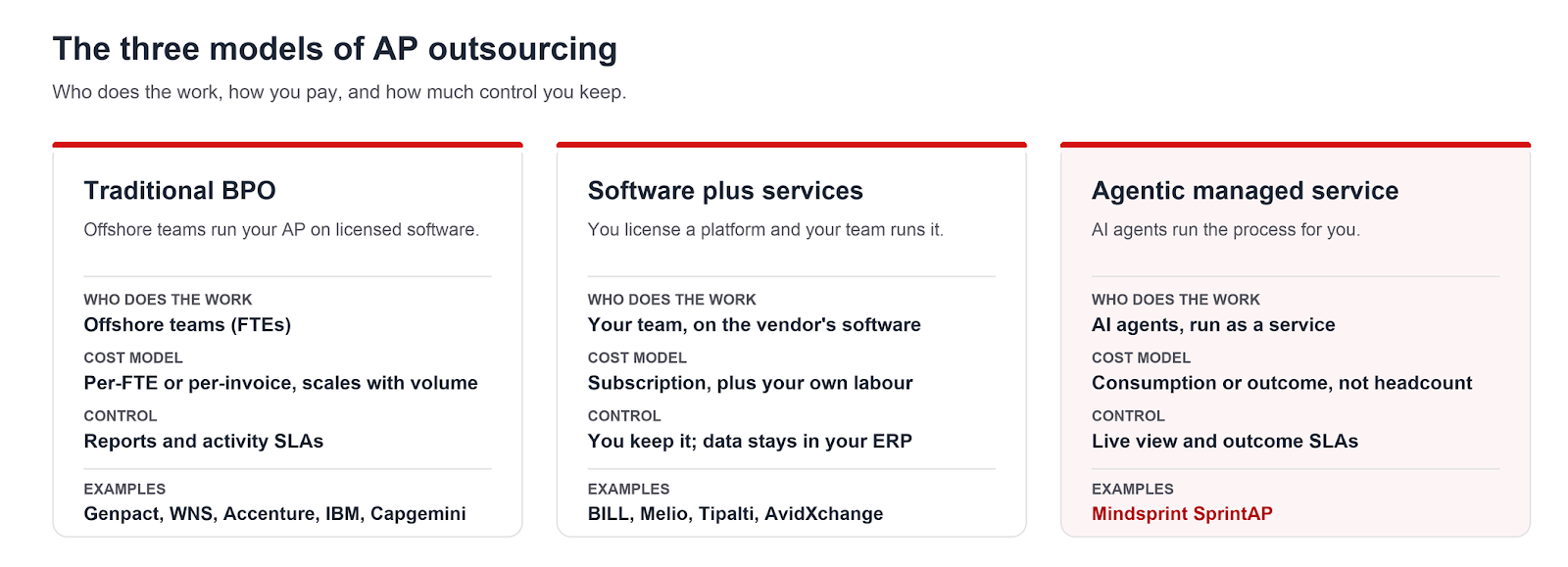
The word outsourcing hides three different things, and most roundups blur them. You are really choosing between three models, and the difference comes down to who does the work, where your data lives, and whether the vendor owns the platform.
Traditional labor-arbitrage BPO. Offshore teams run your AP, usually on licensed third-party software the provider does not own. Savings come from moving headcount to a lower-cost location, so cost scales roughly with volume, ramping up means hiring and training, and you get reports and activity SLAs rather than a live view. Genpact, WNS, TCS, Accenture, IBM and Capgemini sit here.
Software with managed services. You license a platform and your team runs it, with the vendor helping on capture, matching and payments. The software scales well, but the operating load stays with your staff. BILL and Melio suit QuickBooks-based small businesses, Tipalti global mid-market payments, and AvidXchange domestic mid-market.
Agentic managed service. AI agents run the process end to end, delivered as a service with outcome accountability rather than headcount. Cost decouples from volume, spikes are absorbed without hiring, and you keep a live control view, segregation of duties and a full audit trail. This is the emerging model, and it is how Mindsprint SprintAP is built.
What to look for in an AP outsourcing provider
Providers look similar in a deck. These are the dimensions that separate them, and the ones worth pressure-testing against your own invoices before you sign.
Automation depth, not just headcount. How much of the work is done by software and AI versus people. This decides whether your cost falls as volume grows, or just moves offshore.
ERP integration. Real, two-way connectors to the system you run, whether SAP, Oracle, NetSuite, Dynamics or QuickBooks. Treat ERP-agnostic as a claim to verify with specific integrations, not a feature.
Controls and compliance. Segregation of duties, a complete audit trail, duplicate and fraud detection, and SOC 2, so outsourcing does not weaken your controls.
Data security. AP data includes vendor bank details and payment files, a prime fraud target. Ask where data resides, how it is encrypted, and who can see it.
Delivery location. Onshore, nearshore and offshore each trade cost against time-zone overlap, language and data residency. Nearshore, Latin America for a US team, buys overlap; offshore buys cost; an agentic model sidesteps the tradeoff by not depending on where people sit.
Pricing model. Per-FTE and per-invoice pricing rises with volume; consumption or outcome pricing does not. Read how change requests and exceptions are billed.
SLAs that measure outcomes. Outcome commitments (touchless rate, cost per invoice, cycle time) are worth more than activity SLAs that only count invoices processed.
Live visibility. A real-time view of your own payables, not just monthly reports. Losing the live view is the most common outsourcing regret.
Transition and exit. A phased onboarding with a pilot, and a clean way to bring the process back or move it, so you are not locked in.
What accounts payable outsourcing costs
Pricing depends on volume, exception rate, geography and how complex your ERP and compliance are. Published numbers are rare, so treat these as directional and read the model, not just the rate.
Pricing model | Typical cost | Cost scales with |
|---|---|---|
Per invoice | $1.50 to $5, up to $15 for complex | Volume |
Monthly retainer | $2,000 to $20,000 SMB and mid-market; $25,000 to $100,000+ enterprise | Scope and volume |
Per FTE (offshore) | A blended monthly rate per full-time equivalent | Headcount, so volume |
Consumption or outcome (agentic) | Priced on invoices processed or outcomes hit | Decoupled from headcount |
A fully loaded in-house cost per invoice commonly runs $8 to $15 once labour, systems and errors are counted, which is the number outsourcing is measured against. All figures are directional; confirm current pricing with each provider before you budget.
The best accounts payable outsourcing providers in 2026
This list is ranked on fit, not on who sponsors the page, and it deliberately does not put our own option first. Each provider is judged on the criteria above, with honest watch-outs. Where a provider belongs to a different model, the entry says so.
1. Genpact
Genpact grew out of GE's back office and is now one of the largest finance-and-accounting BPOs, a Leader in Everest Group's F&A Outsourcing PEAK Matrix for 13 straight years. Its AP runs on Cora APFlow, an agentic AP suite covering capture, three-way matching and exceptions, duplicate detection and an AI supplier helpdesk, that embeds decades of its own AP operating experience into the agents.
Best for: Large enterprises wanting automation-led AP outsourcing with strong controls and a proven track record.
Pros
Cora APFlow productises AP into named agents for capture, three-way matching, non-PO invoices, anomaly and duplicate detection, and a supplier helpdesk
Everest Group F&A Outsourcing Leader for 13 consecutive years, and a 2025 Star Performer, with the strongest peer sentiment in this set at about 4.6 on Gartner Peer Insights
Real, named outcomes: one client, Wesco, runs 40 percent of its 3 million-plus annual invoices with zero human touch
Deep multi-shore delivery across India, the Philippines and Eastern Europe, with onshore US options
Expanding agentic AI for the office of the CFO through a Google Cloud alliance
Cons
Built for large enterprise, less suited to mid-market or AP-only buyers
Labor-arbitrage roots mean cost still tends to scale with volume
Employee reviews flag high attrition and below-market pay, which can pressure the continuity of your account team
Pricing: Custom; per-FTE, per-invoice and increasingly outcome-based as the agentic model expands.
Bottom line: The safe, most-recognised enterprise choice, now with a genuine agentic-AP product. Pilot it on your own invoice mix, since the touchless-rate figures are vendor-reported.
2. Accenture
Accenture delivers AP inside its Intelligent Finance and Accounting BPO, run on the SynOps human-machine operating engine that blends a large operations workforce with thousands of automation solutions, analytics apps and AI advisors, and now extends into agentic AI. It is a Leader and Star Performer in Everest Group's F&A Outsourcing PEAK Matrix (2025) and a Gartner Magic Quadrant Leader, and its edge is coupling AP operations with heavyweight finance-transformation consulting at global scale.
Best for: Global enterprises standardising a fragmented AP estate as part of a wider finance transformation.
Pros
SynOps combines a large operations workforce with thousands of automation solutions, analytics apps and AI advisors across the F&A cycle
Everest Group F&A Outsourcing Leader and Star Performer (2025), positioned highest on both axes, and a Gartner Magic Quadrant Leader
Documented outcomes at scale: one client cut invoice processing from 15 days to 1 and saved over $140 million
Consulting, technology and operations under one roof, suited to complex, multi-country finance transformations
Blue-chip stability, roughly 779,000 staff and $70 billion revenue, which de-risks vendor viability
Cons
Reviewers say it is strongest on repeatable, low-judgment transactions, with higher-judgment work needing more onshore expertise
At its scale, reviewers note customer focus can slip and change requests can add cost
Premium, consulting-led pricing, oversized for mid-market or AP-only needs
Pricing: Custom, a blend of fixed and variable, outcome-oriented within transformation deals.
Bottom line: The choice when AP outsourcing sits inside a global finance transformation with the budget to match. Overkill for a standalone AP problem.
3. Mindsprint SprintAP
Mindsprint SprintAP is an agentic AP platform delivered as a managed service, from Mindsprint, a Wipro company. It is worth knowing where it comes from: Mindsprint ran accounts payable as a finance function for Olam, a global food and agri business, before productising it, so the model is built by an operator, not a pure vendor.
It is the modern alternative to the labor-arbitrage BPOs, AI agents run the work rather than offshore teams.
Best for: Mid-to-large, multi-entity enterprises that want AP run for them by AI agents, not offshore headcount.
Pros
Nine named AI agents run capture, coding, matching, exceptions and reporting end to end, so the work is done by agents, not offshore FTEs
Outcome-accountable managed service with 30, 60 and 90-day milestones, rather than activity SLAs
Consumption and outcome pricing that does not scale with headcount as volume grows
A live control view, segregation of duties and a full audit trail, so you do not lose visibility the way classic BPO can
ERP-agnostic, sitting on top of the systems you already run, with operator heritage and Wipro's services backing
Cons
Newer as a named outsourcing brand than the 20-year BPOs, with analyst recognition still building
The agentic model asks buyers to trust AI-run operations over a proven offshore-FTE track record
Strongest in complex, multi-entity, high-volume enterprise AP, not simple small-business buying
Pricing: Consumption or outcome-based, custom.
Bottom line: The standout for enterprises that want the outsourcing outcome, lower cost, a higher touchless rate, audit-ready, without the headcount model, and who value a provider that ran AP as a finance function before selling it.
4. WNS (now part of Capgemini)
WNS is a finance-and-accounting specialist known for domain depth and its WNS-Denali source-to-pay arm, and it has been a Gartner Magic Quadrant Leader for F&A BPO four years running. One big change to know: Capgemini acquired WNS in October 2025, so it now operates as WNS, part of Capgemini, and is no longer an independent vendor.
Best for: Enterprises wanting F&A depth and end-to-end source-to-pay, now inside Capgemini.
Pros
End-to-end source-to-pay through WNS-Denali, procurement plus AP, broader than pure AP shops
Proprietary AP-relevant assets: TRAC ONE-F autonomous accounting, a Duplicate Invoice Detector, and Skense document extraction
Gartner Magic Quadrant F&A BPO Leader four consecutive years, and an Everest Leader and Star Performer, with warm peer reviews describing it as an extension of the client's team
Deep vertical practices in insurance, banking, retail and CPG and manufacturing, not one generic engine
Global delivery with nearshore options in the Americas and Europe, not India-only
Cons
Now folded into Capgemini, so brand, contracting entity and roadmap are in transition, a genuine due-diligence flag
Mid-tier scale, around 64,000 staff, versus the mega-players, which matters for very large multi-tower deals
Some reviews cite rushed transitions and quality dips, and employee reviews flag pay and attrition pressure
Pricing: Custom; per-FTE, per-transaction and outcome-based blends.
Bottom line: Strong F&A and source-to-pay depth, but weigh the Capgemini integration: you are now buying a Capgemini-owned operation, not an independent WNS.
5. GEP
GEP is procurement-native: it delivers AP as the pay tail of procure-to-pay, on its own unified platform, GEP SMART, now under the AI-first GEP Quantum, combining software, spend analytics and managed services. It is a Gartner Source-to-Pay Leader and a 12-year Everest procurement-outsourcing Leader, so it fits when AP is part of a wider procurement transformation rather than a standalone F&A need.
Best for: Large enterprises wanting AP inside a unified source-to-pay and procurement platform.
Pros
A unified own-platform, GEP SMART and GEP Quantum, spanning source-to-pay, with named agentic-AI agents such as a Reconciliation Agent and an Anomaly Detection Agent for AP
Gartner Magic Quadrant Source-to-Pay Leader (2025 and 2026) and an Everest procurement-outsourcing Leader for 12 consecutive years
More than 1,000 prebuilt ERP connectors and global e-invoicing compliance
Deep procurement and spend-analytics context around AP, on one codebase rather than stitched acquisitions
Manages over $600 billion in client spend, so real scale in procurement operations
Cons
Procurement-native, so AP is scoped to P2P; not a full-tower F&A BPO with meaningful R2R or O2C
Gartner Peer Insights reviewers cite platform stability and integration friction, so validate in a proof of concept
Privately held and does not publish audited scale, and best value only if you also want procurement
Pricing: Custom, subscription software plus managed-services fees.
Bottom line: The pick when AP belongs inside a wider procurement and source-to-pay transformation on one platform, less so for AP alone.
6. Auxis (now part of Grant Thornton)
Auxis is a nearshore finance-and-accounting specialist delivering AP from Latin America, Costa Rica, Colombia, Mexico and Guatemala, with an advisory-led model rather than pure labour arbitrage. It orchestrates best-of-breed tools (Ephesoft capture, UiPath automation, the Microsoft Power Platform), and as of September 2025 it joined forces with Grant Thornton Advisors, adding a large advisory brand behind it.
Best for: Mid-market to lower-enterprise US teams wanting nearshore AP with time-zone overlap.
Pros
A genuine nearshore advantage, US time-zone overlap, strong English, and US GAAP and IFRS-trained talent
Advisory-led, process re-engineering plus managed delivery, not just headcount, with 80 percent-plus touchless invoice processing cited
Everest Group F&A Outsourcing Major Contender and Star Performer three years running, and a top ISG Provider Lens name
Now backed by Grant Thornton Advisors, September 2025, adding transformation depth and stability
Faster, more consultative onboarding than the mega-BPOs
Cons
A Major Contender, not an Everest Leader, and far smaller, around 1,400 people, than the global BPOs
Latin America only, no native Asia offshore scale or follow-the-sun without partners
Best for mid-market and lower-enterprise, not mega-scale volumes, and the fresh Grant Thornton combination is still settling
Pricing: Custom, outcome-oriented managed services.
Bottom line: The strongest nearshore choice for US teams that value overlap and a consultative model over sheer scale.
7. IBM
IBM Consulting delivers AP across full procure-to-pay as part of its F&A BPO, and its differentiator is proprietary AI: watsonx and watsonx Orchestrate, including a packaged AI agent for finance, bundled with consulting and ERP integration. It has been a Leader in Gartner's Magic Quadrant for F&A BPO in 2024, 2025 and 2026, the most consistent Gartner standing in this set.
Best for: Large, ERP-heavy enterprises wanting AP exceptions handled with proprietary AI inside their stack.
Pros
Genuine proprietary AI IP, watsonx and the watsonx Orchestrate AI agent for finance, not only third-party RPA
Gartner Magic Quadrant F&A BPO Leader three years running, 2024 to 2026
More than 30,000 F&A practitioners supporting large, complex, multi-tower global deals
Strong ERP integration and end-to-end procure-to-pay, order-to-cash and record-to-report under one vendor
Consulting, technology and operations combined for finance transformation
Cons
Value depends heavily on the complexity of your ERP environment and your own internal readiness
Premium and consulting-led, not aimed at small or mid-market AP-only buyers
The watsonx agentic messaging is newer, so validate production maturity on your specific AP use case
Pricing: Custom, scope- and volume-based, outcome-oriented.
Bottom line: The natural fit for ERP-heavy enterprises that want AP run with real proprietary AI, provided you have the scale and internal alignment to use it.
8. Capgemini
Capgemini delivers AP through its Business Services unit on a rich proprietary stack: the D-GEM transformation model, the Frictionless Finance operating framework and its AI.Payables solution. It is an Everest Group F&A Outsourcing Leader, and its October 2025 acquisition of WNS materially expanded its F&A and agentic-AI scale.
Best for: Large, distributed enterprises wanting multi-country AP with SAP-heavy finance transformation.
Pros
A proprietary IP stack, D-GEM for process-level transformation, Frictionless Finance and AI.Payables, not just off-the-shelf RPA
Everest Group F&A Outsourcing Leader, with quantified benefits cited such as up to 90 percent automated invoicing
Deep ERP and SAP S/4HANA integration heritage for transformation-plus-operations deals
Broad scope across transactional and judgment-heavy F&A, including FP&A, tax and treasury, at global scale
The WNS acquisition, closed October 2025, adds large-scale F&A and agentic-AI capacity
Cons
Delivery quality is team- and SOW-dependent, with reviews citing variability, communication friction and churn
Integration risk from absorbing WNS is a multi-year effort and a near-term watch-out
Large-vendor complexity and governance overhead, better suited to enterprise than mid-market
Pricing: Custom, enterprise, transformation-led, outcome-oriented.
Bottom line: A strong multi-country AP option with real proprietary IP, now larger after WNS, if you can manage the scale and the integration period.
Benefits and risks of outsourcing accounts payable
Outsourcing AP is not a free win. The benefits are real, and so are the risks, and an honest comparison names both.
Lower operating cost. A well-run engagement cuts cost per invoice below a fully loaded in-house team, more so when automation, not just cheaper labour, does the work.
Fewer errors and duplicate payments. Structured matching and duplicate detection catch what manual processes miss.
Freed finance staff. Your team moves off data entry and onto analysis, vendor strategy and the close.
Scalability. Volume spikes are absorbed by the provider, by hiring in the labor model or by agents in the agentic one.
The risks are where diligence earns its keep, and the model you choose decides the answer to each:
Data security. AP data includes vendor bank details and payment files, a prime fraud target, so widening who holds it widens the attack surface. Demand SOC 2, encryption and clear data residency.
Loss of the live view. The most common outsourcing regret is losing real-time visibility into your own payables. A live platform view should be a baseline, not a premium add-on.
Integration with legacy software. Deep ERP integration is where projects stall. Back any ERP-agnostic claim with named connectors.
The hidden cost of the per-FTE model. Labor-arbitrage pricing rises with volume and bills for change requests, so total cost often exceeds the headline per-invoice rate. Consumption and outcome pricing avoid that floor.
Offshore quality variance. Human-run offshore AP varies by shift, tenure and site, in ways activity SLAs do not always capture.
How to choose an AP outsourcing provider and transition safely
Once you know your model, choosing well is mostly discipline:
Scope before you shop. Decide which parts of AP you are handing over, all of it or just exceptions and payments, before you take a demo.
Match the model to your volume and ERP. Use the matrix above, and do not let a provider talk you into a heavier model than your volume justifies.
Put outcomes in the contract. Insist on touchless rate, cost per invoice and cycle-time commitments, not just activity SLAs, with penalties.
Verify the integration and the controls. Ask for named ERP connectors, SOC 2, and how segregation of duties and the audit trail work.
Pilot before you cut over. Run a single entity for 30, 60 and 90 days in parallel before a full transition, and watch the red flags: per-FTE lock-in, no live view, and vague ERP claims.