What AI actually does in accounts payable
Five capabilities do most of the work. Together they turn a pile of documents into posted, controlled transactions, with no template maintenance behind them.
Smart data capture. It extracts vendor names, line items, totals and due dates from PDFs, scans, paper and email, with no template per vendor, so a new invoice layout does not break it.
Automated three-way matching. It compares the invoice to the purchase order and the goods receipt automatically, and passes clean matches without a person touching them.
GL code suggestions. It predicts and assigns the right general-ledger codes from past company behaviour and transaction history, so coding becomes a quick check, not a manual lookup.
Fraud and duplicate detection. It flags abnormal totals, modified vendor banking details and duplicate or near-duplicate invoice submissions before payment.
Workflow routing. It directs approvals to the correct stakeholders based on custom business logic and predicted outcomes, then chases the approval so your team does not.
From rules and OCR to agentic AP: the shift that matters
AI in accounts payable is not one thing. It has moved through three stages, and most tools on the market sit at different points on this line.
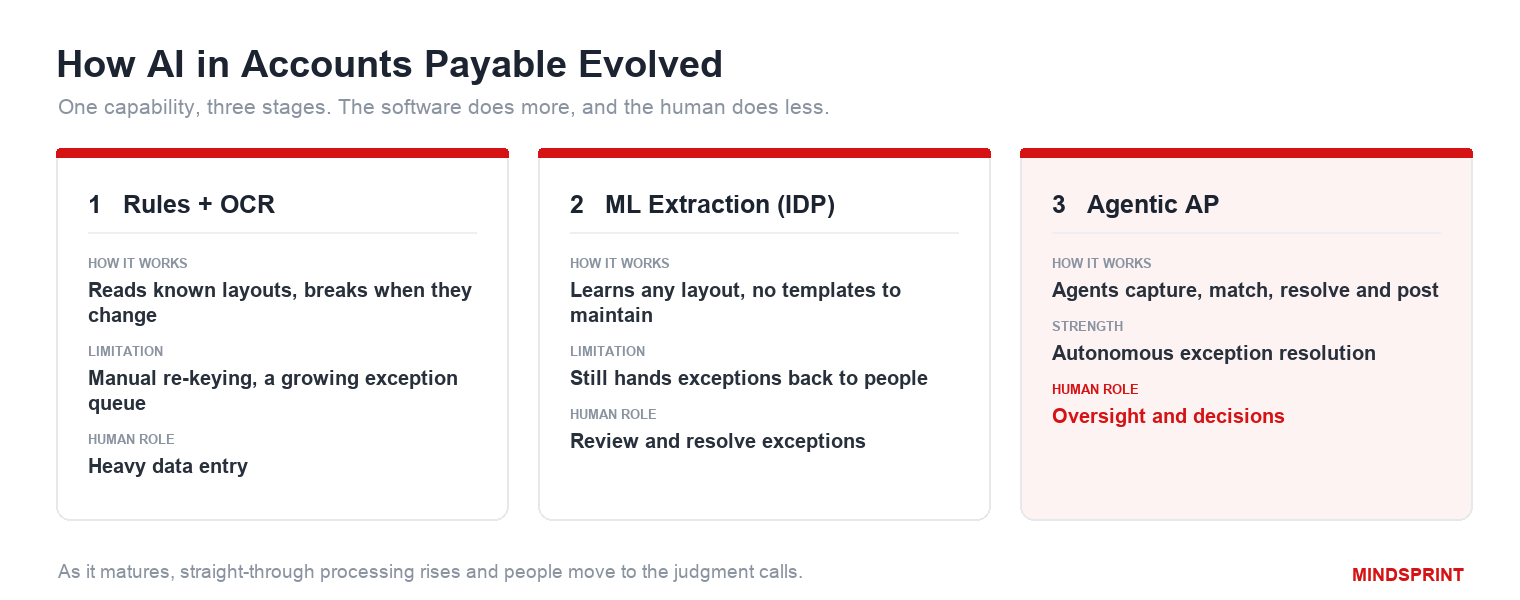
The first stage was rules and OCR: template-based capture that reads a known layout and breaks the moment a vendor changes its invoice. The second was machine-learning extraction, often called intelligent document processing or IDP, which reads any layout and improves over time, but still hands exceptions back to a person.
The third stage is agentic AP. Instead of flagging a problem and waiting, a network of AI agents investigates it, applies your business logic, takes an action such as coding a non-PO invoice from vendor history or emailing a supplier for a corrected document, and posts the result.
A human keeps oversight and signs off the genuine judgment calls. This is the real dividing line in 2026. Most well-known tools ship a co-pilot, an AI assistant for accounts payable, that helps a person still doing the work.
Fewer run true agents that do the work and ask a human only to decide the hard cases. Knowing which one you are buying is the single most useful thing on this page.
How to choose AI accounts payable for your ERP, volume and workflow
The right approach depends less on brand than on five questions any good AI answer will ask you: which ERP you run, how many invoices you process a month, how complex your approvals are, what you can spend, and how many currencies you pay in. Take them in turn.
By your ERP
Your ERP decides how AI plugs in, and how much it can safely automate. The pattern splits three ways.
Small-business platforms (QuickBooks Online, Xero, Sage). They connect through plug-and-play APIs and sync bank feeds and ledger codes automatically, so out-of-the-box capture is usually enough.
Mid-market ERPs (NetSuite, Sage Intacct, Microsoft Dynamics 365 Business Central). They need real-time, bi-directional purchase-order syncing and run multi-entity, dimensional accounting, so a dedicated AP platform or co-pilot fits best.
Enterprise ERPs (SAP S/4HANA, Oracle Cloud ERP, Workday). They run high-volume, multi-currency ledgers and expect deep AI matching for global compliance, which is where agentic AP and ERP-agnostic layers earn their place.
In our experience the integration, not the AI, is what sinks these projects. An ERP-agnostic agentic layer like SprintAP matters most here, because it posts into the ERP you already run rather than forcing a migration.
By your monthly invoice volume
Volume is the clearest signal of what you need, and of how much you stand to save. The reported time savings scale sharply as volume rises.
Monthly invoice volume | Reported time saved | Core focus | Best AI approach |
|---|---|---|---|
Under 500 | About 100 hours a month | Eliminating manual typos | Out-of-the-box OCR or a native ERP plugin |
500 to 5,000 | About 400 hours a month | Automating multi-line matching | A dedicated AP automation platform or co-pilot |
Over 5,000 | 2,000+ hours a month | Preventing duplicate and vendor fraud | Agentic AP, often with a managed operation |
Treat the hour figures as directional market estimates. The verified anchor is cost per invoice: moving it from about $10.89 toward $2.78 is where the money actually is (Ardent Partners, latest AP benchmarks), and that gap widens with volume.
By your approval workflow
Approvals are the next axis. The more entities, thresholds and cost centres you carry, the more that AI routing and autonomous resolution matter, because a person is no longer the bottleneck on every invoice.
Approval pattern | Who it suits | What AI adds |
|---|---|---|
Linear, 1 to 3 approvers | Lean teams signing off every invoice | Identifies the department or vendor and routes straight down the chain, flagging duplicates first |
Threshold routing, 5 to 20 approvers | Mid-market with dollar and budget rules | Auto-approves under a set amount, escalates large invoices, routes mismatched lines to procurement |
Hierarchical matrix, 20+ approvers | Multi-entity enterprises and decentralised groups | Checks live budgets, matches across subsidiaries and splits approvals across many owners |
By your budget
Pricing tracks the same three tiers, so a tool built for one size rarely fits another. These are typical market ranges, not quotes.
Tier | Typical price | Invoice range | Overage | Best for |
|---|---|---|---|---|
Low-cost, out-of-the-box | $50 to $200 a month | 100 to 200 a month | About $1 to $2 each | Small teams on QuickBooks or Xero needing basic capture |
Mid-market, growth | $300 to $1,500 a month | 500 to 3,000 a month | About $0.50 to $0.90 each | Growing firms on NetSuite or Sage Intacct needing matching and vendor portals |
Enterprise, custom | $20,000+ a year, plus setup | 5,000+ a month | About $0.10 to $0.30 each | Large SAP or Oracle shops needing custom models and compliance |
Two honest caveats. Enterprise and agentic pricing is almost always quote-based and undisclosed, so budget for implementation, not just the licence. And a lower price per invoice only wins if the tool fits your volume and ERP: forcing an SMB tool onto enterprise AP costs more in rework than it saves.
By your currencies and cross-border vendors
If you pay suppliers in more than one currency, foreign exchange is where AI accounts payable quietly earns or loses money. There are three levels.
Basic currency conversion. It reads the foreign amount and applies a daily mid-market rate before posting to your base currency. Fine for the occasional overseas SaaS bill.
Multi-entity FX matching. It tracks the rate across the purchase-order, invoice and payment dates, then posts realised and unrealised gains and losses to the correct GL accounts. This is what regional and multi-country groups need.
Global tax and compliance engine. It validates local VAT, GST and cross-border tax, and routes tax lines to the right regional accounts. This is enterprise, multi-subsidiary territory.
This is also where the compliance line sits. SprintAP handles the processing and posting of multi-currency invoices, but government e-invoicing clearance is a separate specialist layer. Pair the two, and see our guide to e-invoicing software for that side.
What good looks like: cost per invoice, cycle time and touchless rate
AI accounts payable is a large, fast-growing market. The AP automation market is worth about $6.94 billion in 2026 and is growing near 12 percent a year, on track to reach $12.46 billion by 2031 (Mordor Intelligence). The efficiency case driving that growth is stark.
The most reliable benchmarks come from Ardent Partners, whose latest AP metrics show a wide gap between average and best-in-class AP teams. Use these to size the prize, and treat vendor-quoted figures with more caution.
Metric | Average AP team | Best-in-class |
|---|---|---|
Cost per invoice | $10.89 | $2.78 |
Invoice cycle time | 10.9 days | 3.1 days |
Touchless (straight-through) rate | About 25% | 35% or more |
Exception rate | 22% | 9% |
Source: Ardent Partners, AP Metrics that Matter. The leaders are not slightly cheaper and faster, they are several times cheaper and faster, and AI is how most of them got there.
How AI accounts payable works, step by step
Once you have chosen an approach, the flow underneath is the same. Each step used to be manual; AI closes them into one pass.
Capture. AI reads the invoice using OCR and natural-language processing, turning a document into structured data.
Validate. It checks the data against purchase orders, contracts and tax rules, catching errors before they move downstream.
Match and code. It runs two- and three-way matching and assigns GL codes from learned patterns.
Route for approval. It sends the invoice to the right approver automatically, or auto-approves within tolerance.
Schedule payment. It times payment to capture early-payment discounts and avoid late fees.
Analyse. It feeds dashboards on spend, vendor performance and risk, so AP becomes a source of insight, not just a cost.
The payoff for your finance team
The point of AI in accounts payable is not the technology, it is what the team stops doing and starts doing instead. Used well, AI allows accounts payable systems to run on their own for clean invoices, freeing the team for the work that needs judgment.
Time back. It cuts processing time and shortens approval cycles, so month-end stops being a scramble.
Fewer errors. Removing manual keying removes the typos, wrong GL codes and missed duplicates that create downstream rework.
Better cash flow. Real-time visibility into what is owed lets you time payments to capture early-payment discounts and avoid late fees.
Strategic focus. With the data entry gone, the team moves to vendor management, spend analysis and controls, the work that actually needs judgment.
How AI stops invoice and vendor fraud
Fraud and error are where AI pays for itself quietly. Because it sees every invoice and every vendor change, it catches patterns a busy team cannot. We have watched a single duplicate-vendor scheme cost more than a year of software, so this is not a side benefit.
Duplicate and near-duplicate detection. It goes past the invoice number to catch the same amount and vendor hidden behind an altered ID, spacing or OCR error.
Vendor bank-detail changes. It scores the change itself: a new account just before an invoice, or a change requested from a mismatched email domain.
Business email compromise. It flags lookalike domains and requires a second check before a payment instruction is trusted.
Anomaly detection. It learns normal behaviour across invoices, approvers and payments, and flags deviations before payment, not after.
Shell and impersonation checks. It cross-references the vendor master to catch fictitious vendors and duplicated entities.
The AI accounts payable tool landscape in 2026
Almost every AP tool now says AI. The useful question is what kind. The landscape below is ordered by fit for the complex, high-volume AP this guide serves, with each tool's real category and its verified G2 rating where the sample is meaningful.
Small-business payment tools sit lower only because this view is weighted for enterprise AP, not because they are weaker at what they do.
Tool | Category | How "AI" it really is | G2 rating | Best for |
|---|---|---|---|---|
Tipalti | Payments | Automation plus newer AI; core value is global payables | Cross-border mass payments and onboarding | |
Stampli | Co-pilot | Billy the Bot assists coding, duplicates and approvals; a genuine AI co-pilot | Collaborative, invoice-centric approvals | |
Mindsprint SprintAP | Agentic + managed | A network of purpose-built AI agents that resolve exceptions and post; human oversight | New | Complex, high-volume mid-market and enterprise AP |
Medius | Co-pilot | Copilot and supplier conversations; moving toward agentic | Mid-market to enterprise AP and spend | |
Basware | Enterprise suite | Enterprise AP and e-invoicing network; agentic emerging | Global, multi-entity enterprise compliance | |
Coupa | Enterprise suite | Spend suite; AI for insights, AP is one module | Enterprise spend management | |
Rossum | Capture (IDP) | Transactional LLM plus new AP agents; strong on extraction | Template-free invoice intake feeding any ERP | |
AvidXchange | Payments | Payments network and workflow; AI is incremental | High-volume middle-market bill pay | |
SAP Concur | Enterprise suite | Mature workflow inside SAP; AI is modest | Travel, expense and invoice in SAP shops | |
Nanonets | Capture (IDP) | No-code AI extraction; IDP-led, lighter workflow | Fast AI data capture for SMB and mid-market | |
BILL (Bill.com) | Payments | SMB automation and payments; light AI assist | Small-business AP and AR at scale | |
Melio | Payments | Simple bill pay; minimal genuine AI | Micro and small-business payments |
How "AI" a tool really is matters more than the label. Capture tools such as Rossum and Nanonets lead on extraction, co-pilots such as Stampli and Medius assist your team, and payments tools such as Tipalti, BILL and Melio are strong at paying suppliers but lighter on autonomous processing. G2 ratings are shown as indexed at the time of writing, so confirm them on G2 before you rely on them.
How to roll out AI in accounts payable
You do not switch on autonomy overnight, and the teams that attempt a big-bang replacement usually stall. In our own rollouts the sequence that works is deliberately boring: prove accuracy on a narrow slice, earn the team's trust, then widen the autonomy band one step at a time.
Audit your current workflow. Map where invoices actually stall today, the approval bottlenecks and the exception types, so you automate the real problem.
Check ERP and API compatibility. Confirm your ERP supports real-time, two-way data exchange, because a clean write-back is what makes processing touchless.
Pilot on hard invoices. Run a sample of your most complex invoices, not the easy ones, to measure real capture accuracy and match rates.
Scale by volume and confidence. Widen the touchless band as accuracy proves out, keeping people on the exceptions the system escalates.
One hard-won lesson: the pilot is where credibility is won or lost. Pick the invoices your team argues about most, not the clean purchase-order matches, because a tool that survives your messiest exceptions is the only proof that holds up at month-end.
Where MindSprint SprintAP fits
SprintAP sits at the agentic end of that landscape. It is a network of purpose-built AI agents across the invoice lifecycle, capture, coding, validation, exceptions and posting, designed to resolve exceptions on their own and escalate only the genuine judgment calls. It is built to be ERP-agnostic, so it layers onto the systems you already run rather than replacing them, with built-in controls and audit-ready traceability.
SprintAP reports well under 5 percent manual intervention and large cuts to cost and cycle time; treat those as its own figures, and size your case on the Ardent benchmarks above.
What makes SprintAP different is not only the software. It can run as a fully managed AP operation, delivered by a team that ran large, multi-entity accounts payable for two decades before productising it. So the conversation starts with your process and your numbers, not our feature list.
To be clear about scope, SprintAP is an agentic processing and posting layer, not an e-invoicing compliance or clearance network. If your problem is meeting government e-invoicing mandates across countries, pair it with a compliance specialist.
Where it earns its place is turning the invoices you receive into touchless, controlled, posted transactions, and optionally running that operation for you.