The 8 best supplier relationship management software platforms at a glance
Ratings link through to G2. Prices are researched ranges, because only one platform here publishes a rate card.
Platform | Best for | G2 rating | Published price |
|---|---|---|---|
SAP Ariba Supplier Management | Global SAP enterprises needing network reach | None, custom quote | |
Kodiak Hub | Genuine relationship depth and supplier development | None, custom quote | |
Mindsprint Procuresprint | Supplier management connected to the buying cycle | Not yet listed | None, custom quote |
Ivalua | Complex, direct-materials heavy supplier bases | None, custom quote | |
Jaggaer | Regulated sectors and supplier performance | None, custom quote | |
Coupa | Supplier data inside unified spend visibility | None, custom quote | |
Gatekeeper | Contracts and suppliers together, mid-market | From about $875 a month | |
AdaptOne | Compliance and certification-driven programmes | None, custom quote |
Mindsprint Procuresprint is newer than the platforms around it and is not yet listed on G2. That is stated here rather than left out.
When companies start looking for SRM software
The trigger is rarely a supplier problem. It is usually a question someone senior asked that nobody could answer.
Which suppliers actually matter? Spend concentration is unknown, so investment and attention are spread evenly across suppliers that are not equally important.
Why did that supplier fail without warning? Risk was visible in the data months earlier, but nobody was reviewing it on a cycle.
What did we get from that relationship last year? Quarterly business reviews happen ad hoc, notes live in inboxes, and commitments made in the room are never tracked.
Who owns this supplier? Three people talk to them, none of them coordinate, and the supplier plays them against each other.
A merger or a new market doubled the supplier base overnight, and the approach that worked at 200 suppliers does not work at 900.
If none of those sound familiar, the honest answer is that you may not need SRM software yet. That section is further down.
SRM vs vendor management vs procurement software
Three categories overlap here and vendors use the labels loosely, which makes scoping harder than it should be.
Vendor management | Supplier relationship management | Procurement / source-to-pay | |
|---|---|---|---|
The problem it solves | Supplier records are incomplete, duplicated or out of date | You cannot tell which suppliers matter or how the relationship is performing | You are paying too much, or buying is uncontrolled |
Core activity | Onboarding, compliance documents, master data, basic performance | Segmentation, structured reviews, development plans, relationship history | Sourcing, contracting, requisition, PO, invoice |
Who owns it | Procurement operations or master data | Category managers and the CPO | Procurement and finance together |
Typical trigger | Audit finding or a failed onboarding | A supplier failed without warning, or nobody could say which suppliers matter | Savings target or spend leakage |
Buy it when | Records are the mess | Relationships depend on one person's memory | Price and control are the problem |
The practical test is what problem you are actually solving.
If your supplier records are a mess, duplicated and out of date, that is vendor management. Fix the record layer first.
If you cannot tell which suppliers are worth investing in, or relationships depend on one person's memory, that is SRM.
If you are paying too much for what you buy, that is sourcing, and no SRM platform fixes it because the price was agreed upstream.
And if people are buying off-contract, that is maverick spend and a procure-to-pay control problem. SRM tells you which suppliers matter, but it will not stop someone raising an order outside the process or move spend under management on its own.
Most SRM platforms include vendor management. Very few vendor management tools do genuine SRM, because segmentation and structured review are a different discipline from record keeping.
We compare the record layer separately in our guide to vendor management software. This page stays on the strategic layer.
How to segment your supplier base, and why it comes first
Segmentation is the first capability any SRM platform asks you for, and the one most organisations have not done. The software cannot decide which suppliers matter. You have to.
The standard framework is the Kraljic matrix, which sorts suppliers on two axes: how much profit impact the spend carries, and how much supply risk sits behind it.\
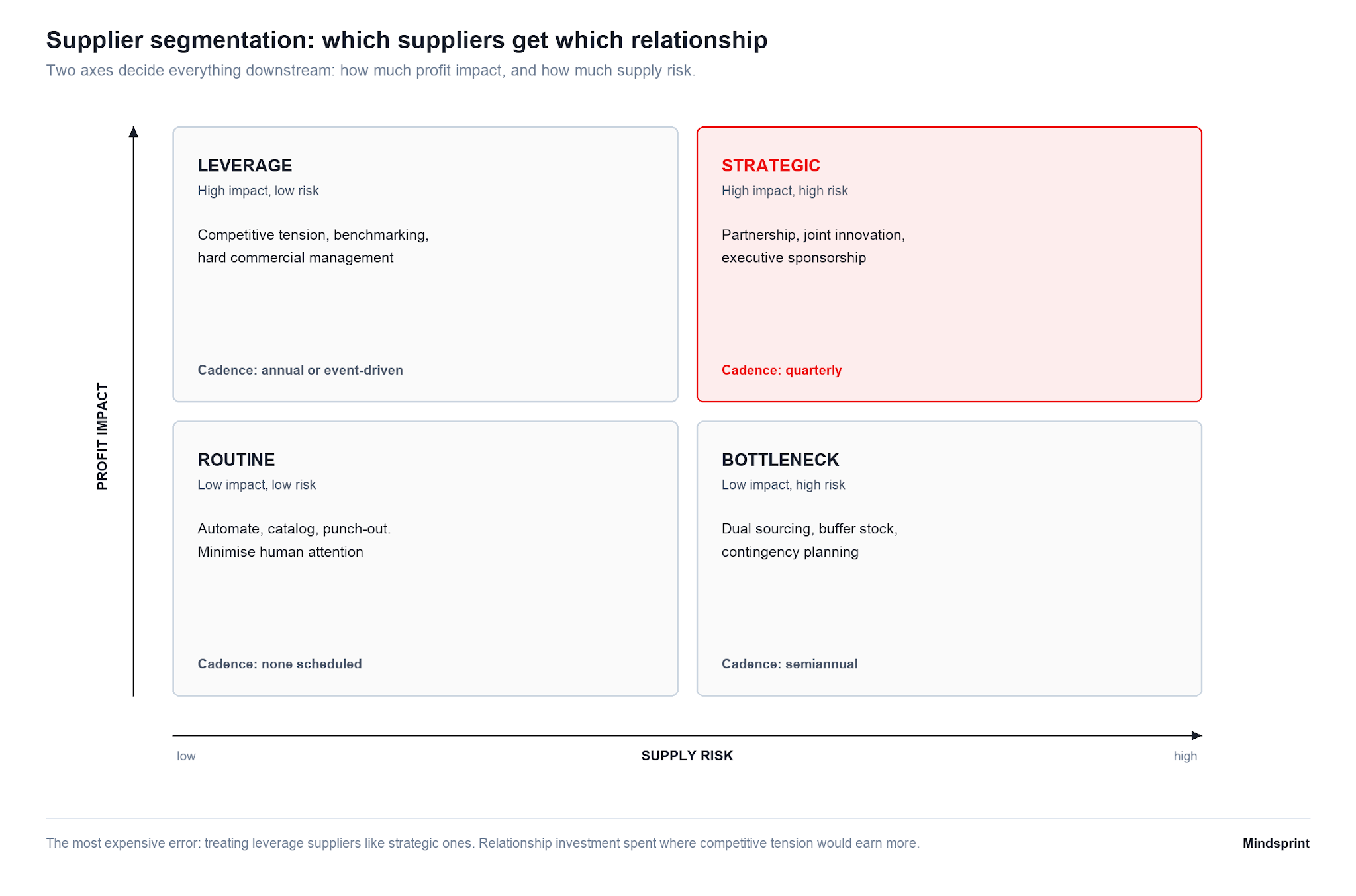
Four quadrants fall out of those two axes, and each one demands a genuinely different relationship.
Strategic. High impact, high risk. Few suppliers, large consequences. These get long-term partnership, joint innovation, executive sponsorship and integration into your planning.
Leverage. High impact, low risk. Plenty of alternatives and real money at stake. These get competitive tension, benchmarking and hard commercial management, not relationship investment.
Bottleneck. Low impact, high risk. Small spend that can stop production. These get supply continuity work: dual sourcing, buffer stock, contingency plans.
Non-critical or routine. Low impact, low risk. The long tail. These get automation, catalogs and as little human attention as possible.
The most common and expensive error is treating leverage suppliers like strategic ones. Quarterly business reviews with a supplier you could replace in a fortnight is relationship investment spent where competitive tension would have earned more.
The second error is the reverse. A bottleneck supplier with tiny spend gets ignored because the spend report says they are trivial, right up until they stop delivering.
Re-score the matrix at least annually, and whenever something material changes. Suppliers move between quadrants, and a segmentation nobody refreshes becomes a description of last year.
Segmentation is only useful if different segments are treated differently. This is the model to configure in whatever platform you buy.
Segment | Relationship approach | Review cadence | Who owns it | What the software must do |
|---|---|---|---|---|
Strategic | Partnership, joint innovation, shared roadmaps | Quarterly | Category manager plus an executive sponsor | Full scorecard, action tracking, collaboration space, relationship history |
Leverage | Competitive tension, benchmarking, hard commercial management | Annual or event-driven | Category manager | Spend and price benchmarking, sourcing event history |
Bottleneck | Supply continuity, dual sourcing, contingency planning | Semiannual | Supply chain or category manager | Continuous risk monitoring, alternative supplier mapping |
Routine | Automate and forget | None scheduled | Nobody beyond the catalog | Catalog, punch-out, auto-onboarding, exception alerts only |
Two things follow from that table and they are the practical test of whether your SRM programme is real.
Cadence should differ by segment. Quarterly for strategic, semiannual for bottleneck, annual or event-driven for leverage, and nothing scheduled for routine. A programme reviewing every supplier on the same cycle has not segmented, it has made a calendar.
Ownership should differ too. Strategic suppliers need a named executive sponsor as well as a category manager. Routine suppliers need no owner at all beyond the catalog.
Governance is the word most platforms use for this. It means the agreed cadence, the named owners and the escalation route per segment, and it is the part buyers most often leave unconfigured.
When you evaluate platforms, ask to see this configured rather than described. Ask how the system enforces a different review cadence and a different scorecard per segment, because that is where generic tools quietly fall over.
What the best SRM software should actually do
Feature grids in this category are close to identical. These five capabilities separate genuine SRM from a supplier database with a dashboard.
Supplier segmentation. Classify suppliers by spend, risk, criticality and substitutability, so effort goes where it changes something. Without this, SRM is a filing system.
Structured review cycles. Scheduled business reviews with an agenda, scorecard, actions and owners, rather than a meeting someone remembers to book.
Performance data connected to decisions. Scorecards that feed award decisions, renewal terms and improvement plans. A score nobody acts on is theatre.
Collaboration over time. Shared improvement plans, innovation ideas and corrective actions that both sides can see, not an email thread.
Relationship history preserved. Who agreed what, when, and what happened next. This is what survives when the category manager leaves, and it is the capability buyers most underestimate.
Two more matter to anyone operating across entities: continuous risk screening rather than a one-time check at onboarding, and a supplier portal suppliers will actually use.
Judge every platform below on those seven, not on module counts.
How we evaluated these platforms
Most SRM guides are written by a vendor that appears in their own list, usually at number one. Ours appears at number three and we build it, so here is the method.
Scored against the seven capabilities above, not against feature counts.
Separated SRM from vendor management first, so P2P-led tools with a supplier module are not presented as SRM platforms.
Researched real prices rather than writing contact sales, and said plainly where a vendor publishes nothing.
Read verified user reviews for themes recurring across multiple buyers, not isolated complaints.
Stated our own weaknesses at the same length as everyone else's, including where a specialist beats us.
The 8 best supplier relationship management software platforms
1. SAP Ariba Supplier Management: best for global enterprises that need the largest supplier network
The supplier management modules within SAP Ariba, covering registration, qualification, segmentation, performance and risk, connected to the SAP Business Network.
Its advantage is reach. Millions of suppliers already transact on the network, so a meaningful share of your base needs no onboarding at all.
Its disadvantage is that supplier management is one part of a very large suite, and you rarely buy it alone.
Best for: global enterprises already standardised on SAP that need network reach and deep qualification.
Real cost: core supplier modules run about $80,000 to $300,000 a year. A full source-to-pay footprint commonly lands between $400,000 and $1.5M+.
Pros
The largest supplier network in this list, which shortens onboarding on common vendors
Mature supplier qualification, segmentation and risk modules
Deep native integration with SAP ECC and S/4HANA
Strong global compliance coverage across jurisdictions
Cons
Suppliers can be charged network fees to transact with you, which creates onboarding resistance
Relationship depth is shallower than a dedicated SRM specialist
Interface is widely described as dated and fragmented across modules
Rarely sold as a standalone supplier management purchase
Key features: supplier registration and qualification, segmentation, performance scorecards, risk monitoring, supplier portal, network reach, S/4HANA integration.
Bottom line: the safe default inside SAP, and the strongest network on the market. Weaker than the specialists on structured relationship development.
2. Kodiak Hub: best for teams that want genuine relationship depth rather than a supplier database
The category-native SRM platform, and the one that appears in almost every comparison on this topic for good reason.
It was built for supplier relationship management specifically rather than bolted onto a procure-to-pay suite, and it shows in the segmentation and review workflows.
It is the platform to beat if relationship development is genuinely your problem.
Best for: procurement teams whose problem is relationship quality and supplier development, not transaction processing.
Real cost: not published, quoted against users, modules and scope. Implementation and integration are charged separately.
Pros
The deepest supplier segmentation and scorecard model in this list
Structured review cycles with actions, owners and follow-through built in
Strong supplier collaboration and innovation capture
Modern interface that procurement teams adopt without heavy training
Publishes genuine SRM thinking rather than repackaged procurement marketing
Cons
Not a procure-to-pay platform. Requisitions, POs and invoices live elsewhere
Smaller vendor and partner ecosystem than the enterprise suites
No published pricing
Less suited to organisations whose first problem is transactional control
Key features: supplier segmentation, performance scorecards, structured business reviews, risk monitoring, sustainability and ESG tracking, supplier collaboration and innovation management.
Bottom line: the strongest pure SRM platform here. If your problem is relationships rather than transactions, start with this one.
3. Mindsprint Procuresprint: best for multi-entity enterprises that want supplier management connected to the buying cycle
An agentic source-to-pay platform whose supplier management module covers discovery, onboarding with automated KYC, continuous risk screening and performance tracking.
The distinguishing point is connection rather than depth. Supplier data feeds sourcing, contracts and requisition-to-GRN on the same platform, so a risk flag reaches the buyer before the order goes out.
It can also be run as a managed service rather than only licensed, which no other platform in this list offers.
Best for: mid-to-large multi-entity enterprises where supplier onboarding consumes real headcount and risk needs watching continuously.
Real cost: not published, quoted against modules and scope. Ask for it fully loaded, and ask what the managed-service option costs against licence plus headcount.
Pros
Automated KYC and continuous risk screening at onboarding rather than a one-time check
Supplier data connected to sourcing, contracts and PR-to-GRN, so risk and performance reach the point of decision
Nine named agents across the lifecycle, including supplier discovery and onboarding
No supplier network fees, so onboarding does not require persuading vendors to pay
Available as a managed procurement service, which is unique in this list
Cons
We are a source-to-pay platform with strong supplier management, not an SRM specialist. Kodiak Hub is deeper on relationship development
No published supplier segmentation or SRM maturity model
Newer than the Gartner-recognised suites, with no analyst placement and no named public references yet
Not yet listed on G2, so there is no independent review base to read
Wrong choice for small single-entity supplier bases
Key features: supplier discovery, AI-driven onboarding, automated KYC, continuous risk screening against a large external dataset, performance tracking, supplier portal, and connection to eSourcing, contract lifecycle management and PR to GRN.
Bottom line: the right pick when supplier management should not be an island. If you want relationship depth above all else, Kodiak Hub is the more focused tool.
4. Ivalua: best for complex enterprises with heavy direct spend and unusual requirements
A single configurable source-to-pay platform with genuinely strong supplier management, particularly for organisations buying direct materials.
Its strength is that it bends. Category structures, approval logic and supplier data models that break simpler tools are configurable here.
The cost of that flexibility is time and internal capability.
Best for: complex, direct-materials heavy procurement with a capable internal team.
Real cost: from around $180,000 a year for a single module at mid-market scale. Full-suite deployments cluster between $520,000 and $1.6M.
Pros
Deep, configurable supplier management and risk scoring
One unified platform rather than acquired modules stitched together
Strong on direct materials and multi-tier supplier visibility
Handles unusual data models that defeat simpler tools
Cons
Configurability lengthens implementation considerably
Requires skilled internal ownership to get value
Smaller partner ecosystem than SAP or Coupa
Overkill for straightforward indirect supplier bases
Key features: supplier information management, segmentation, risk and performance scorecards, multi-tier visibility, sustainability tracking, and full source-to-pay coverage.
Bottom line: the best fit for complex supplier bases with a team capable of running it. Punishes thin procurement functions.
5. Jaggaer: best for manufacturing, life sciences and public sector supplier performance
A source-to-pay suite with real strength in supplier performance management and genuine vertical depth.
Where a sector has specific supplier qualification or compliance rules, Jaggaer has usually met them before.
Its supplier management is stronger than its procure-to-pay side, which is unusual in this market.
Best for: manufacturing, higher education, life sciences and public sector organisations with regulated supplier requirements.
Real cost: not published, quoted by scope. Mid to upper enterprise pricing, with partner-led implementation.
Pros
Strong supplier performance management and qualification workflows
Genuine vertical depth including regulated sector requirements
Good supply chain collaboration for direct materials
AI-assisted supplier and spend analytics
Cons
Procure-to-pay is less polished than the supplier side
User experience lags Coupa and Kodiak Hub
Implementation is partner led and can run long
Smaller independent review base than the market leaders
Key features: supplier qualification and onboarding, performance scorecards, risk management, supply chain collaboration, sourcing and contract management.
Bottom line: pick it when your sector has supplier rules other platforms treat as edge cases.
6. Coupa: best for unified spend visibility across a large supplier base
A business spend management platform whose supplier records sit inside a much wider spend picture covering procurement, invoicing, expenses and payments.
Its advantage is context. Supplier performance is visible against actual spend behaviour rather than in isolation, and community benchmarking adds an outside view.
Its supplier management is competent rather than specialist.
Best for: enterprises that want supplier data inside one unified spend platform people will actually use.
Real cost: core platform licensing starts around $150,000 to $250,000 a year at mid-market scale. Enterprise deployments run $500,000 to $3M+, with implementation frequently adding as much again.
Pros
Supplier performance seen against real spend behaviour, not in isolation
Community benchmarking that surfaces comparisons a single organisation cannot see
The best adoption of the enterprise suites, which is what keeps supplier data current
ERP agnostic with mature two-way connectors
Cons
Supplier relationship depth is shallower than Kodiak Hub or Ivalua
Implementation frequently costs as much as the first two years of licence
Full value needs the wider suite, so a supplier-only deployment is poor value
Premium pricing and high total cost of ownership
Key features: supplier information management, risk assessment, performance tracking, community benchmarking, supplier portal, and full spend management across procurement, invoicing and payments.
Bottom line: strong when supplier management should sit inside unified spend. Weak as a standalone SRM purchase.
7. Gatekeeper: best for teams that want contract and supplier management together at a published price
A contract and supplier management platform that treats the two as one problem, which for many mid-market organisations is exactly right.
Supplier records, obligations, renewals and performance sit in one place, so a supplier review can reference the actual agreement.
It is also the only platform in this list that publishes a starting price.
Best for: mid-market organisations whose supplier and contract management should live together.
Real cost: published from about $875 a month, roughly $10,500 a year at entry, with custom pricing above that. The only transparent rate card in this comparison.
Pros
Publishes pricing openly when nobody else here does, which makes it a useful benchmark in negotiations
Contract and supplier data genuinely unified rather than integrated
Strong obligation and renewal tracking
Fast to deploy compared with the enterprise suites
Cons
Not a full SRM platform. Segmentation and structured development are lighter than Kodiak Hub
No sourcing or procure-to-pay capability
Analytics are functional rather than deep
Scales less well into very large, multi-entity supplier bases
Key features: supplier records and onboarding, contract repository with obligation and renewal tracking, performance monitoring, risk registers, workflow automation and reporting.
Bottom line: the pragmatic mid-market choice, and the transparency is worth something. Quote its price back at vendors who refuse to give you one.
8. AdaptOne: best for compliance-heavy supplier lifecycle management
A supplier lifecycle platform built around qualification, compliance and diversity tracking rather than spend.
It appears consistently in SRM comparisons because it does one thing the suites do lightly: managing the supplier record as a compliance object across its whole life.
It is a narrower tool than most here, deliberately.
Best for: organisations with heavy supplier compliance, certification or diversity reporting obligations.
Real cost: not published, quoted by scope and supplier volume.
Pros
Strong supplier qualification and certification tracking
Good supplier diversity and compliance reporting
Configurable onboarding workflows for regulated requirements
Focused scope means less unused functionality to pay for
Cons
Narrow. No sourcing, contracts or procure-to-pay
Relationship development and segmentation are lighter than the specialists
Smallest independent review base in this list
No published pricing
Key features: supplier registration and qualification, certification and compliance tracking, diversity reporting, configurable onboarding workflows, supplier portal and audit trails.
Bottom line: the right answer when compliance and certification drive your supplier programme. The wrong one if you want breadth.
Other SRM platforms you will see named, and where they fit
Several platforms appear in comparison lists for this term without belonging in the main eight. Here is why each sits outside it, so you can rule them in or out quickly.
GEP SMART. A capable unified source-to-pay suite with solid supplier management, but it is bought as a suite with a services layer rather than as an SRM tool, and entry pricing puts it out of reach for most mid-market budgets.
Oracle Supplier Management. The sensible default if you already run Oracle Fusion, for the same reason Ariba is inside SAP. Little reason to choose it otherwise.
Zycus and Medius. Both carry supplier modules inside broader source-to-pay platforms. Competent record keeping and performance tracking, but neither is built around segmentation and structured development.
Precoro, Tradogram and Kissflow. Procure-to-pay led tools with supplier records attached. Good at onboarding and approvals for smaller teams, and genuinely not SRM platforms. These anchor our vendor management comparison instead.
Anvyl. Focused on supply chain and purchase order visibility upstream of delivery rather than on relationship governance. Useful alongside an SRM platform, not instead of one.
The pattern worth noticing is that most tools marketed as SRM are supplier records with a scorecard bolted on. Segmentation, differentiated cadence and preserved relationship history are what separate the real thing, which is why those three sit at the top of the capability list earlier.
What supplier relationship management software costs
Only one platform in this comparison publishes a rate card, which tells you most of what you need to know about how this market sells.
Gatekeeper from about $875 a month is the only public number. Roughly $10,500 a year at entry, and a genuine benchmark to raise with any vendor who will not quote.
Enterprise suites run $80,000 to $300,000 a year for supplier modules alone, and $400,000 to $3M+ for full-suite footprints. Supplier management is rarely sold standalone at this tier.
Specialists such as Kodiak Hub and AdaptOne quote against users, supplier volume and modules. Expect mid five figures upward, and ask what happens when your supplier count grows.
Implementation runs 50 to 150% of the first-year subscription across the enterprise platforms, and it is the line item that breaks business cases.
Supplier network fees are the cost that never appears on your invoice. Some networks charge your suppliers to transact with you, which they price back into your contracts or resist by refusing to onboard.
Three questions worth asking every vendor before a quote arrives. Does the price rise with supplier count or user count? Are my suppliers charged anything? And what is excluded from the implementation figure?
The KPIs that tell you SRM is working
No page on this topic publishes these, which is odd given every one of them claims measurable value. Track these six from the start.
KPI | What good looks like | Why it matters |
|---|---|---|
Supplier concentration | Top 20 suppliers as a known share of spend | You cannot prioritise a base you have not sized |
Scorecard coverage | Scorecards live on 70%+ of addressable spend | A great score on 12% of spend tells you nothing |
Review completion rate | 90%+ of scheduled reviews actually happen | The honest adoption metric. Below this the programme has stopped |
Risk incidents caught early | Rising share flagged before impact | The clearest evidence continuous screening is earning its cost |
Value from strategic suppliers | Tracked savings, innovations and service gains | Connects the programme to something finance recognises |
Supplier-initiated improvements | Growing count per quarter | Shows the relationship is two-way rather than a scorecard being sent out |
Two rules make them useful rather than decorative.
Measure scorecard coverage before scorecard scores. A brilliant score on 12% of spend tells you nothing about the supply base.
Review completion is the honest adoption metric. If scheduled business reviews are not happening, the platform has become a database and the programme has quietly stopped.
Two design rules decide whether a scorecard changes behaviour or decorates a slide. Weight the categories differently by segment, because a strategic supplier's innovation contribution matters and a routine supplier's does not.
And attach a consequence. A poor score should trigger an improvement plan with dates, and a good one should show up in award decisions. A score with no consequence teaches everyone to ignore it.
When SRM software is the wrong purchase
No competitor on this topic says this, which makes it the most useful section here.
Under about 50 active suppliers. Segmentation adds little when a category manager can hold the whole base in their head, and a spreadsheet plus a calendar will outperform a platform.
No segmentation decided yet. If nobody has agreed which suppliers are strategic, the software will ask you a question you cannot answer and you will default to treating everything equally.
Supplier master never cleaned. Duplicates and stale records make scorecards unreliable, and an unreliable scorecard destroys trust in the programme faster than having none.
No owner for the process. SRM is a discipline that needs someone accountable for running reviews. Software does not create that role.
The real problem is price, not performance. That is a sourcing problem, and SRM will not solve it.
In three of those five cases the money is better spent on cleaning supplier data and agreeing a segmentation model. Both improve procurement immediately, and both make the eventual platform work.
How to choose the right SRM software
Fit narrows the field. Your single biggest constraint usually picks the winner from what is left.
Your constraint | Where to look | Why |
|---|---|---|
Relationship depth is the actual problem | Kodiak Hub | Built for SRM rather than bolted onto a P2P suite |
You run SAP and need network reach | SAP Ariba Supplier Management | Largest supplier network and native S/4HANA fit |
Supplier risk keeps surfacing too late | Mindsprint Procuresprint | Continuous screening tied to sourcing and buying, not a one-time check |
Complex direct materials and unusual data | Ivalua | Configurable supplier model that bends to your structure |
Regulated sector supplier rules | Jaggaer | Vertical depth other platforms treat as edge cases |
You want it inside unified spend | Coupa | Supplier performance seen against actual spend behaviour |
Contracts and suppliers should live together | Gatekeeper | Unified, fast to deploy, and publishes a price |
Compliance and certification drive the programme | AdaptOne | Supplier record managed as a compliance object |
The bottom line on supplier relationship management software
There is no best SRM platform, only the best fit for your supplier base, your existing stack and the problem you are actually solving.
Check first that you need SRM rather than vendor management. If supplier records are the mess, fix the record layer before buying a relationship layer.
If relationship depth is genuinely the problem, Kodiak Hub is the most focused tool here. SAP shops get network reach and native fit from Ariba. Complex direct spend points to Ivalua, regulated sectors to Jaggaer, and unified spend visibility to Coupa.
Mid-market teams wanting contracts and suppliers together should look at Gatekeeper, which will also tell you the price. Compliance-driven programmes should look at AdaptOne.
And if the problem is that supplier management sits disconnected from sourcing and buying, so risk flags never reach the person raising the order, that is where Mindsprint Procuresprint fits.
That comes from two decades of running supplier operations at scale rather than only building software for them.