What is source-to-pay (S2P)?
Source-to-pay (S2P) is an integrated procurement process that connects sourcing, contracting, purchasing and payment into a single, streamlined workflow. Rather than treating strategic procurement, choosing suppliers, and operational procurement, buying and paying, as separate worlds, S2P runs them as one connected process.
Its goal is broader than speed. By starting at spend analysis and supplier selection, S2P optimises the entire supplier lifecycle. It reduces cost, ensures compliance, manages supplier risk and strengthens supplier relationships, not just the efficiency of a single invoice.
S2P vs P2P: what is the difference?
This is the distinction most people are really asking about, so it is worth getting straight before the detail.
Aspect | Source-to-Pay (S2P) | Procure-to-Pay (P2P) |
|---|---|---|
Scope | Strategic and operational: the whole lifecycle | Operational only: the transactional half |
Starts at | Spend analysis and supplier selection | An approved supplier and a requisition |
Includes | Sourcing, RFx, contracts and supplier management, then P2P | Requisition, PO, goods receipt, invoice and payment |
Goal | Optimise the supplier lifecycle and total cost | Efficient, controlled transactions |
Relationship | The umbrella process | A subset of S2P |
Read simply: procure-to-pay is a subset of source-to-pay. P2P handles the transactions once a supplier is chosen. S2P adds the strategic sourcing and supplier management that decide who you buy from, on what terms, and how well they perform.
One more comparison people ask about is S2P versus order-to-cash (O2C). They are mirror images. S2P is the buy side, from sourcing a supplier to paying them. O2C is the sell side, from a customer order to collecting the cash. S2P manages what you spend; O2C manages what you earn.
The source-to-pay process: two phases, seven stages
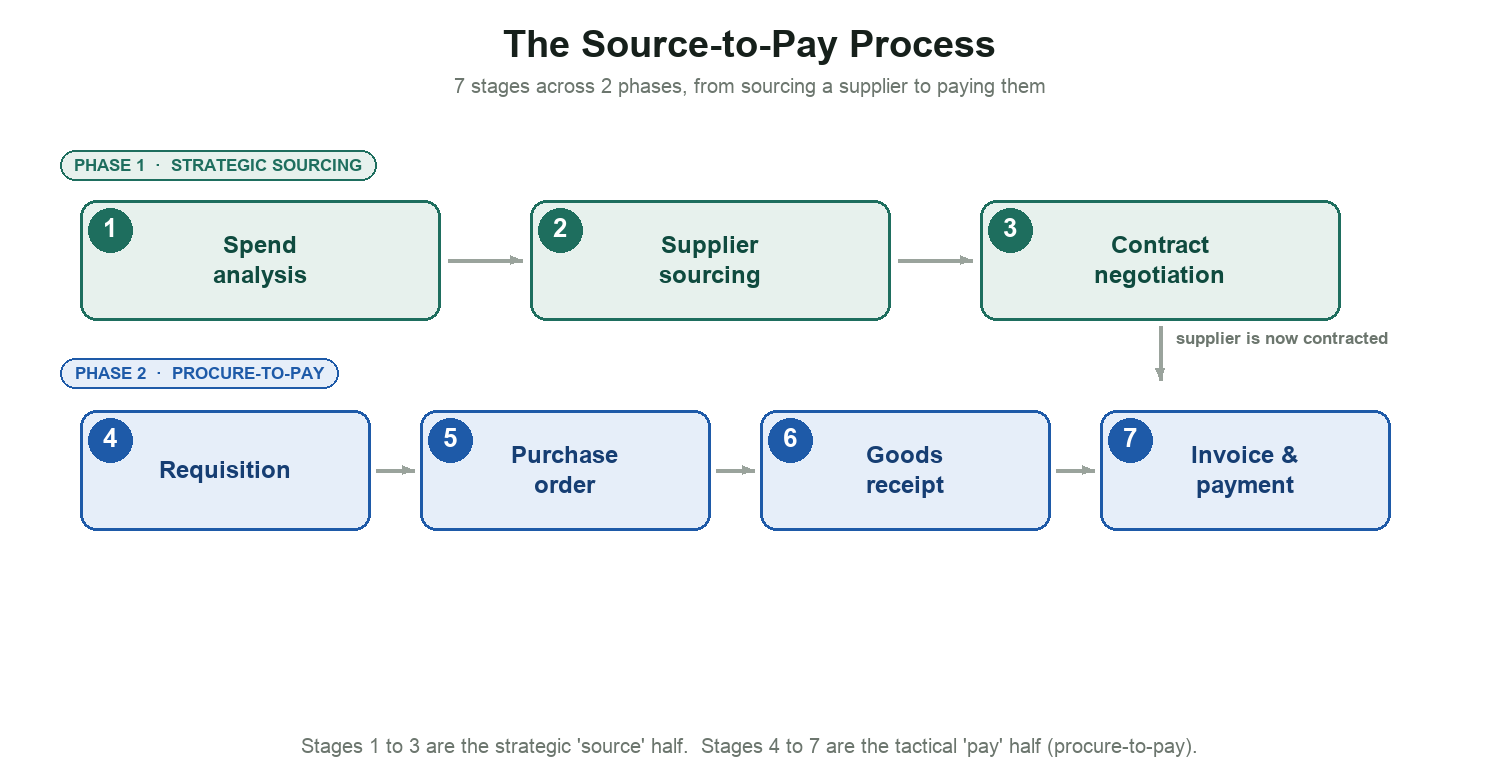
The S2P process follows a structured sequence divided into two phases: strategic sourcing (the source half) and procure-to-pay (the pay half). Here is what happens at each stage, and where each one tends to break.
Phase 1: strategic sourcing (the source half)
This half decides who you buy from and on what terms, before a single order is placed. It is where most of the value is won.
Stage 1: Spend analysis. Understand what the organisation actually buys, by category and supplier, and define the business requirement. Source without this and you negotiate blind. Where it breaks: spend data fragmented across entities that no one has consolidated.
Stage 2: Supplier sourcing. Take the requirement to market through RFx, an RFI to shortlist, an RFP for detailed proposals, or an RFQ for price, then evaluate vendor capability. Where it breaks: evaluating on price alone instead of total value.
Stage 3: Contract negotiation. Finalise the pricing structure and terms, then sign and store the legal agreement. Where it breaks: the negotiated rates never make it into the systems that pay, so you leak savings on day one.
Phase 2: procure-to-pay (the pay half)
Once a supplier is contracted, this half executes the buying and paying. We cover its automation in depth in our procure-to-pay guide; here is the sequence.
Stage 4: Requisition. An employee raises a purchase requisition, ideally against the contracted catalogue, and it routes for approval by amount and department. Where it breaks: free-text, off-contract requests that bypass the rates you just negotiated.
Stage 5: Purchase order. The approved requisition becomes a formal PO dispatched to the vendor. Where it breaks: the after-the-fact PO, raised only when the invoice arrives, leaving nothing to match against.
Stage 6: Goods receipt. Whoever receives the goods or service inspects the delivery and logs the goods receipt. Where it breaks: no receipt logged, so 3-way matching is impossible.
Stage 7: Invoice processing and payment. Run 3-way matching, resolve discrepancies, authorise payment on terms, and close the PO. Where it breaks: exception overload, when every mismatch is treated as a fire drill.
At a glance, the seven stages across the two phases:
Stage | Phase | Key actions |
|---|---|---|
1. Spend analysis | Source | Analyse spend patterns, define requirements |
2. Supplier sourcing | Source | Issue RFx (RFI/RFP/RFQ), evaluate vendors |
3. Contract negotiation | Source | Finalise pricing, sign agreements |
4. Requisition | Pay | Create requisitions, route approvals |
5. Purchase order | Pay | Generate and dispatch POs |
6. Goods receipt | Pay | Inspect deliveries, log goods receipt |
7. Invoice and payment | Pay | 3-way match, resolve, pay, close PO |
Strategic sourcing: where the value is won
The source half is what makes S2P more than P2P. It rests on two disciplines: spend analysis and a structured supplier evaluation.
Spend analysis means classifying and analysing what you buy, so you can see concentration, fragmentation and off-contract spend before you go to market.
RFx is how you take the requirement out: an RFI to gather information and shortlist, an RFP for detailed solution proposals, and an RFQ when you mainly need price. The evaluation is where discipline matters most.
How to structure an RFP evaluation framework
An RFP evaluation framework scores supplier proposals objectively against predefined, weighted criteria that total 100 percent. A common structure:
Assign weighted criteria. Allocate percentages across every requirement, totalling 100 percent, agreed before the proposals arrive.
Technical fit (30 to 40 percent). Grade capability, technology and service delivery against your requirement.
Commercial cost (30 to 40 percent). Score total cost of ownership, not just the unit price.
Risk (15 to 20 percent). Evaluate financial stability, cybersecurity, compliance and legal terms.
ESG (5 to 10 percent). Score environmental, social and governance practices.
Rate each response on a standard 1-to-5 rubric, then normalise the input by averaging scores across multiple internal evaluators, so one strong opinion does not skew the result. Keep the scored trail for audit. The framework is what makes a sourcing decision defensible when someone asks why you picked that vendor.
Contract management: keeping the savings you negotiated
Winning a good price in the negotiation is only half the job. If the contract is then filed and forgotten, the savings you fought for quietly leak away. Contract management, or contract lifecycle management, is the discipline that keeps them.
Central repository. Keep every contract in one searchable place, so none is lost and everyone always pays against the current agreement, not an old one.
Renewal and expiry tracking. Get alerts before key dates, so you are never auto-renewed at a stale rate or left buying off-contract because an agreement quietly lapsed.
Compliance and obligation monitoring. Check that the agreed prices, discounts and service levels are actually delivered, and that both sides meet their commitments.
Leakage control. Contract leakage, paying off-contract or non-negotiated rates, is one of the most common ways savings vanish before they reach the bottom line. You cannot stop what you do not measure.
At scale, across hundreds of suppliers and contracts, this stops being a filing task and becomes a discipline. It is where a large share of the value that sourcing created is either protected or lost.
3-way matching: the core control on the pay side
On the pay half, 3-way matching is the single most important financial control. It is the check that stops you paying for goods you never ordered or never received, by cross-checking three procurement documents against each other before any funds are released.
Document | What it confirms |
|---|---|
Purchase order (PO) | The quantities and prices you ordered and authorised |
Goods receipt (GR) | The quantities you physically received |
Invoice | The amount the vendor is billing you to pay |
When all three agree within tolerance, the invoice can pay automatically. When they do not, the system holds it. In practice that means:
Set tolerance levels. Define an acceptable price variance, for example up to 2 percent, so trivial rounding does not create work.
Flag price discrepancies. Route the invoice to a buyer when unit prices do not match the PO.
Flag quantity mismatches. Hold payment when the invoiced volume exceeds what was received.
Prevent overpayment fraud. Duplicate and unearned payments are caught and blocked automatically, not discovered in an audit.
Two-way matching, the PO and invoice only, is lighter but weaker, because it never confirms the goods actually arrived. Three-way is the control auditors expect on physical goods.
Done by hand, matching is slow and error-prone. Automated, the system matches every clean invoice in seconds and routes only the genuine exceptions to a person, which is what makes touchless accounts payable possible.
Supplier performance management: closing the loop
S2P does not end at payment. The final stage feeds back into the first, turning the process from a straight line into a cycle, and it is the stage that compounds value over time. Track each supplier against the contract on a few clear measures:
On-time delivery. Whether suppliers hit agreed delivery windows and lead times, because late supply cascades into everything downstream.
Quality and defect rates. Returns, rejects and defects measured against the contract, so quality problems surface as data, not anecdotes.
Compliance. Whether the supplier meets contractual, regulatory and ESG obligations, with lapses flagged before they become risk.
Cost and risk. Price adherence against the contract, plus any financial or cyber risk that could threaten continuity of supply.
Capture these as a supplier scorecard, review them on a regular cadence, and carry the record into the next sourcing round. A supplier that misses delivery windows or slips on quality should not quietly win the next RFP.
This feedback loop is the stage that point tools most often ignore, and the one that makes S2P a cycle that improves each time round.
The benefits of source-to-pay
Lower cost. Structured sourcing and enforced contracts capture the savings that maverick, off-contract buying loses.
Spend visibility. One connected process gives finance a real-time view of committed and actual spend, by category and entity.
Compliance and control. Every stage is captured and auditable, and buying stays on preferred suppliers at agreed rates.
Lower supplier risk. Managed onboarding, scoring and monitoring surface financial, cyber and ESG risk before it bites.
Stronger supplier relationships. Clean orders, self-service onboarding and on-time payment make you an easier customer, which shows up in better terms.
Faster cycles, more strategic teams. Automation cuts sourcing and approval times, freeing procurement from tactical work for negotiation and category strategy.
The challenges of S2P, and how to avoid them
S2P delivers most of its value at scale, which is also where it is hardest to get right. The common pitfalls:
Fragmented data. Spend, vendor and contract data scattered across entities and ERPs has to be cleaned and consolidated first. Automating on top of messy data just automates the mess.
The sourcing-to-pay handoff. The gap between the team that negotiates and the team that pays is where savings leak. Connecting the source half to the pay half is the whole point of S2P, and the part most often left half-done.
Change management. Buyers, approvers and suppliers all have to adopt new ways of working. Most stalled programmes stall here, not in the software.
Supplier onboarding and adoption. A supplier portal only helps if suppliers actually use it, which takes onboarding effort and the right incentives.
Doing it all at once. A big-bang rollout across every category and entity is high-risk. Phase it, usually starting with the highest-volume categories.
Source-to-pay software
S2P software suites digitise the whole lifecycle to remove manual data entry and paperwork. The established players:
SAP Ariba. Enterprise scale, deep ERP integration and one of the largest supplier networks.
Coupa. Spend visibility through a user-friendly, cloud-native interface.
Ivalua. Highly configurable for complex, non-standard workflows.
Jaggaer. Strong in direct-materials procurement and specialised supplier networks.
GEP Smart. AI-powered spend analytics and automated sourcing.
Which one fits comes back to your ERP, your spend volume and how global your supplier base is. Most suites sit on top of the ERP as the spend-management layer rather than replacing it.
Where an agentic, managed source-to-pay like SprintAP fits
Most of the suites above hand you software to configure and run. Where Mindsprint fits is different: it runs the source-to-pay cycle for you, as an agentic operation anchored on SprintAP.
SprintAP is Mindsprint's agentic platform, deepest on the pay half of source-to-pay, which is its heritage. Its agents capture, match, code and post invoices with full controls, segregation of duties and an audit trail.
Around that core, Mindsprint operates the wider source-to-pay cycle, from supplier and requisition management through to payment, as a managed, agentic operation rather than a set of tools you integrate and staff yourself.
It is ERP-agnostic, layering onto SAP, Oracle or NetSuite rather than replacing them, and it was built by a team that ran sourcing, procurement and AP for a global commodities business.
To be clear about scope. If you want a self-serve sourcing suite to configure yourself, the established S2P platforms are the right call, and this is not that.
Where Mindsprint earns its place is complex, high-volume, multi-entity source-to-pay, where the handoffs between sourcing, buying and paying are the problem and you would rather own an outcome than run the cycle yourself. Because we have operated that cycle ourselves, the conversation starts with your process, not our product.