Which problem are you actually solving?
Answer this before reading ten profiles, because two of the three answers mean you should not replace Ariba at all.
You want to leave Ariba entirely. The supplier fees, the implementation weight or the interface have made the platform a net cost. You need a replacement suite, and this page is written for you.
You want to keep Ariba but fix the front door. Contracts and sourcing work, and the problem is that ordinary employees cannot use it. An intake and orchestration layer in front of Ariba solves that for a fraction of a replacement.
You want the negotiated prices actually enforced. Your sourcing is fine and your invoices do not match your contracts. That is a transactional control problem, not a suite problem, and swapping platforms will not fix it.
The tell is simple. If Ariba is merely hard to use, replacing it is a two-year programme that may reproduce the problem. If your suppliers are being charged to trade with you, no configuration fixes that.
The 10 best SAP Ariba alternatives at a glance
SAP Ariba is the baseline row, because a comparison without the thing you are comparing against is not one. Ratings link to G2 with review counts, since a 4.7 on twelve reviews and a 4.1 on 743 are not the same claim.
Platform | Best for | G2 rating (reviews) | Published price |
|---|---|---|---|
SAP Ariba (baseline) | The widest supplier network and deepest S/4HANA fit | None, custom quote | |
1. Coupa | Getting people to actually use it | None; $500K-3M+ enterprise reported | |
2. Ivalua | Complex direct materials Ariba never fitted | None; from ~$180K annually reported | |
3. Mindsprint Procuresprint | Escaping supplier fees, or having procurement run for you | No G2 profile | None, quote based |
4. GEP SMART | Wanting the vendor to help run procurement | Not sourced | None; reported entry ~$500K annually |
5. Oracle Fusion Cloud Procurement | Organisations moving off SAP ERP entirely | Not sourced | $175-625 per user monthly, published |
6. Jaggaer | Higher education, life sciences, public sector | None, custom quote | |
7. Zycus | Mid-market source-to-pay on a budget | None, custom quote | |
8. Workday Strategic Sourcing | Workday Financials estates | Not sourced | None, via Workday licensing |
9. Procurify | Approval control and budget visibility fast | Not sourced | $12 / $24 / $39 per user monthly, published |
10. Precoro | Small teams that want a published price | Not sourced | From $499 monthly, published |
On the review counts. They matter more than the scores here. Ariba and Coupa have hundreds of reviews behind their ratings, while several alternatives have fewer than thirty, which makes their scores directional at best.
On the missing ratings. G2 blocks automated access, so every score is from a published secondary source and needs click-testing before anyone quotes it on a call. Cells say Not sourced rather than guessing.
On our own row. Procuresprint has no G2 profile and no analyst placement, so there is nothing independent for you to read. That is stated in the table rather than hidden below it.
How we evaluated these platforms, and why you should question any ranking
Search alternatives to SAP Ariba and the top results are G2, Gartner Peer Insights and SaaSworthy, with the rest being vendors ranking themselves. We are in the second group, so here is what we did and what we have to gain.
Conceded Ariba's strengths first. It is a 2025 Magic Quadrant Leader with the largest supplier network in the category and the deepest S/4HANA integration. Nothing on this page disputes that.
Grounded positioning in the analyst record. Coupa, Ivalua, GEP, Oracle and SAP are all confirmed 2025 Leaders. Where a platform's position could not be verified, the table says so rather than implying one.
Verified the supplier fee mechanics against SAP's own published fee schedule rather than repeating a figure from another blog. The rates, the threshold and the annual cap all come from SAP.
Used review counts alongside ratings. Several widely published comparisons quote a 4.7 or a 3.6 without mentioning the score rests on twelve reviews, which is how a small vendor appears to beat an established one.
Declared our own position. Mindsprint builds Procuresprint. It is ranked third rather than first, scored on the same criteria, with five disqualifiers stated in its own profile.
We also bring an operator's bias and you should know it. Mindsprint ran procurement inside a global food and agri business for two decades before it sold software, with more than 3,000 suppliers digitally connected across several countries.
That shows up in what this page weighs. Supplier onboarding friction, multi-entity governance and the cost that lands on your vendors get more attention than a feature grid would give them, because those are what stall a rollout.
Ariba's architecture problem: why these issues are not fixable with configuration
Almost every alternatives page lists the same complaints about Ariba. Interface complexity, long implementation, slow performance, difficult supplier onboarding. All true, and all symptoms.
The cause is that SAP Ariba is two products in one licence. There is a procurement application, and there is the SAP Business Network, a many-to-many marketplace where suppliers and buyers exchange documents.
The network is the moat. It is why Ariba can claim millions of suppliers already transacting, and it is genuinely valuable if your vendor base is already on it.
It is also the revenue model, and that is where the problems originate. Suppliers above a volume threshold pay to transact with you, which means your onboarding conversation is a commercial one rather than a technical one.
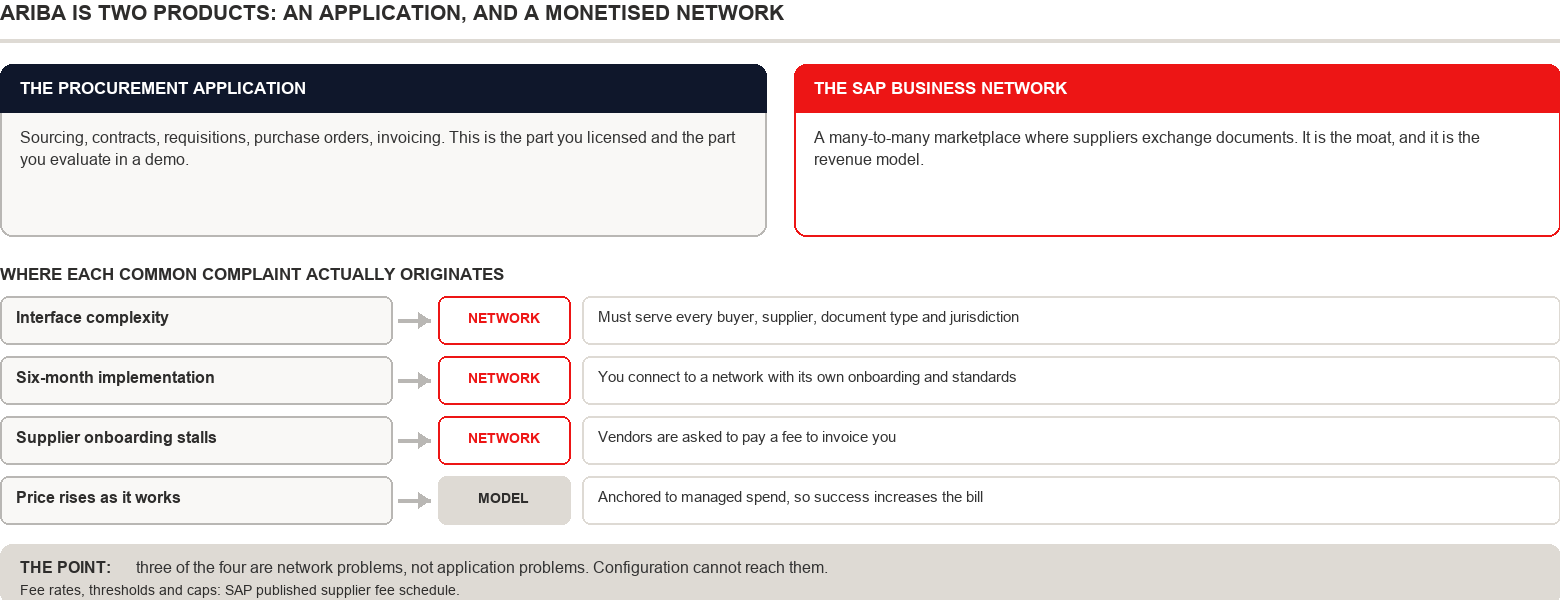 Figure 1. Ariba is an application fused to a monetised supplier network. Three of the four common complaints originate on the network side.
Why the interface carries weight a single buyer never needed. A network serving thousands of buyers and millions of suppliers has to accommodate every document type and every jurisdiction, which is a different design problem from serving your team.
Why implementation runs long. You are not configuring one system, you are connecting to a network with its own onboarding process, document standards and supplier-side requirements. G2 puts the average at six months.
Why supplier onboarding stalls. Your vendors are being asked to pay a fee to invoice you. That is not resistance to change, it is a rational commercial objection, and no amount of internal change management answers it.
Why the price rises as it works. Ariba pricing is anchored to annual managed spend, so bringing more spend under management, which is the entire point of the platform, increases what you pay for it.
None of this is a criticism of the engineering. It is a description of a business model, and it is the honest reason a replacement is worth evaluating even though Ariba is a Magic Quadrant Leader.
It also tells you which alternatives genuinely differ. A platform without a monetised network cannot charge your suppliers, and a platform priced on users rather than managed spend does not get more expensive as it succeeds.
The supplier network fee audit: what Ariba costs the vendors you buy from
This is the line item that never appears on your invoice, because it appears on theirs. The mechanics are published by SAP, so you can check every number here.
How the SAP Business Network supplier fee works | The published rule | What it means for you |
|---|---|---|
When a supplier starts paying | Above five documents AND the volume threshold in one buyer relationship, annually | Most tail suppliers never pay; your mid-size and large vendors do |
Standard transaction rate | 0.155 per cent of transacted volume in that buyer relationship | On $300,000 of invoicing, roughly $465 a year per supplier |
Services rate | 0.35 per cent where service entry sheets are involved | Services-heavy spend is charged at more than double the goods rate |
Annual cap | $20,000 a year per buyer relationship | Protects your largest vendors, and changes the total materially |
Billing basis | Billed quarterly on the prior quarter's transacted volume | Supplier cost tracks your ordering pattern, not a flat fee |
Subscription fee | Billed annually on the previous year's document count | A second charge on top of the transaction fee |
Distributed spend example | 500 suppliers × $300,000 at 0.155% | About $232,500 across your base, nobody hits the cap |
Concentrated spend example | 10 suppliers × $15,000,000, all capped | $200,000 across your base, every one capped |
Who ultimately pays | Suppliers reprice, resist onboarding, or both | The cost returns to you in contract rates, invisibly |
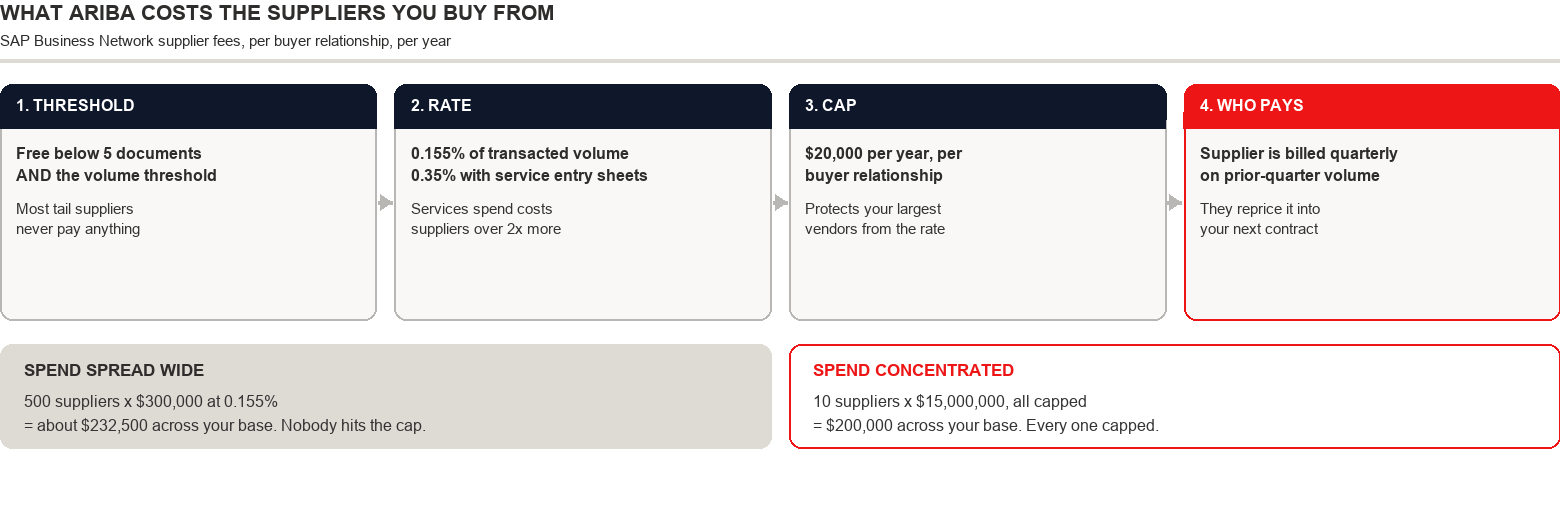 Figure 2. How the SAP Business Network supplier fee is calculated, and where the annual cap changes the arithmetic.
The threshold first. Suppliers transact free until they exceed five documents and the volume threshold within a single buyer relationship in a year. Most of your tail suppliers never reach it.
The rate, and the variant that catches services buyers. It is 0.155 per cent of transacted volume in a standard relationship, and 0.35 per cent where service entry sheets are involved, so services-heavy spend is charged at more than double.
The cap that most articles omit. Fees are capped at $20,000 a year per buyer relationship. That protects your largest suppliers and means the total depends entirely on how your spend is distributed.
The worked example, with the assumption stated. Five hundred suppliers each invoicing $300,000 at 0.155 per cent pay $465 each, roughly $232,500 collectively across your base, and none of them reach the cap.
The same spend concentrated differently. Ten suppliers each invoicing $15 million would each hit the $20,000 cap, totalling $200,000. Distribution matters more than volume, which is why you have to model your own base.
What happens next is the part that affects you. Suppliers do not absorb a cost of doing business with a single customer. They price it into their next quotation, refuse to onboard, or route invoices outside the network.
Ask three questions of any network-based platform before you sign. Will my suppliers be charged, at what threshold, and what is your onboarding completion rate when they are.
Who leaves SAP Ariba, and what specifically pushed them
This is a committee decision, and each seat at the table leaves for a different reason. That matters because the replacement that satisfies one of them may not satisfy the others.
Who is pushing to leave | What specifically pushed them | What they need from the replacement |
|---|---|---|
CPO or Head of Procurement | Supplier onboarding stalls because vendors object to paying a fee to invoice you | No network fees, and a documented onboarding completion rate |
Procurement Operations lead | A six-month implementation that still left exceptions to clear manually | A fixed-price implementation against defined scope, and a phased rollout |
Category or Sourcing Manager | Direct materials and complex multi-lot awards never fitted the tool | Real sourcing optimisation and direct-spend data on one model |
Business requesters | The interface is hard enough that raising a purchase request by email is faster | Guided buying an occasional user can complete without training |
CFO or Finance Director | Cost rises as spend under management grows, so success increases the bill | A pricing anchor tied to users or transactions, not managed spend |
IT or ERP owner | Maintaining the network connection and document standards is permanent work | Bi-directional ERP sync on vendor master, PO, receipt and invoice |
One pattern worth naming. The person who feels the pain daily is almost never the person who signs the replacement, which is why business cases built on user experience lose to ones built on supplier cost and compliance risk.
What actually matters when you are replacing Ariba specifically
The general evaluation criteria for procurement software are covered on our B2B procurement platforms page. These eight are the ones that only matter because you are leaving Ariba.
Supplier network economics. Does the platform charge your suppliers anything to transact, at what threshold, and can you get that answer in writing before you sign?
Supplier re-onboarding load. How many of your existing vendors already transact on the new platform, and who owns re-onboarding the rest, because this is the work that sinks migrations.
Pricing anchor. Is the price tied to managed spend, transaction volume, or users? A managed-spend anchor reproduces the problem you are leaving.
S/4HANA integration depth, if you are staying on SAP ERP. Which objects sync bi-directionally, specifically vendor master, purchase order, goods receipt and invoice, and which are one way?
Direct versus indirect spend coverage. Ariba is strong on indirect. If you are a manufacturer, check the replacement handles bills of materials and direct materials sourcing properly.
Implementation shape and fixed price. Ask for a fixed price against defined scope and what is explicitly excluded, then compare it against Ariba's six-month benchmark.
Adoption by occasional requesters. The reason spend left Ariba in your organisation will follow you if the replacement is equally hard for someone who buys twice a year.
India and multi-jurisdiction compliance. GST e-invoicing with IRN generation, e-way bills, GSTIN validation and data residency, covered in full further down.
Quick match: your reason for leaving, and where to look first
Why your evaluation started | Where to look first | Why |
|---|---|---|
Suppliers object to network fees | Procuresprint, Coupa | Neither charges your vendors to transact with you |
The implementation took too long | GEP SMART, Procurify | Faster reported time to value against Ariba's six-month average |
Nobody in the business will use it | Coupa | Guided buying and the strongest adoption record of the enterprise suites |
Direct materials never fitted | Ivalua | Built for direct spend and sub-tier supplier visibility |
It costs more every year as it works | Oracle Fusion, Procurify, Precoro | Priced on users or seats rather than on managed spend |
We were oversold an enterprise suite | Procurify, Precoro | Approval control and budget visibility without a programme |
We are moving off SAP ERP anyway | Oracle Fusion, Workday Strategic Sourcing | Decide procurement inside the ERP decision, not separately |
Sourcing works, only the front door is broken | Zip or Tonkean on top of Ariba | Fixes adoption without a migration, at a fraction of the cost |
We do not want to run another platform | Procuresprint, GEP SMART | Both offer a managed procurement model rather than licence-only |
How to use this. Pick the row that matches the reason your evaluation started, shortlist those two or three platforms, and skip the rest of the profiles entirely.
Enterprise source-to-pay replacements
These five are full source to pay software suites that can genuinely replace Ariba end to end across sourcing, contracts, purchasing and invoicing at multi-entity scale.
1. Coupa: best for getting people to actually use it
Coupa is on this list because it solves the specific Ariba problem most organisations feel daily, which is that ordinary employees route around the system. It is the most adopted enterprise suite here, and adoption is what produces spend data.
Its defining asset is guided buying. Requesters get steered to contracted suppliers and negotiated prices by default, which is the single most effective control on off-contract spend available in this category.
The tradeoff is cost and scope. Coupa is expensive, the implementation is a programme rather than a project, and a partial rollout badly underuses what you paid for.
Best for: enterprises leaving Ariba over user adoption and internal friction rather than over price.
Real cost: core licensing starts around $150,000 to $250,000 annually at mid-market scale, with enterprise deployments commonly $500,000 to $3M+. Implementation adds $400,000 to $1.5M or more. Three-year terms typically price 15 to 25 per cent below annual.
Pros
A 2025 Gartner Magic Quadrant Leader positioned highest for Ability to Execute
Consistently the best adoption of any enterprise suite here, which is the whole point of replacing Ariba
Community Intelligence benchmarking drawn from aggregated customer spend, which no single organisation can replicate alone
ERP agnostic with mature two-way connectors to SAP, Oracle, NetSuite and Dynamics
4.2 on G2 across 561 reviews, the second-largest independent review base in this comparison
Cons
Implementation frequently costs as much as the first two years of licence
Sourcing and contract management are less deep than Ivalua for complex direct spend
Some breadth arrived through acquisition, so integration between areas feels uneven
A sourcing-only or invoicing-only deployment disappoints reliably
Not ideal for: organisations whose primary complaint about Ariba is cost. Coupa is not cheaper.
Key features: guided buying, catalogues and punch-out, strategic sourcing, contract management, procure-to-pay with three-way matching, spend analysis with community benchmarking, supplier management, expenses and payments, and ERP-agnostic two-way integration.
Bottom line: the strongest pick when adoption is why you are leaving. Budget the implementation honestly or the business case breaks.
2. Ivalua: best for complex direct materials Ariba was never built for
Ivalua earns its place because Ariba's strength is indirect spend, and manufacturers leaving Ariba are usually leaving because direct materials never fitted. Ivalua was designed for the categories that go into what you make.
Its defining asset is configurability on a single data model. Unusual approval structures, category hierarchies and supplier scorecards are shaped to your process rather than chosen from a menu.
The tradeoff is that configurability has to be paid for in time and internal capability. Ivalua rewards mature procurement teams and punishes thin ones.
Best for: manufacturers and complex enterprises with heavy direct spend and requirements that will not fit a standard configuration.
Real cost: from around $180,000 a year for a single module at mid-market scale. Large full-suite deployments cluster between $520,000 and $1.6M, with a reported median near $680,000 for 400 to 600 procurement users.
Pros
A 2025 Gartner Magic Quadrant Leader, and the highest G2 score in this comparison at 4.4
Genuine strength in direct materials and sub-tier supplier visibility, where Ariba is weakest
One unified platform rather than acquired modules stitched together
Handles complex SAP data structures and Master Data Governance well if you are keeping S/4HANA
Cons
Its 4.4 rating rests on 99 reviews, a far smaller base than Ariba or Coupa
Configurability lengthens implementation, so the six-month Ariba benchmark is not automatically beaten
Needs a capable internal team, which is a real constraint if procurement is already stretched
Smaller partner and supplier ecosystem than SAP or Coupa
Not ideal for: straightforward indirect buying, where it is both overkill and over budget.
Key features: configurable strategic sourcing and e-auctions, direct and indirect spend on one data model, contract lifecycle management, supplier risk and performance scorecards, spend analysis, procure-to-pay, and deep configuration of category and approval structures.
Bottom line: the best fit if direct materials are why Ariba never worked for you. Confirm you can staff the design phase.
3. Mindsprint Procuresprint: best for escaping supplier network fees and having procurement run for you
Procuresprint is on this list for one specific reason relevant to an Ariba migration, which is that it has no supplier network and therefore charges your suppliers nothing to transact with you.
Its defining asset is not the module list, which looks like everyone else's. It is that Mindsprint will operate procurement for you against an outcome rather than only licensing you software to run yourself.
That comes from where it was built. Mindsprint ran procurement inside a global food and agri business for two decades before selling this to anyone, so the design assumptions are an operator's.
Best for: multi-entity enterprises leaving Ariba over supplier fees or onboarding friction, and teams who would rather commit to an outcome than operate another suite.
Real cost: not published, quoted against modules and scope. Ask for it fully loaded including implementation, and ask what the managed-service option costs against licence plus headcount, because that comparison is the point.
Pros
No supplier network fees, so onboarding does not require persuading vendors to pay to invoice you
Nine named autonomous agents across supplier discovery, onboarding, sourcing, contract authoring, PO award and spend classification
Supplier onboarding with automated KYC and continuous risk screening, where multi-entity procurement usually leaks weeks
Available as a fully managed procurement service, which no other platform on this list offers
End-to-end continuity with Mindsprint SprintAP on the invoice side, so sourcing, buying and paying run without a handoff gap
Cons
No Gartner Magic Quadrant placement and no G2 profile, so there is no independent evidence to read
A much smaller supplier network than Ariba, which is the trade you are making by avoiding the fees
No published pricing, which is a fair criticism of us as much as of anyone else here
Newer and less known than the four platforms around it, so diligence takes more work
No named public reference customers yet, so ask us for a private one of your size
Not ideal for: simple small-business buying, or organisations that need the largest possible pre-connected supplier network on day one.
Key features: five modules covering supplier management, eSourcing, contract lifecycle management, spend analysis and requisition to goods receipt, nine named AI agents, automated supplier KYC and continuous risk screening, over 100 languages, human-in-the-loop guardrails, ERP-agnostic integration, and an optional managed-service model.
Bottom line: the standout if supplier fees are why you are leaving and you would rather buy an outcome than another suite. Verify module maturity against your must-haves.
4. GEP SMART: best when you want the vendor to help run procurement
GEP is on this list because a meaningful share of teams leaving Ariba are not short of software, they are short of people to run it. GEP supplies both.
Its defining asset is that combination. GEP is a substantial procurement services and consulting business as well as a software vendor, which puts it closer to a managed model than most software companies can reach.
The tradeoff is entry price. GEP positions at upper mid-market and above, and the reported entry point puts it out of reach for genuine mid-market budgets.
Best for: large and upper mid-market organisations open to consulting-led delivery, particularly where the internal team cannot absorb another platform.
Real cost: reported entry around $500,000 a year, quote based. The services relationship often carries as much of the value as the licence, so compare the whole engagement rather than the software line.
Pros
A 2025 Gartner Magic Quadrant Leader, confirmed in the published record
One unified platform covering direct and indirect spend, built cloud native rather than assembled
Faster reported time to value than the legacy enterprise suites, which matters against Ariba's six months
Procurement consulting and managed services available from the same vendor
Cons
Entry pricing excludes real mid-market budgets despite the positioning
Smaller install base and user community than SAP or Coupa
No G2 rating was sourced in our research, so independent review diligence is harder
Reporting flexibility is a recurring theme in user feedback
Not ideal for: organisations under roughly $200 million in addressable spend, where the entry price cannot be justified.
Key features: unified source-to-pay across direct and indirect spend, strategic sourcing and category management, contract management, procure-to-pay, spend analysis, supplier management, and optional procurement consulting and managed services.
Bottom line: a strong unified alternative if you want the vendor involved in running procurement, not just supplying it.
5. Oracle Fusion Cloud Procurement: best if you are moving off SAP anyway
Oracle belongs here for a narrow but common case. Organisations leaving Ariba as part of a wider move off SAP ERP should not evaluate best-of-breed suites at all.
Its defining asset is that there is no integration layer. Procurement shares one data model with finance and supply chain rather than connecting to them, so committed against actual spend reconciles without an interface.
It is also one of very few enterprise options publishing per-user rates, which means you can model the cost before a sales conversation.
Best for: enterprises already standardised on, or migrating to, Oracle Fusion Cloud ERP.
Real cost: Oracle publishes module-based rates in the region of $175 to $625 per user per month, making it one of the few enterprise options you can model before a sales call.
Pros
A 2025 Gartner Magic Quadrant Leader for Oracle Fusion Cloud Procurement
Native integration with Oracle Fusion ERP and supply chain, with no interface layer to maintain
Published per-user pricing, which is genuinely rare at this tier
Clean reporting on committed against actual spend, since the data never leaves the system
Cons
Very little reason to choose it if you are not becoming an Oracle shop
Sourcing and supplier risk are shallower than the specialist suites
Configuration and change requests route through Oracle partners
No G2 rating was sourced for the procurement module in our research
Not ideal for: organisations staying on SAP S/4HANA, where you would be adding an integration problem rather than removing one.
Key features: self-service procurement and guided buying, sourcing and negotiations, supplier qualification management, contract management, purchase order and receipt processing, and native reporting inside Oracle Fusion ERP.
Bottom line: the obvious answer inside Oracle and a weak one outside it. If you are staying on SAP, skip this profile.
Specialist and vertical alternatives
These three are not general Ariba replacements. Each wins in a specific context where the enterprise suites above are the wrong shape.
6. Jaggaer: best for higher education, life sciences and public sector procurement
Jaggaer is on this list because Ariba is a poor fit for grant-funded and scientific procurement, and Jaggaer has spent two decades in exactly those environments. It began as SciQuest, serving university and research buying.
Its defining asset is vertical depth. Scientific catalogue integrations, multi-fund grant tracking, chemical inventory and lab asset management are native rather than configured.
The tradeoff is breadth outside those verticals. In manufacturing, food or retail it competes without the vertical advantage that makes it compelling elsewhere.
Best for: universities, research institutions, hospitals and public agencies where transparent bidding and fund accounting are mandatory.
Real cost: quote based, enterprise scale, with pricing driven by modules and institutional size rather than published rates.
Pros
Genuinely unmatched in higher education and scientific procurement, built there rather than adapted
Strong on direct materials, inventory replenishment and complex freight logistics
4.3 on G2, the second-highest score in this comparison
Handles public bidding transparency and multi-fund grant tracking natively
Cons
That 4.3 rests on only 29 reviews, so treat it as directional rather than conclusive
Its Magic Quadrant position was not confirmed in the sources we checked
Less compelling outside its core verticals, where Coupa or Ivalua are stronger
Interface and reporting are functional rather than modern
Not ideal for: commercial manufacturing, retail or technology buyers with no grant or public-tender requirements.
Key features: scientific and lab catalogue integrations, multi-fund grant tracking, public bidding and RFP transparency, direct materials sourcing, inventory replenishment, contract management, supplier management and spend analytics.
Bottom line: the clear answer in higher education, research and public sector. Look elsewhere if you are none of those.
7. Zycus: best for mid-market teams wanting generative AI without enterprise pricing
Zycus appears on almost every Ariba alternatives list, and it is included here with a caveat rather than a recommendation. It targets mid-market source-to-pay with a strong automation and generative AI story.
Its defining asset is contract management depth relative to its price point, along with generative AI features across sourcing and contract authoring that larger suites gate behind premium tiers.
The problem is evidence. Zycus sits at 3.6 on G2 across just twelve reviews, which is both the lowest score and the thinnest base in this comparison, and neither number can be ignored.
Best for: mid-market organisations that need broad source-to-pay coverage on a budget the enterprise suites cannot serve.
Real cost: quote based, positioned below the enterprise suites, with no published rate card available.
Pros
Broad source-to-pay coverage at mid-market rather than enterprise pricing
Generative AI across sourcing and contract authoring included rather than tier-gated
Robust contract management for the price point
Bridges operational procurement into Workday's ledger through API automation
Cons
3.6 on G2, the lowest score in this comparison, on only twelve reviews
Its Magic Quadrant position was not confirmed in the sources we checked
The thin review base makes independent diligence genuinely difficult
Ask hard about implementation timelines, since no benchmark is publicly available
Not ideal for: risk-averse buyers who need a substantial independent review base before signing.
Key features: source-to-pay coverage, generative AI sourcing and contract authoring, contract management, eProcurement, supplier management, spend analysis and Workday ledger integration.
Bottom line: worth a demonstration if budget is binding, but insist on multiple reference calls given how little independent evidence exists.
8. Workday Strategic Sourcing: best if your finance system is Workday
This belongs on the list for the same reason Oracle does. If your ERP is Workday, the integration argument usually outweighs any feature comparison you could run against a best-of-breed suite.
Its defining asset is that sourcing events, contracts and supplier records sit alongside your financial ledger rather than integrating with it, so committed spend reconciles without a reconciliation project.
The tradeoff is scope. It is a sourcing and contract tool rather than a full source-to-pay suite, so the transactional layer often still needs a partner platform.
Best for: Workday Financials customers who need sourcing and contract workflow without introducing a second data model.
Real cost: quote based through Workday licensing, with pricing shaped by your existing Workday relationship rather than published separately.
Pros
Native alignment with Workday Financials, removing the interface layer entirely
Strong supplier collaboration and contract workflow for sourcing-led teams
Leverages an existing vendor relationship, which shortens procurement and legal review
Sensible pairing with Coupa or a P2P layer for the transactional half
Cons
Not a full source-to-pay replacement for Ariba on its own
Little reason to consider it outside a Workday estate
The 4.8 Gartner rating circulating in comparison lists could not be verified and should be ignored
Thinner spend analytics than the dedicated suites
Not ideal for: organisations needing requisition-to-invoice automation as the primary requirement.
Key features: strategic sourcing and RFx, supplier collaboration, contract lifecycle workflows, supplier records aligned to the Workday ledger, and reporting inside Workday Financials.
Bottom line: the right call inside Workday, paired with something else for the transactional layer.
Mid-market alternatives: when Ariba was simply the wrong size
A real share of teams searching for Ariba alternatives were sold an enterprise suite for a mid-market problem. If that is you, the honest answer is a much smaller platform.
9. Procurify: best for fast approval control and budget visibility
Procurify is on this list because it solves the problem organisations actually had before someone sold them Ariba, which is uncontrolled purchasing and approvals living in email.
Its defining asset at this size is adoption. Occasional requesters use it without training, and below 1,000 employees adoption is the single biggest predictor of whether you get usable spend data.
Budget visibility is the other draw. Requesters see remaining budget before committing spend, not after finance closes the month.
Best for: organisations under roughly 1,000 employees that need approval control and budget visibility in weeks rather than quarters.
Real cost: published per user per month, with Starter around $12, Business around $24 and Premium around $39. Implementation typically runs $1,000 to $5,000, with training charged separately.
Pros
Published per-seat pricing you can model in a spreadsheet, unlike anything above it on this list
Genuinely easy to adopt, with one of the strongest review bases among mid-market tools
Real-time budget visibility before spend is committed
Certified native NetSuite integration, plus QuickBooks and Dynamics Business Central
Cons
No strategic sourcing, e-auctions or contract lifecycle management
Reporting is basic against the enterprise suites, with limited multi-entity views
Outgrown quickly by multi-entity, multi-currency operations
Per-user pricing stops being cheap as headcount grows
Not ideal for: multi-entity groups or anyone who genuinely needs sourcing events.
Key features: requisitions and approval workflows, purchase order creation and tracking, goods receipt, real-time budget tracking, spend reporting, mobile approvals, vendor records and accounting integrations.
Bottom line: buy it for control and budgets, not for sourcing. If Ariba was oversold to you, this is the honest correction.
10. Precoro: best for small teams that want a published price
Precoro is here because it does the one thing nothing else on this list will do, which is tell you the price before a sales call. After an Ariba negotiation, that has real value.
Its defining asset is transparency. A published rate card gives you a defensible benchmark when enterprise vendors refuse to quote, which is useful even if you do not buy it.
Deployment is measured in weeks, and three-way matching is included rather than gated behind a higher tier.
Best for: smaller teams that want purchasing control at a predictable, published price.
Real cost: from about $499 a month at entry, with reported per-user rates from around $39 and ten-user setups landing between $300 and $600 a month depending on features.
Pros
Transparent published pricing, which doubles as a benchmark against quote-only vendors
Live in weeks rather than months, against Ariba's six-month average
Clean approval workflows and three-way matching at a small-business price
Integrates with QuickBooks, Xero, NetSuite and Dynamics Business Central
Cons
Limited strategic sourcing and contract management
Analytics are basic, with no spend cube or category-level opportunity identification
Not designed for complex multi-entity governance
Will be outgrown if your spend or entity count is genuinely growing
Not ideal for: enterprises with multi-entity governance, complex sourcing or heavy compliance requirements.
Key features: requisitions and configurable approval routing, purchase orders, goods receipt and three-way matching, basic supplier management, budget control, custom fields, and accounting integrations.
Bottom line: the clearest value at the small end, and the only vendor here that tells you the price up front.
Also worth shortlisting, depending on the situation
Five more names appear in ariba software competitors lists. Each is right in a narrow case, which is why none got a full profile here.
Zip and Tonkean. If Ariba's sourcing and contracts work and only the front door is broken, an intake and orchestration layer sits in front of it and fixes adoption for a fraction of a replacement.
Euna Solutions, formerly Bonfire, and Mercell. Purpose-built for public sector bidding and agency compliance, with Mercell the leading European public procurement network.
Fraxion. A focused spend and approval tool for smaller organisations, closer in scope to Procurify than to a source-to-pay suite.
Order.co and ProcureDesk. Genuinely small-business tools, consolidating vendor invoices into one bill or connecting Amazon Business buying into accounting software.
Zapro. Appears on several lists with a 4.7 rating attributed to G2 that we could not verify at all. Treat both the rating and the positioning with caution until you can check it yourself.
SAP Ariba alternatives compared on cost
SAP Ariba pricing is not published, and neither is most of this list. Only three platforms publish anything, which is why business cases for replacing Ariba are so often wrong before the first invoice.
Platform | Price published? | Annual cost range | What drives the price |
|---|---|---|---|
SAP Ariba (baseline) | No | $80,000-300,000 core modules; $400,000-1.5M+ full suite reported | Managed spend, modules, users, plus supplier network fees |
Coupa | No | $150,000-250,000 mid-market; $500,000-3M+ enterprise | Modules, transaction volume, users. Implementation $400K-1.5M+ |
Ivalua | No | From ~$180,000 single module; $520,000-1.6M full suite | Modules, users, configuration depth |
Mindsprint Procuresprint | No | Quote based against modules and scope | Modules, entities, and whether you take the managed service |
GEP SMART | No | Reported entry around $500,000 | Modules plus the services engagement, often the larger half |
Oracle Fusion Cloud Procurement | Yes | $175-625 per user per month | Module mix and user count, modellable before a sales call |
Procurify | Yes | $12 / $24 / $39 per user monthly | Seats and tier. Implementation $1,000-5,000 on top |
Precoro | Yes | From $499 monthly; ~$39 per user reported | Seats and features. Ten-user setups $300-600 monthly |
Every platform above | — | Add 50 to 150 per cent of year-one licence | Implementation, and it is the largest line after the licence |
Every platform above | — | Add 0.5 to 1 FTE through go-live | Your own team, and it never appears in a business case |
Implementation is the line that breaks business cases. It runs 50 to 150 per cent of the first-year subscription across the enterprise platforms, and Coupa enterprise implementations alone are reported at $400,000 to $1.5M or more.
Watch the pricing anchor, not just the number. Among procure to pay platforms, a price tied to managed spend gets more expensive as it succeeds, which is one of the things you may be leaving Ariba to escape.
Supplier re-onboarding is a real cost with no invoice attached. Every vendor has to be re-registered, re-validated and reconnected, and that work lands on your team rather than the vendor's.
Your own people are the forgotten line. Half to one full-time equivalent through implementation is normal and almost never appears in a business case.
Migration prep: before you cancel SAP Ariba
Switching friction is the real objection, not price. Ariba holds your supplier records, your contracts and your transaction history, and getting them out is a project with a sequence.
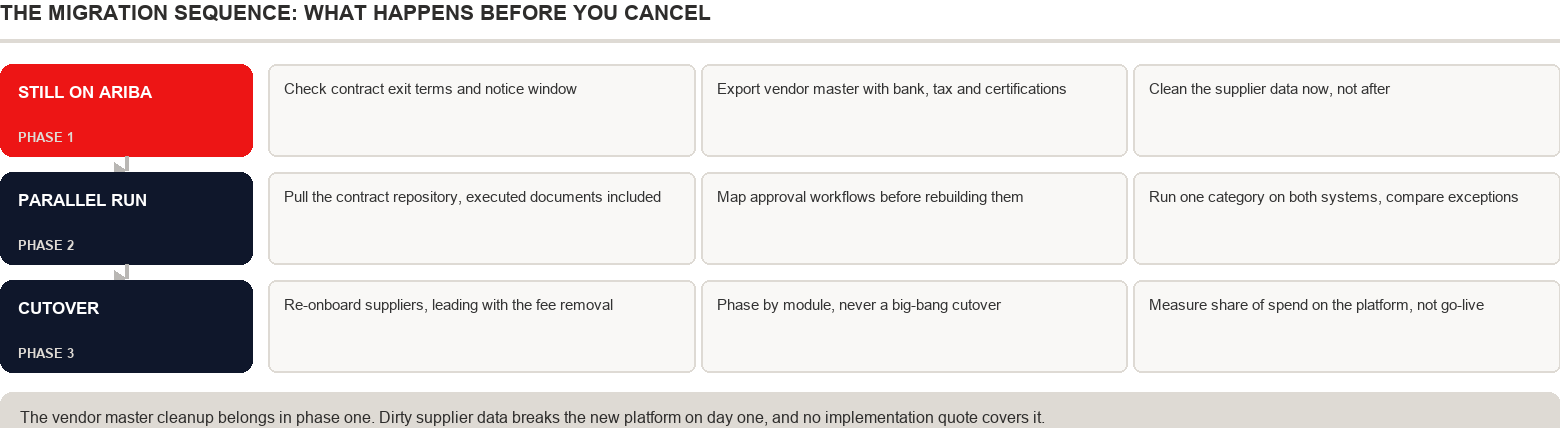 Figure 3. The migration sequence. The vendor master cleanup happens while you are still on Ariba, not after.
Check your contract exit terms first. Enterprise agreements commonly carry multi-year terms with auto-renewal, so establish your notice window before you start evaluating, not after you have chosen.
Export the vendor master properly, including bank details, tax registrations and the certifications you collected. This is the asset with real value, and it is the hardest to reconstruct.
Pull the contract repository with executed documents, not just metadata. Negotiated price terms and renewal dates sit inside those PDFs and they are what protect you after the migration.
Map the workflows before you rebuild them. Approval hierarchies accumulate exceptions over years, and rebuilding them faithfully in a new platform reproduces problems you could have fixed.
Run parallel for one category, not everywhere. Pick a single spend category or entity, run both systems, and compare the exception rate before committing to a full cutover.
Plan supplier communication as a commercial exercise. Your vendors have configured themselves for the SAP Business Network, and telling them the fee is going away is the easiest onboarding message you will ever send.
One sequencing point that saves months. Do the vendor master cleanup while you are still on Ariba, because dirty supplier data breaks the new platform on day one and cleaning it is rarely inside the implementation quote.
Why procurement platform replacements fail, and how to prevent it
Around 58 per cent of enterprise software projects fail, and the causes are consistent enough to plan against. Almost none of them are the software.
Poor requirements is the top cause, responsible for over 39 per cent of failures. Not poor software. Requirements nobody wrote down properly before the demonstrations started.
Unclear goals account for nearly 37 per cent. If success is defined as go-live rather than a share of spend under management, the project will hit the measure and miss the point.
Communication breakdowns feature in 57 per cent, usually between procurement, finance and IT, each assuming another team owns adoption.
Dirty supplier and item master data breaks the system on day one, and cleaning it is rarely inside the implementation quote from any vendor here.
Buyers who will not use it. If people can still raise a purchase order by email, they will, and your spend data stays as incomplete as it was inside Ariba.
Two defences that work. Phase the rollout by module rather than going live everywhere at once, because a small deployment that works beats a large one that stalls.
And define success as a percentage of spend flowing through the platform by a date. That is the only measure that distinguishes a migration from a rebranding.
Ten questions that expose a poor fit during evaluation
Vendor demonstrations are rehearsed against clean data. These are not, and the hesitation in the answer tells you as much as the answer.
Will my suppliers be charged anything to transact with me, at what threshold, and will you put that in the contract?
What is your supplier onboarding completion rate, and how long does it take for a vendor base of my size and geography?
Is your price anchored to managed spend, transaction volume or users, and what happens if my spend under management grows 40 per cent?
What is the fixed-price implementation for my scope, what is explicitly excluded, and how does that compare to six months?
Which objects sync bi-directionally with my ERP, specifically vendor master, purchase order, goods receipt and invoice, and which are one way only?
Show me a three-way match failing right now, on messy data, and show me what the exception queue looks like.
After go-live, what does a workflow change cost and how long does it take to make?
Can you punch out to my three largest distributors, and have you done it before for a customer like me?
Show me spend analysis on a supplier with three different name spellings across two entities.
Give me a reference customer of my size, in my industry, who migrated off Ariba in the last 18 months.
That last question is the most revealing on the list, and it is fair to ask it of every vendor here, including us. We will give you a private reference rather than a public logo.
SAP Ariba alternatives for India: GST, e-invoicing and data residency
India carries the largest SAP Business Network supplier population of any market, and it has requirements that will disqualify an otherwise strong replacement.
If any part of your operation buys or invoices in India, check these before shortlisting anything.
GST e-invoicing and IRN generation. Invoices above the turnover threshold must be reported to the Invoice Registration Portal with a valid IRN and QR code. Confirm this is native rather than a manual export.
E-way bills. Movement of goods above the value threshold needs one, so ask whether generation is tied to the purchase order and goods receipt flow or handled outside the system entirely.
GSTIN validation at onboarding, and repeated afterwards. A supplier whose registration lapses creates input tax credit exposure for you, so validation has to recur rather than happen once.
Input tax credit reconciliation. Mismatches between your records and supplier filings are the most common source of blocked credit, so ask specifically how the platform surfaces them.
Data residency under the DPDP Act 2023. Certain personal data must be stored in India, so confirm an Indian region genuinely exists rather than sitting on a roadmap.
There is an upside to leaving a fee-bearing network in this market specifically. Indian supplier margins are frequently thinner, so a transaction fee lands harder and removing it is a more persuasive onboarding message.
Where Procuresprint fits, and where it does not
Mindsprint builds Procuresprint and it is ranked third on this page rather than first, which is deliberate. Coupa and Ivalua are better answers for most Ariba migrations.
When we are genuinely the right call. You are leaving over supplier network fees or onboarding friction, you run multiple entities, and you would rather buy a procurement outcome than operate another platform.
When Coupa is the better answer. Adoption is your problem, you want the largest community benchmarking data set, and you have the implementation budget to do it properly.
When Ivalua is the better answer. Direct materials and complex sourcing are why Ariba never fitted, and you have a mature team that can run a configuration programme.
When you should stay on Ariba. Your vendor base is already fully onboarded, your suppliers are large enough to absorb the fees without repricing, and S/4HANA integration depth outweighs everything else.
What we cannot show you. No Gartner placement, no G2 profile, no published price list and no public reference customers, so an evaluation has to run on your own data in a working session.
If none of the first three describe you, the comparison table above is more useful than this section, and we would rather you used it.
Where this guide comes from, and what we excluded
What we operate. Mindsprint runs procurement and supplier operations for a multi-entity global group with more than 3,000 suppliers digitally connected across several countries and tax regimes.
What that contributes here. The supplier fee argument, the re-onboarding warning and the vendor master sequencing advice all come from having done this rather than from reading about it.
The evidence rule. Supplier fee rates, thresholds and caps come from SAP's own published fee schedule. Analyst positioning comes from the 2025 Gartner Magic Quadrant for Source-to-Pay Suites, published March 2025 across 12 vendors.
What we excluded and why. A 4.7 rating attributed to Zapro on G2 that we could not verify, and two identical 4.8 ratings attributed to Gartner for GEP and Workday that mix an incomparable scale with the G2 scores around them.
Where we corrected the market. Several published comparisons quote a Jaggaer G2 score of 4.1 and an Ivalua score of 4.3. The figures we found were 4.3 and 4.4, on 29 and 99 reviews respectively.
One limit worth stating. Review scores and pricing in this category move, so treat every number here as a snapshot and click through the linked profiles before quoting anything on a call.
The bottom line on replacing SAP Ariba
There is no single best SAP Ariba alternative, and an SAP Ariba replacement is not one decision. There is only the best fit for why you are leaving, and the four common reasons lead to four different platforms.
Leaving over supplier fees or onboarding friction points to Procuresprint or Coupa, because neither charges your vendors to invoice you.
Leaving over adoption points to Coupa. It is the most used enterprise suite here, which is why coupa vs ariba is the most searched comparison in this category.
Leaving because direct materials never fitted points to Ivalua, and being a university, hospital or public agency makes jaggaer vs ariba the comparison that matters instead.
Leaving because Ariba was oversold to a mid-market problem points to Procurify or Precoro, and Precoro is the only vendor here that will tell you the price up front.
Leaving because direct materials never fitted points to Ivalua, and leaving because Ariba was oversold to a mid-market problem points to Procurify or Precoro.
And if you are moving off SAP ERP entirely, evaluate Oracle Fusion or Workday inside that decision rather than shopping best-of-breed suites separately.
One last thing worth saying plainly. Ariba is a Magic Quadrant Leader at 4.1 across 743 reviews, and if your suppliers are already onboarded and absorbing the fees, staying is a defensible answer.
The reason to leave is structural rather than qualitative, and that is exactly why configuration will not fix it.