The procurement contract management process at a glance
Stage | What happens | Who owns it | Typical duration | What breaks |
|---|---|---|---|---|
1. Intake and requirements | Convert a request into a specification: outcome, budget code, risk tier, and the named post-award owner. | Business requester, procurement gate | 3 to 10 days | Requester arrives with a supplier already chosen. |
2. Sourcing, drafting and negotiation | RFI or RFP, clause library drafting, service levels, price sheet, audit rights and exit terms. | Procurement and legal | 2 to 6 weeks by value | Bespoke terms on routine agreements. |
3. Approval and execution | Route by value and risk under the delegation of authority, then e-signature. | Procurement, finance and legal thresholds | Signature 3 to 5 days from final approval | Approval chains that grew by accretion. |
4. Post-award monitoring | Delivery performance, invoice against price sheet, obligation fulfilment, quarterly reviews. | Named contract manager | Continuous | Nobody was named, so nothing is monitored. |
5. Renewal, amendment or closure | Review 90 days before expiry, then renew, amend under change control, or close and revoke. | Contract manager with procurement | Start 90 days before notice date | Auto-renewal because the window closed. |
Procurement management versus contract management: the difference that decides who owns the contract
These two terms are used interchangeably and they describe different work, owned by different people, measured in different ways.
The confusion is not academic. It is the reason contracts go unmanaged after signature.
Dimension | Procurement management (pre-award) | Contract management (post-award) |
|---|---|---|
The question it answers | What do we need, who should supply it, and on what terms? | Are both parties doing what the agreement says? |
When it runs | From intake to contract signature. | From signature to renewal or exit. |
Who owns it | Procurement, with legal on terms. | A named contract manager, with finance on price compliance. |
What success looks like | Right supplier, right terms, cycle time inside benchmark. | Obligations met, invoices matching the price sheet, no surprise renewals. |
Primary metric | Time to establish a contract; negotiated savings. | Contract compliant spend; obligations met on time; renewal capture. |
How it usually fails | Requirement arrives with a supplier attached. | The role is nobody's actual job. |
Tooling that fits | Sourcing and e-procurement suites. | CLM plus the transaction system that sees the purchase order. |
The asymmetry matters. Procurement management is a well staffed discipline with a recognised profession, defined tooling and clear metrics. Contract management after award is frequently nobody's full time job.
The UK Government Functional Standard for Commercial addresses this by mandating a distinct contract manager for the post-award phase, separate from the commercial practitioner who ran the procurement. Most private sector organisations have no such rule.
If you take one thing from this guide, take this: name the post-award contract manager before you sign, not after.
Everything in stages four and five depends on that person existing.
The award handoff: what transfers, who accepts it, and what gets dropped
Every guide on this topic diagnoses the gap between sourcing and contract administration. None of them publishes the handoff itself. Here it is.
What must transfer at award | Who accepts it | What happens when it does not |
|---|---|---|
The obligation register: every commitment, date and service level extracted from the executed contract. | Contract manager | The clause exists and nothing monitors it. This is the single most common failure. |
The price sheet or rate card, as a usable reference rather than buried in the agreement. | Contract manager and accounts payable | Invoices are paid at list price while a negotiated rate sits unused. |
The named contract manager, recorded against the contract before signature. | The contract manager, in person | Stage four never starts. Nobody is accountable and nobody notices. |
Key dates: notice, renewal, expiry, milestone and reporting deadlines, loaded into something that alerts. | Contract manager | Auto-renewal by default, and missed remedies because the claim window closed. |
The exit and transition plan agreed in negotiation. | Contract manager and IT | Exit is improvised under time pressure, at whatever the supplier then charges. |
Assumptions made during negotiation: volumes promised, service levels traded away, risks knowingly accepted. | Contract manager | The successor renegotiates from a false baseline and repeats the same concession. |
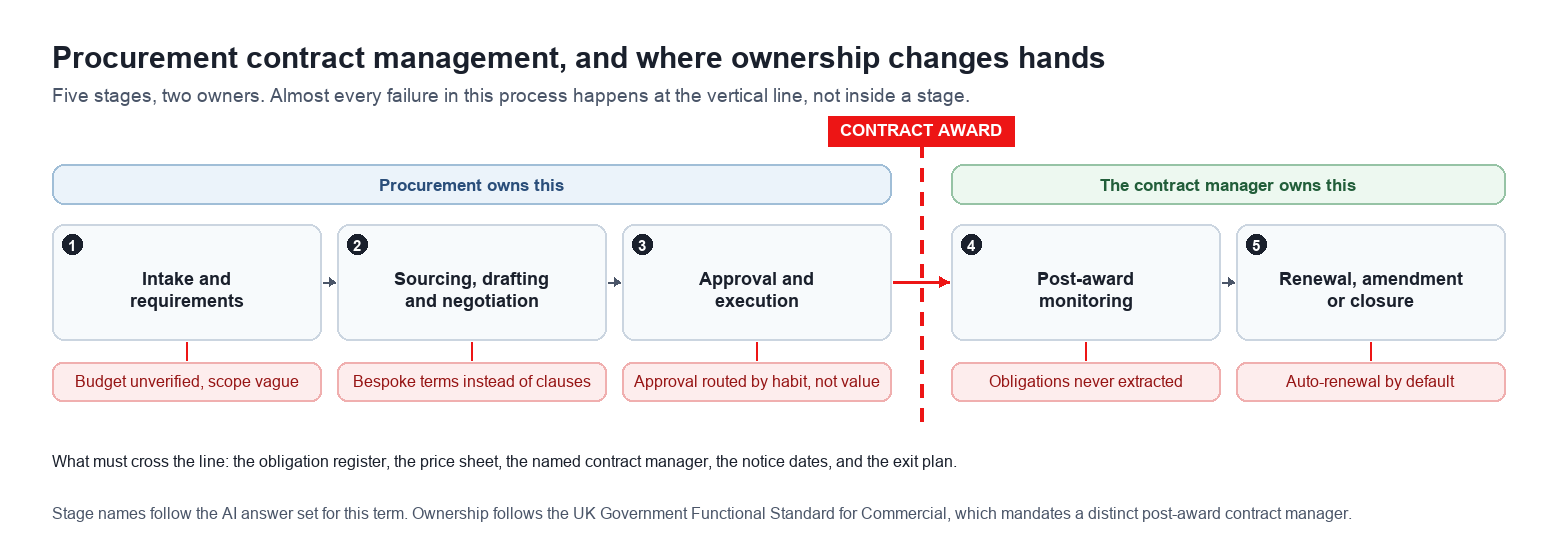
The five stages of procurement contract management, the two owners, and the award boundary where responsibility changes hands.
Two rules make the handoff hold.
Nothing transfers by email. An email is not an acceptance, and a forwarded contract is not a briefing.
The contract manager signs for what they receive, exactly as a warehouse signs for goods.
This matters more than contract quality. An obligation nobody extracted is an obligation nobody monitors: the clause exists, the enforcement does not.
One observation from running this ourselves. The item that goes missing at award is almost never the obligation register, because that at least has a legal owner.
It is the price sheet, which belongs to procurement before award and to accounts payable after it, and therefore to nobody during the handover.
Who owns procurement contract management, and the pain that drives it
Five roles carry part of this process and they measure success differently.
Find your row before reading the stages, because the stage that matters most to you depends on where you sit.
Who owns part of it | The pain that drives it | What they need |
|---|---|---|
Chief Procurement Officer | Negotiated savings that never reach the P&L, and no single view of what has been signed across entities. | One contract register with owner, value, dates and risk tier. |
Procurement or category manager | Cycle time measured in weeks, most of it queuing rather than negotiating, with the business buying around the process. | Intake discipline, clause libraries, and approval routing by value. |
Contract manager | Inherited contracts with no obligation register, tracked in a spreadsheet rebuilt every quarter. | Obligations extracted at award, with alerts and a named counterpart. |
CFO or financial controller | Invoices paid at list price when a contracted rate exists, and renewals that commit spend nobody approved. | Invoice against price sheet checking, and renewal review before the notice date. |
General Counsel or legal operations | Bespoke terms on routine agreements consuming review capacity that should go to material risk. | A clause library, defined escalation thresholds, and exceptions that are recorded. |
Note what the practitioners themselves say. In the NCMA and Contract Management Institute 2024 survey of 819 respondents, workforce development and management ranked ahead of process efficiency, innovation and contract lifecycle management as a concern. The constraint is people, not tooling.
Where this guide comes from
This is written from running the process rather than surveying it. Three things shaped what is in here.
What we operate. Mindsprint runs procurement and supplier operations for a multi entity global group with more than 3,000 suppliers digitally connected across several countries. The failure patterns described below are ones we have had to fix.
What we checked. Cycle time benchmarks come from APQC and World Commerce and Contracting. The automation adoption figure comes from the NCMA and CMI 2024 General Survey Report, read from the published report rather than quoted second hand. Stage ownership follows the UK Government Functional Standard for Commercial.
What we left out. A ranked software listicle, which belongs on a different page, and any benefit figure we could not attribute. Where a number is a vendor's own claim it is labelled as one, including ours.
Two limits, stated plainly. The full APQC percentile tables sit behind membership, so we publish the published figures and do not estimate the rest.
And Mindsprint sells a platform and a managed service that run this process. Both are disclosed at the end rather than threaded through the guide.
Stage 1: Intake and requirements definition
Intake is the stage most organisations do not have. Requests arrive as emails, corridor conversations and forwarded quotes, and the process starts already compromised.
The work is to convert a want into a specification: the outcome required, the budget line it will be paid from, the criticality of the service, and who will own it after signature.
Verifying budget before engaging a supplier sounds obvious and is routinely skipped. It is the cheapest way to stop a negotiation that finance was never going to fund.
Who owns it
The business requester, with procurement operating the intake gate. Procurement should be able to refuse an incomplete request without that being a political act.
What good looks like
A single intake route that everyone uses, with a form rather than an inbox.
Outcome based requirements, not a product name copied from a vendor's website.
Budget code verified and the spend category identified before supplier contact.
A risk tier assigned, which determines how much diligence, negotiation and monitoring follows.
The post-award contract owner named at this point, not after signature.
Where it breaks
A requester arrives with a chosen supplier and a signed quote. Every stage after this becomes paperwork rather than a decision, and the negotiation leverage is already gone.
Stage 2: Sourcing, drafting and negotiation
This is the stage with the most attention and the most tooling.
It is also where the terms that stages four and five depend on are either created or lost.
Sourcing runs first. A request for information establishes the market, a request for proposal establishes the field, and only then does drafting begin.
Use a clause library rather than drafting from scratch. Bespoke language on a routine agreement adds legal review time without adding protection, and it is the main reason simple contracts take weeks.
Negotiate the parts that will be tested later. Service levels are worth little without a stated measurement method, a reporting frequency and a consequence attached.
Service levels with remedies. Specify who measures, how often, and what happens when a level is missed. Credits and liquidated damages are only claimable if the mechanism is written down.
Price sheets and rate cards as an annexe. This is the artefact stage four will check invoices against. If it is buried in prose, nobody will use it.
Audit and information rights. The right to request evidence without renegotiating, which is what makes post-award monitoring possible at all.
Notice and renewal terms. Record the notice date somewhere that will alert a person, not only in the document.
Exit and transition obligations. Data return, transition assistance and what it costs. Negotiate this while you still have leverage, which is before signature.
Who owns it
Procurement owns the commercials, legal owns the terms, and the business owner signs off the service levels they will have to live with in practice.
Where it breaks
Bespoke terms on low value agreements. Every non standard clause is a future review, a future dispute and a future exception, and most of them protect nothing.
Stage 3: Approval and execution
Approval is the stage where cycle time is won or lost, and it is almost always slower than it needs to be for a structural reason: routing is done by habit rather than by rule.
Route by value and risk, not by habit. Encode the delegation of authority once and apply it automatically. A low value renewal should not travel the same path as a new critical supplier.
Apply segregation of duties. The person who raised the requirement cannot be the person who approves the contract.
Run approvals in parallel unless one depends on another. Most organisations route everything sequentially by default and pay for it in weeks.
Execution itself should be the fastest part. Electronic signature has removed the mechanical delay, so contract award is now a question of queueing rather than logistics.
Benchmarks put signature turnaround at three to five days from final approval to executed contract. If yours is longer, the delay is administrative, not commercial.
Who owns it
Procurement drives it, the delegation of authority governs it, and finance and legal approve within their thresholds. This is the last stage procurement owns.
Where it breaks
Approval chains that grew by accretion. Nobody can say why a particular person is on the list, and nobody will remove them, so every contract carries the cost of a decision made years ago.
Stage 4: Post-award performance monitoring
This is the longest stage and the one most likely to quietly stop happening. It has a deadline for nothing, which is precisely the problem.
Three distinct checks live here and they are frequently collapsed into one, which is why organisations believe they are monitoring when they are only filing.
Delivery performance. Did the supplier deliver what was agreed, on time and to specification, measured against the service levels negotiated in stage two.
Price compliance. Cross check supplier invoices against the contract price sheet. This is the single highest yield check in the entire process and the one most often skipped, because it requires the contract and the invoice to be visible in the same place.
Obligation fulfilment. Both sides have commitments. Insurance certificates, reporting, security reviews and volume commitments all expire or fall due, and someone has to be accountable for each.
Ardent Partners puts contract compliant spend at 59.5 per cent on average against 74.9 per cent for world class procurement teams.
The gap between those numbers is what stage four exists to close.
World Commerce and Contracting puts average contract value erosion at 8.6 per cent, and around 11 per cent once a deal moves into delivery. Almost all of that erosion happens after signature.
The Hackett Group found in 2025 that world class teams recorded 60 per cent less savings leakage than their peers, and the difference is review discipline rather than tooling.
The KPIs worth tracking
KPI | What it tells you | Target to aim at |
|---|---|---|
Time to establish a contract | Whether your process is competitive. | 37 days or less, per APQC's fastest quartile. |
Signature turnaround | Whether the delay is commercial or administrative. | 3 to 5 days from final approval. |
Contract compliant spend | Whether people buy on the terms you negotiated. | 74.9% is world class; 59.5% is average. |
Invoice price variance | Whether you are paying the contracted rate. | Zero unexplained variance against the price sheet. |
Obligations met on time | Whether post-award management is real. | Reported per contract, per period. |
Renewal capture rate | Whether renewals are decisions or accidents. | 100% reviewed before the notice date. |
Contracts with a named owner | Whether stage four can happen at all. | 100%. Below that, the rest is unmeasurable. |
Who owns it
The named contract manager, with the category manager on commercial performance and finance on price compliance. If this is nobody's named job, it will not happen.
Where it breaks
Monitoring by exception. Nothing is reviewed until something fails, at which point the review is a post mortem and the leverage to fix it has gone.
Stage 5: Renewal, amendment or closure
The final stage is a decision point with three outcomes, and the most common outcome is the one nobody chose: automatic renewal because the notice window closed unnoticed.
Start the renewal review 90 days before expiry, using the performance data from stage four.
A review conducted after the notice date is not a review, it is an announcement.
Renew. Justified by performance data, ideally with renegotiated terms reflecting what the last term actually taught you about volumes, service levels and pricing.
Amend. Scope, pricing or duration changes handled through formal change control, with the amendment attached to the original agreement rather than living in an email thread.
Close. Formal termination notice within the contractual window, then run the exit plan agreed at negotiation: access revoked, data returned or destroyed with written confirmation, assets recovered, final invoices settled and the vendor record deactivated rather than deleted.
Capture the reason for exit. It is the input almost nobody records and the one that most improves the next sourcing decision.
Where it breaks
Nobody is watching the calendar. Auto-renewal and evergreen clauses convert an absence of attention into a financial commitment, usually at an uplift and usually for another full term.
How long procurement contract management should take
Almost no guide on this subject gives the reader a number.
These are the published figures, so you can place your own process before deciding whether you have a technology problem.
Measure | Published figure | Source |
|---|---|---|
Establishing a supplier contract, fastest organisations | 37 days or less, from opening negotiation to signature | APQC Open Standards Benchmarking |
Establishing a supplier contract, slowest organisations | 51 days or more | APQC Open Standards Benchmarking |
Typical commercial contract cycle time | 30 to 90 days: 30 to 45 mid-market, 60 to 90 or more for enterprise | World Commerce and Contracting |
Signature turnaround | 3 to 5 days from final legal approval to executed contract | Contract management KPI benchmarks |
Routine approvals, high performers | 1 to 3 days; 5 to 10 days for complex reviews | Contract management KPI benchmarks |
Measure your own cycle from the date the intake request is raised to the date the contract is executed, not from the date legal received it.
The gap between those two definitions is where most of the hidden delay sits.
If your total is above 51 days, the fix is usually intake and approval routing rather than negotiation.
Negotiation is visible and gets attention. Queuing is invisible and does not.
What belongs in a contract management plan
The UK Government Functional Standard for Commercial requires a contract management plan by name, defining the roles and responsibilities of each party.
It sits alongside the Procurement Act 2023 in the same framework.
Almost no commercial organisation writes one.
It is a short document, it costs nothing, and it is the artefact that makes stages four and five possible. Below is what it should contain.
Section | What it records |
|---|---|
Parties and owners | The contract manager by name, the supplier's counterpart by name, and the escalation contact on both sides. |
Scope and deliverables | What was actually bought, in the words of the agreement, with the acceptance criteria. |
Obligations register | Every commitment by both parties, with an owner and a due date or trigger for each. |
Service levels and measurement | The levels, who measures them, how often, and the remedy when one is missed. |
Commercials and price checking | The price sheet or rate card, the invoicing route, and who checks invoices against it. |
Governance and cadence | Review meetings, reporting frequency, and who attends. Scaled to the contract's risk tier. |
Key dates | Notice, renewal, expiry, milestone and reporting dates, and where the alert is set. |
Change control | How amendments are raised, approved and attached to the original agreement. |
Risk and dependencies | The risks accepted at signature, and any fourth party the supplier relies on. |
Exit and transition | What happens at the end: data return, transition assistance, asset recovery and the cost of each. |
Write it before signature, not after. A plan written after award is a description of whatever already happened, which is not the same thing as a control.
One page per contract is enough for most agreements. Reserve the longer version for critical suppliers, where the tier justifies the effort.
Contract management automation and AI: what six in ten organisations have not done
Every article on this subject treats automation as inevitable. The primary data says otherwise, and starting from the real number produces better advice.
In the NCMA and Contract Management Institute 2024 General Survey Report, 587 practitioners were asked whether their organisation is implementing digital technology solutions such as robotic process automation. 355 of them, 60.48 per cent, said no.
So the useful question is not whether to automate. It is why the majority have not, and what to do first if you are among them.
What to automate first, and in what order
Automation in this process is a ladder, not a menu. Each tier depends on the one below it, and the most common failure is buying the top tier without the bottom three.
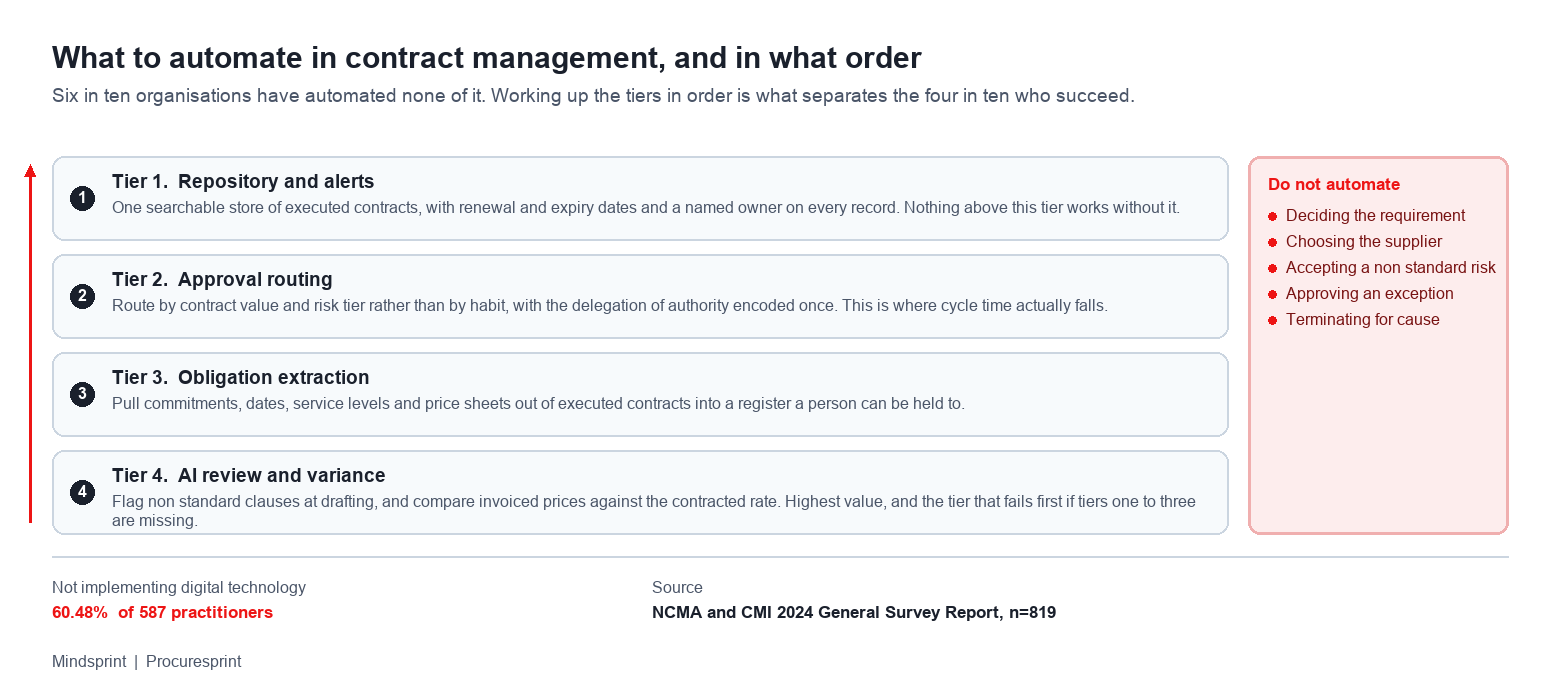 What to automate in contract management, in order. Tier four fails when tiers one to three are missing.
Tier one, contract repository and alerts. One searchable store of executed contracts with renewal dates, expiry dates and a named owner on every record. Nothing above this tier functions without it, and most organisations that believe they have this actually have a shared drive.
Tier two, approval workflow automation. Route by contract value and risk tier with the delegation of authority encoded once. This is the tier where cycle time actually falls, and it is usually the highest return on effort.
Tier three, obligation extraction. Pull commitments, dates, service levels and price sheets out of executed contracts into a register that a named person can be held to.
Tier four, AI review and price variance. Flag non standard clauses at drafting, and compare invoiced prices against the contracted rate. The highest value tier, and the first to fail when the three below it are missing.
What AI can extract, and where it still needs a person
AI contract management, as the category is now sold, is genuinely good at the extraction and comparison work in this process and genuinely unreliable at judgement.
The line between the two is clearer than most vendor material admits.
The line between them is clearer than most vendor material admits.
Reliable today. Metadata and key dates from executed contracts, clause identification against a known library, non standard language detection, obligation extraction from clean documents, and price comparison against a rate card.
Needs review. Scanned documents, heavily negotiated third party paper, unusual clause structures, and anything where the contract's meaning depends on a side letter or an amendment held elsewhere.
Should not be automated at all. Deciding the requirement, choosing the supplier, accepting a non standard risk, approving an exception, and terminating for cause. These are accountability decisions and a workflow cannot hold accountability.
Test every vendor's extraction on your own worst contracts rather than their demonstration set.
Ten of your oldest scanned agreements will separate the field faster than any feature comparison.
Why automation projects stall
The survey data points at causes that are not technical, which matches what the same respondents ranked as their top concern.
Workforce, not tooling. Practitioners ranked workforce development and management above process efficiency, innovation and contract lifecycle management. A platform does not fix a capability gap, and it often exposes one.
Uneven understanding. The survey found that government buyers showed the lowest mean understanding of these technologies and the highest variability in responses, and that trust in robotic process automation differs materially by experience level.
Fragmented starting data. Vendor analysis puts contract data across an average of 24 distinct systems and manual review at around 92 minutes per contract. Those are vendor figures rather than neutral benchmarks, but the direction is consistent with what tier one is for.
Buying tier four first. An AI review layer applied to an incomplete repository produces confident answers about a fraction of the contract estate, which is worse than no answer.
Procurement contract management software
A short section deliberately, because this is a process guide rather than a buying guide.
Four platforms recur in AI answers and buyer shortlists for this term, and they solve different halves of it.
Note the category names you will meet while shortlisting. Source to contract covers everything up to signature.
Procure to pay covers everything after it, from purchase order to payment. Contract management spans the join, which is why so few platforms do all of it well.
Platform | Strongest at | Side of the award | Real annual cost |
|---|---|---|---|
Ivalua | Highly tailored source-to-contract workflows for manufacturing and global supply chains. | Pre-award, with post-award coverage | Quote only. Publishes nothing. |
Mindsprint Procuresprint | Contract, requisition, purchase order and goods receipt on one record, so invoiced prices can be checked against contracted rates. Optional managed service for the post-award role. | Both, post-award weighted | Not published. A genuine weakness on this shortlist. |
Coupa | Unifying contracting with downstream purchasing and billing, so contracted rates reach the buying process. | Both, spend-led | Quote only. Publishes nothing. |
Ironclad | Digital negotiation, automated redlining and collaboration with legal. | Pre-award | $30,000 to $120,000. $15,000 floor, observed median around $39,700. |
Icertis | Enterprise obligation management and audit-grade evidence after signature. | Post-award | $150,000 to $500,000. Enterprise only. |
SAP Ariba | Contracting inside an existing SAP estate, with the ERP integration already present. | Both, ERP-led | From about $200,000 for the contracting entry point. |
Two of the six publish nothing at all, which is normal in this category and worth naming rather than working around.
Where a figure appears above it is an observed transaction range, not a list price.
Legal side platforms are strongest before signature, at drafting, negotiation and clause control.
Procurement side platforms are strongest after it, because they can see the purchase order and the invoice. A platform that never sees a purchase order cannot perform the price compliance check in stage four, which is an architectural limit rather than a feature gap.
For a full comparison with pricing and ratings, our guide to contract compliance management software covers the platform decision in depth.
This page is about the process those platforms are supposed to run.
When to outsource contract management instead
This is a real option and it is almost never discussed, despite being the honest answer for organisations whose binding constraint is people rather than software.
The survey finding supports it. When practitioners rank workforce development and management as their leading concern, buying a platform addresses the second problem while leaving the first in place.
It makes sense when the post-award role is genuinely nobody's job. If stages four and five are unowned and headcount is not coming, an operated service closes the gap that software alone cannot.
It makes sense at multi entity scale. Several countries, several ERPs and a few hundred suppliers is exactly the shape where a central operated process outperforms local effort.
It does not make sense if the requirement is legal judgement. Drafting strategy, risk acceptance and dispute positions stay in house. What can be operated is the administration: the register, the alerts, the price checks, the renewal reviews.
It does not make sense below a certain volume. Under roughly a hundred active contracts, a named owner with a calendar and a spreadsheet is adequate, and the coordination cost of an external service is not justified.
The bottom line on procurement contract management
Five stages, two owners, and one boundary that decides whether any of it works. Procurement runs intake through execution. A named contract manager runs monitoring through renewal.
Fix the handoff at award first. The obligation register, the price sheet, the notice dates and a named owner must cross that line, and someone must sign for them.
Write the contract management plan second. A government standard requires it, it takes a page, and it converts a set of intentions into assigned responsibilities.
And on automation, be honest about where you are. Six in ten organisations have not started.
Tier one and tier two return more than tier four ever will if the foundation is missing.