What is an e-invoicing system?
An e-invoicing system handles the creation, exchange and processing of invoices in a structured, machine-readable format, not paper or a PDF. Instead of someone reading a PDF and typing the numbers in, the invoice arrives as data, usually XML, that the buyer's system validates and posts automatically. Invoices become data, not documents.
The format is what makes the difference. A PDF or scanned image is only a picture of an invoice. A true e-invoice is the invoice itself, written as data both sides can read. A tax authority can check it instantly; AP processes it with no manual entry. In practice, an e-invoicing system:
Creates structured invoices from your ERP or accounting data in a standard format such as UBL, Peppol BIS or Factur-X.
Validates them against tax rules, business rules and, where relevant, the buyer's purchase order.
Transmits them over a network such as Peppol or through a government tax portal.
Receives and stores compliant invoices, feeding them into accounts payable and the audit trail.
E-invoice vs PDF, EDI and paper: what actually counts
The word e-invoice gets used loosely, so it helps to be precise about what qualifies.
Paper or posted invoice. Manual, slow, no structured data. Not an e-invoice.
PDF or scanned image, even emailed. A digital document, but still unstructured, so a human or OCR has to read it. Not a true e-invoice.
EDI (Electronic Data Interchange). Genuinely structured, system-to-system data. A real, if older, form of e-invoicing, common in large supply chains but often bilateral and costly to set up.
Structured e-invoice (UBL, Peppol BIS, Factur-X). Machine-readable data on an open standard, validated and exchanged over a network or tax portal. This is what modern mandates require.
The practical test: if a person still has to read the invoice to get its data into your system, it is not a true e-invoice.
How an e-invoicing system works, step by step
Three things make an e-invoicing system work, and every step below builds on them:
Structured data. The invoice is created in a machine-readable format such as XML, UBL or Peppol, so computers read it directly instead of a person opening a PDF.
System integration. The system connects straight to your ERP and accounting software, so invoice data flows in and out without re-keying.
Automated validation. It checks tax rules, purchase orders and the line-item maths before the invoice is sent, so errors are caught early.
With that foundation in place, a compliant invoice flows through four core stages, plus a fifth wherever a government sits in the middle of the transaction:
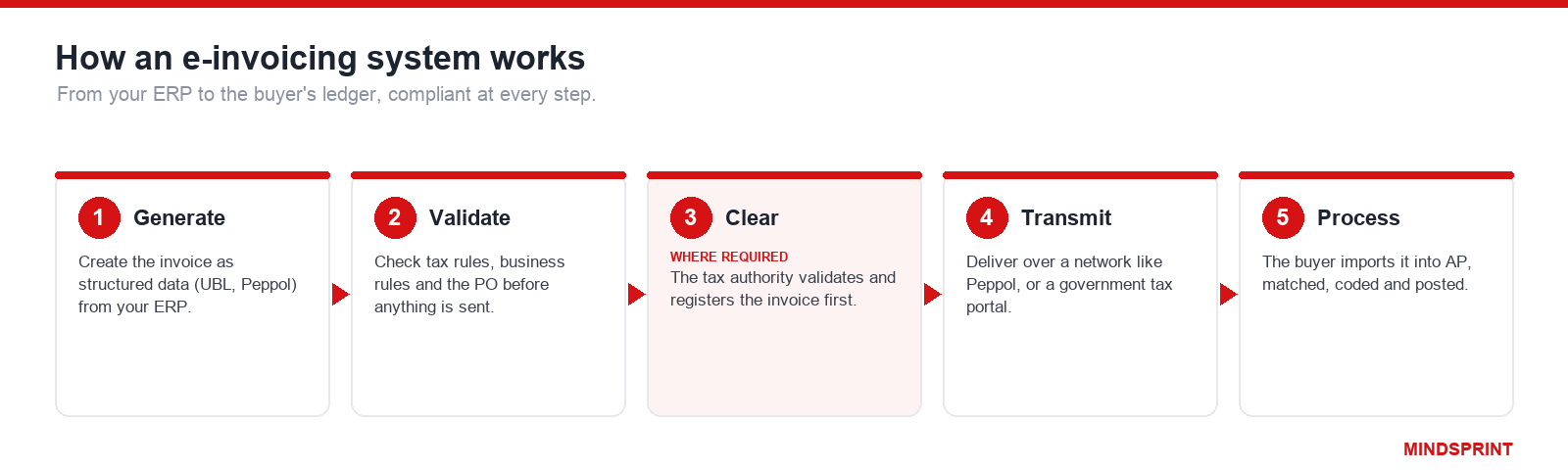
Generation. The system pulls the invoice data from your ERP or accounting software (customer, line items, tax, terms) and produces it in the required structured format.
Validation. Before anything is sent, the invoice is checked against internal business rules and the relevant tax authority's requirements, so errors are caught before they become rejections.
Clearance, where required. In clearance countries a tax authority must validate and register the invoice before it can be sent. India returns an Invoice Reference Number (IRN) and QR code, Saudi Arabia registers it on the Fatoora platform, and Mexico clears CFDI through SAT.
Transmission. The e-invoice is delivered to the buyer through a network access point (Peppol, DBNAlliance) or a government platform, in a structured format, securely.
Processing. On the buyer's side the invoice is imported straight into accounts payable, matched, coded and posted without re-keying.
The formats and standards behind e-invoicing
E-invoicing works only because the sender and receiver agree on a structure. A few standards dominate. You will see these names on every mandate page, so it helps to recognise what each one is for, even if you never touch the detail.
EN 16931. The European rulebook for what an e-invoice must contain. Most EU mandates require it.
UBL. The most common XML format for e-invoices, and the one the Peppol network runs on.
Peppol BIS. The exact format for sending invoices across the Peppol network, built on UBL and EN 16931.
CII. An alternative XML format to UBL, used inside some hybrid formats.
Factur-X and ZUGFeRD. Hybrid formats in France and Germany that tuck the structured data inside a normal-looking PDF, so people and machines can both read it.
XML and JSON. E-invoices are almost always XML. Some tools let you send JSON that is converted to a valid format behind the scenes.
Which format you need depends on where you invoice: Factur-X in France, XRechnung in Germany, FatturaPA in Italy, FA_VAT on Poland's KSeF, CFDI in Mexico, NF-e in Brazil, ZATCA's UBL in Saudi Arabia, and IRN-stamped JSON in India. France and Germany's hybrids hide the XML inside a readable PDF.
The takeaway for a multi-country business: you will not standardise on one format. You need a system that can produce and read several, mapped to each jurisdiction.
The three regulatory models: post-audit, clearance and network
Governments enforce e-invoicing in three broad ways. Knowing which model a country uses tells you how far the tax authority sits inside your invoice flow, and where your risk lives.
Model | How it works | Where you see it | Main risk |
|---|---|---|---|
Post-audit | Businesses issue invoices freely and report periodically; the tax authority audits after the fact | Traditionally most of the EU | Exposure sits in your records and periodic reporting |
Clearance (CTC) | The tax authority validates and clears each invoice in real time before it can be sent | India, Saudi Arabia, Mexico, Brazil, Italy (via SDI) | Real-time dependence on government platform uptime |
Decentralised network | Accredited access points exchange invoices over a network (four or five-corner model) and report near real time | Belgium, Nordics, the EU direction, US DBNAlliance | Interoperability and master-data quality across providers |
The world is moving toward what is called continuous transaction controls, where the tax authority sees each invoice as it happens, either by clearing it centrally or through a Peppol-style network. The older post-audit approach, where you simply report later, is fading.
The 2026 global e-invoicing mandate landscape
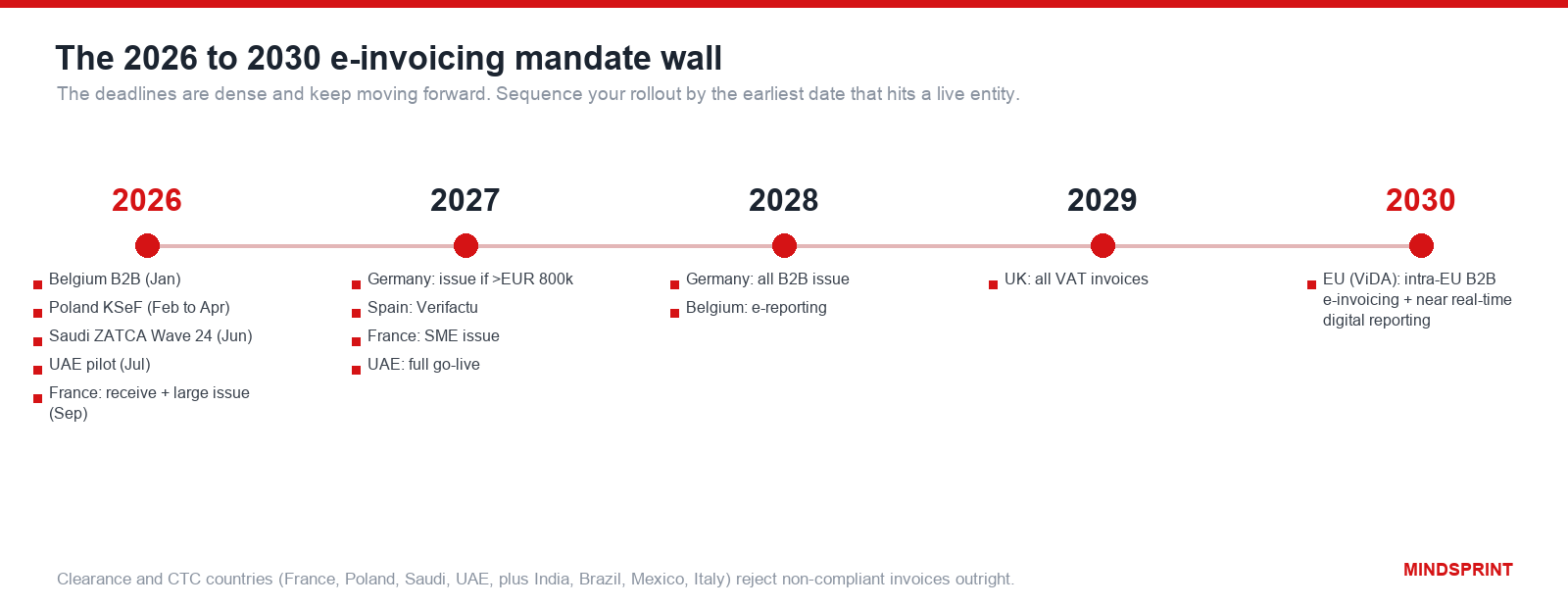
2026 is the year e-invoicing stops being optional in much of the world. Here is where the major mandates stand, and why a multi-country business cannot treat this as a single project.
Region / country | Model and network | Status in 2026 |
|---|---|---|
European Union (ViDA) | Decentralised, EN 16931 | VAT in the Digital Age adopted March 2025; digital reporting from 2028, structured e-invoicing for intra-EU B2B from 2030 |
Belgium | Peppol, UBL | Mandatory B2B from 1 January 2026, all businesses at once |
France | PDP platforms; Factur-X, UBL, CII | Receiving for all and issuing for large and mid-size from September 2026; SMEs issue from September 2027 |
Poland | KSeF | Phased from February 2026 (large taxpayers) to April 2026 (all) |
Germany | EN 16931 | B2B receiving capability required from January 2026; issuing phased after |
Italy | SDI (clearance) | Long-established mandatory clearance model |
Saudi Arabia | ZATCA / Fatoora (clearance) | Phase 2 integration by turnover waves; Wave 24 reaches SAR 375,000 taxpayers by 30 June 2026 |
India | GST IRP (clearance) | Mandatory for businesses above INR 5 crore turnover; IRP returns an IRN and QR code |
Mexico | CFDI via SAT (clearance) | Mandatory since 2014, one of the most mature regimes |
Brazil | NF-e / NFS-e (clearance) | Pre-clearance for goods and services |
United States | DBNAlliance (voluntary network) | No federal B2B mandate as of 2026; a voluntary Peppol-style exchange network, with electronic invoicing used in federal procurement |
Two things stand out. First, no two regimes are identical, in model, format or timing. Second, the deadlines keep moving. A compliance approach built for one country in one year will not hold across a group.
ViDA: the EU's shift to real-time reporting
The single biggest change for anyone trading in Europe is ViDA, the VAT in the Digital Age package, adopted in March 2025 and in force since April 2025.
Its first effect is already visible: member states can now mandate domestic e-invoicing without a special EU derogation, which is why France, Germany, Belgium, Poland and Spain are all moving at once.
The milestone to plan for is July 2030. From then, structured e-invoicing on the EN 16931 standard is mandatory for intra-EU B2B, with digital reporting: invoices issued within 10 days and reported to the tax authority at issuance, not in a periodic return. The EC Sales List is abolished.
By January 2035, countries that already run their own systems, such as Italy, must harmonise with the EU standard. The direction is unmistakable, from post-audit, where the authority sees invoices only later, to near real-time reporting as they are issued.
The cost of getting it wrong: rejected invoices and lost VAT
The fines are not the scary part. In clearance and continuous-controls countries, an invoice the tax authority has not validated legally does not exist, so it cannot be paid or claimed for VAT. Your tax error becomes your customer's cash-flow problem.
Italy is the clearest case: an invoice that fails validation on the SdI platform counts as never issued, with a penalty of 70 percent of the VAT. In India, an invoice without a valid IRN and QR code is not valid, and the buyer cannot claim input tax credit.
The fines add up. Romania charges 15 percent of the invoice value to both seller and buyer for trading outside its system. France moves to 50 euros per missing e-invoice from September 2026. In Germany, a non-compliant invoice can cost the buyer their input-VAT deduction until it is corrected.
The pattern is the same everywhere: in a clearance country, a rejected invoice is not a late filing, it is an invoice you cannot get paid on. That is why these entities belong on the operations risk register, not only the tax one.
E-invoicing vs AP automation: how they fit together
This is the distinction most guides blur, and it matters for what you actually buy.
E-invoicing handles the compliant exchange. It makes sure the invoice is in the right structured format, cleared where required, and delivered over the right network. Its job is compliance and interoperability.
AP automation handles what happens next. Once the invoice arrives it captures, validates, matches to the purchase order, codes, routes for approval and posts to the ERP. Its job is touchless processing and control.
You need both. A compliant e-invoice still keyed in by hand wastes the compliance you paid for; a slick AP tool fed non-compliant invoices fails an audit. In a mature setup the e-invoicing layer feeds clean, compliant invoices straight into AP automation, and no one re-keys anything.
In practice, three-way matching, approval workflows, real-time dashboards and days-payable analytics all live in the AP automation layer. The e-invoicing system makes the invoice compliant; AP automation does the rest.
The benefits of an e-invoicing system
Faster payments and better cash flow. Structured invoices skip manual entry and approval delays, shortening the cycle from receipt to payment.
Fewer errors. Removing manual keying removes the mistakes that cause exceptions, disputes and rework.
Real-time tax compliance. Invoices meet each jurisdiction's mandate as they are issued, not scrambled together at audit time.
Lower processing cost. Independent studies put a paper invoice at about 17.60 euros to process, a semi-automated e-invoice at about 6.40 euros, and a fully integrated one near 1 euro, a saving of 60 to 80 percent (Billentis).
Reduced fraud. Government registration and structured data make fake or altered invoices far harder to pass.
Cleaner data and visibility. Structured invoice data feeds analytics on days payable outstanding, cash forecasting and spend by entity.
The hard part: what multi-country e-invoicing really demands
For a single business in a single country, e-invoicing is a project. For a multi-entity, multi-country enterprise it is a moving compliance program, and that is a different problem.
The difficulty is not any single mandate, it is that they multiply. Each country you operate in adds its own:
Regulatory model: post-audit, clearance or real-time reportingTechnical format: Factur-X, FatturaPA, CFDI and more
Network or portal: Peppol, Italy's SdI, Poland's KSeF
Turnover threshold and go-live date, both of which keep moving
So what looks like one e-invoicing project is really a dozen, and the targets keep shifting: France's mandate alone has slipped more than once.
In clearance countries the stakes are sharper than being late. If the tax authority has not cleared an invoice, it is not slow, it is invalid, and your customer can refuse to pay until it is fixed. A formatting slip does not just risk a fine, it stops cash.
Having run AP across dozens of countries ourselves, this is the part we felt most. Any one country's rules are learnable; the real work is governance, standardising how every entity operates while each jurisdiction pulls toward a local exception. At scale, e-invoicing is an operating discipline, not a software purchase.
Build it, buy point solutions, or connect to one network
That multiplication forces an architecture choice, and each option carries a real cost.
Build in-house. Full control, but you must track every mandate worldwide and re-engineer for each format change. Realistic only for the largest firms with a dedicated indirect-tax engineering team.
Point solutions, country by country. Fast local compliance, but a fragmented estate: dozens of integrations, inconsistent archives, and no single audit view.
One connected network or provider. A single ERP integration reaching every required network and format. Demand a provider that tracks mandates with its own legal team, owns its stack rather than subcontracting coverage, and sits on the standards bodies.
The honest middle ground is centralised orchestration with local clearance connectors. A clearance country forces a government-platform stamp you cannot centralise away, so you standardise everything you can and connect locally only where the state demands it.
Archiving: the obligation that outlasts the invoice
Sending a compliant invoice is only half the duty. Every jurisdiction also tells you how to keep it, and for how long, and that obligation outlasts the invoice, the ERP that made it, and often the vendor you bought the system from.
Four requirements recur everywhere, from the EU VAT Directive and mirrored globally: authenticity of origin, integrity of content, legibility, and quick access on audit. Integrity is proven with a digital signature and a tamper-evident trail, and the structured original must be kept unaltered, not a PDF of it.
Retention periods differ: about ten years in France, Italy and Belgium, eight in Germany, six in the UK, and up to thirty for some property deals. Data residency matters too, since some countries require the archive to sit in-country or in the EU. Design a jurisdiction-aware archive from day one.
What an e-invoicing system costs
There is no single sticker price, because e-invoicing is priced in layers. Knowing the layers is what lets you compare quotes and avoid the surprise line items that show up once you go multi-country.
Per-document or per-transaction: a few cents to a euro per invoice sent or received, the largest variable at high volume
Per-connection or network fee: a charge for each country platform or Peppol access point you plug into
Platform subscription: an annual license for the software layer, tiered by volume and modules
Implementation and per-country onboarding: one-off setup for each new jurisdiction, format and integration
The economics still favour going digital. Billentis puts a paper invoice near 17.60 euros fully loaded, a semi-automated e-invoice around 6.40, and a fully integrated one close to 1 euro, a 60 to 80 percent saving once volume is real. The trap is the hidden layer: a cheap per-document rate can be swamped by per-country onboarding, format-update fees and long-term archiving, so compare the fully loaded cost across every country you invoice in, not the headline rate.
What to look for in an e-invoicing system
Multi-format, multi-jurisdiction coverage. Can it produce and read UBL, Peppol BIS, Factur-X and the local formats for every country you operate in?
Both models. Does it handle clearance countries such as India, Saudi Arabia and Mexico as well as network countries such as Belgium and the US?
ERP-agnostic integration. Does it connect to your ERP, or ERPs, without a rip-and-replace?
Compliance that keeps up. Who maintains the mandate changes, and how quickly do updates ship?
A clean handoff to AP automation. Do compliant invoices flow straight into processing, or land in another inbox?
Audit trail and archiving. Structured, tamper-evident storage that satisfies each jurisdiction's retention rules.
Master data control. Can it flag duplicate vendors and catch changed bank details, the most common route for invoice fraud?
When you are ready to compare specific platforms, see our guide to e-invoicing software.
E-invoicing readiness checklist
Before you buy anything, walk this checklist. It turns a moving compliance problem into a plan you can sequence, budget and hand to an owner.
Map your footprint. List every country where you issue or receive invoices, with the model, format, network and threshold for each. This one map turns a vague “we need e-invoicing” into a costed, sequenced program, and it usually surfaces two or three countries nobody had flagged.
Check each threshold, then re-check it. Thresholds keep dropping: Saudi Arabia's ZATCA and India's GST have both lowered theirs in waves, so an entity that is exempt this year can be in scope the next. Treat scope as an annual review, not a one-time tick.
Pressure-test your ERP. Confirm it can produce each required format and connect to the right network or portal, and do it per system if you run more than one ERP. The gap almost always hides in the smallest, oldest system, not the flagship one.
Choose your exchange, country by country. Decide where you connect through a compliance network, a government portal or a service provider. There is rarely one answer for the whole group, and a mix is normal, not a failure.
Wire it into AP. Make sure a compliant invoice flows straight into accounts payable, not into a shared inbox that someone re-keys. Compliance you do not process automatically is compliance you have paid for twice.
Give change an owner. Mandates move constantly, so name a person or team to track the updates and give them budgeted time each year to adapt, before a deadline forces a scramble.
Test end to end before go-live. Run real sample invoices all the way through: generate, clear, deliver and reconcile against the buyer's copy. In a clearance country a failed test is far cheaper than a rejected invoice that stops a customer paying you.
Where an agentic AP layer fits alongside e-invoicing
E-invoicing compliance networks such as Basware, Pagero and Sovos specialise in the exchange and clearance layer. Where Mindsprint SprintAP fits is the layer immediately after: turning compliant, structured invoices into touchless accounts payable.
SprintAP is an agentic AP platform, built by a team that ran multi-country AP for two decades. It takes in structured e-invoices and ordinary documents alike, then validates, codes, matches and posts them to your ERP, with full controls and an audit trail. Being ERP-agnostic, it sits on top of what you already run.
To be clear on scope: SprintAP is not itself a global e-invoicing clearance network, so for the compliance exchange in complex jurisdictions you pair it with a specialist. What it does is ensure that once an invoice is compliant, it is processed straight through, so the compliance you paid for converts into faster AP.