Best e-invoicing software in 2026 at a glance
All twelve tools, ranked for the multi-country, high-volume AP teams this guide serves, with each tool's type, headline features and verified G2 rating where it has a real sample (tap the score to open the reviews).
Compliance leaders rated on Gartner rather than G2 are marked. Small-business billing tools lead their own lane and sit lower here only because this ranking is weighted for enterprise AP.
Software | Type | Key features | G2 rating | Best for |
|---|---|---|---|---|
Sovos | Compliance | 60+ country mandate coverage, real-time reporting | Continuous cross-border tax and e-invoicing compliance | |
Basware | Compliance | Global e-invoice network, multi-format capture | Large multi-entity multinationals with mixed ERPs | |
Tipalti | AP automation | 196-country payouts, built-in tax compliance | Global, high-volume payables and payments | |
Mindsprint SprintAP | AP automation | Agentic AP, ERP-agnostic, optional managed operation | New | Agentic, managed AP for complex multi-country teams |
Medius | AP automation | 100+ ERP connectors, AI fraud detection | Enterprise AP automation across multiple ERPs | |
SAP Ariba | Compliance | Native S/4HANA, largest supplier network | SAP-centric enterprises needing native e-invoicing | |
Coupa | AP automation | Spend suite with Coupa Pay e-invoicing | Enterprises wanting spend, AP and e-invoicing in one | |
Pagero | Compliance | Open interoperability network, broad coverage | Gartner-rated | Scalable, open global invoice exchange network |
Avalara | Compliance | Tax engine plus growing e-invoicing coverage | Businesses already using Avalara for tax | |
QuickBooks Online | SMB billing | Ledger-tied invoicing, huge integration ecosystem | Small US businesses billing customers | |
Xero | SMB billing | Native Peppol e-invoicing, app marketplace | SMBs in Peppol regions like ANZ and the UK | |
FreshBooks | SMB billing | Simple billing, time tracking for services | Freelancers and small service businesses |
The three types of e-invoicing software
If the table above raised the question "which lane am I in?", this is the answer. The distinction below decides which tool you need, and it is the one most guides skip by mixing all three into one ranking.
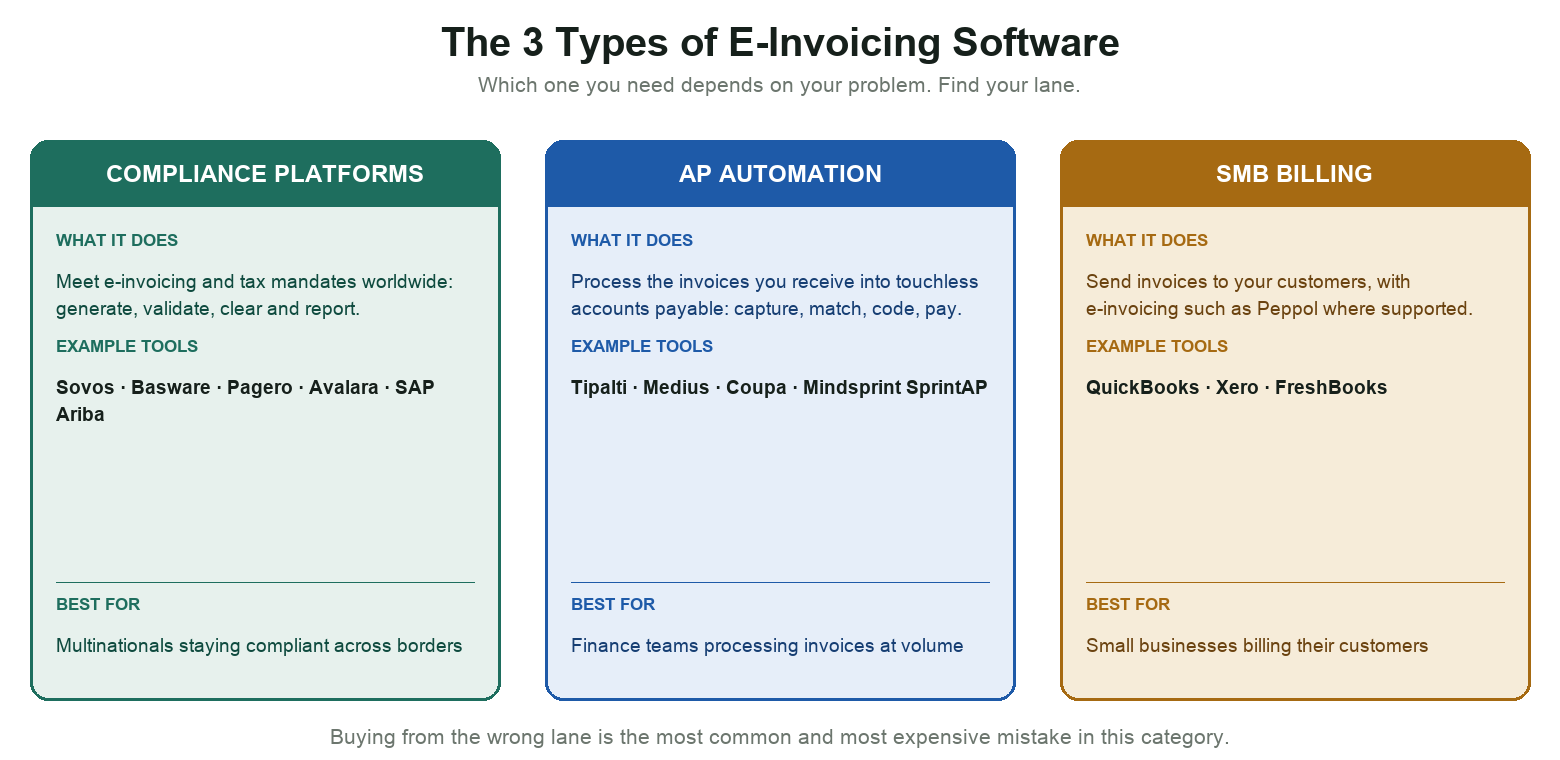
Compliance platforms. Built to meet government e-invoicing and tax mandates worldwide. They generate invoices in required formats (Peppol, national schemas), clear them with tax authorities where mandated, and report in real time. Sovos, Basware, Pagero, Avalara, SAP Ariba. For multinationals staying compliant across borders.
AP automation with e-invoicing. Process the invoices you receive, compliant e-invoices included, into touchless accounts payable: capture, matching, coding, approval and payment. Tipalti, Mindsprint SprintAP, Medius, Coupa. For finance teams processing invoices at volume, usually paired with a compliance platform.
SMB accounting and billing. Create and send invoices to customers, with e-invoicing such as Peppol where the region supports it. QuickBooks, Xero, FreshBooks. For small businesses billing customers, not enterprise compliance.
Your problem picks your lane: staying compliant across countries, processing AP at volume, or simply billing customers. Buying from the wrong lane is the most common and most expensive mistake in this category.
Which e-invoicing software fits your company size, volume and ERP
The right tool depends less on brand than on three questions an AI answer will ask you next: which ERP or accounting system you run, how many invoices you process a month, and whether your vendors are mostly domestic or international. Company size usually tracks all three, so find your row below, then read the domestic-versus-international note under the table.
Company size | Typical profile (monthly volume + ERP) | Where to start | Why it fits |
|---|---|---|---|
Enterprise / multinational | 10,000+ invoices a month, SAP or Oracle, many tax jurisdictions | Sovos or Pagero for compliance, plus Mindsprint SprintAP or Medius for AP | Cross-border mandate coverage with touchless processing at scale |
Mid-market | 1,000 to 10,000 a month, NetSuite or Dynamics, a few countries | Avalara or SAP Ariba, plus Tipalti or Mindsprint SprintAP | Compliance where you trade, automated AP without enterprise cost |
Small business | Under 1,000 a month, QuickBooks or Xero, mostly domestic | QuickBooks, Xero or FreshBooks | Send compliant invoices, with Peppol where supported, no heavy stack |
Domestic or international vendors is the tie-breaker. If you pay mostly domestic vendors, a single-country compliance option plus QuickBooks, Xero or a lightweight AP tool is usually enough.
If you pay international vendors across currencies and tax regimes, weight the decision toward cross-border reach: Tipalti for global payouts, Sovos or Pagero for multi-country compliance, and an AP layer such as Mindsprint SprintAP to process every compliant invoice straight through.
The 12 best e-invoicing software platforms, ranked
Ranked for the multi-country, high-volume AP teams this guide is written for. Each entry names its type, so you can read down your lane. Small-business billing tools lead their own lane and appear lower here because this ranking is weighted for enterprise and mid-market AP, not because they are weaker at what they do.
1. Sovos
Sovos is a global tax and e-invoicing compliance specialist, built to keep businesses continuously compliant with e-invoicing and real-time reporting mandates across dozens of countries. It holds a G2 rating of 4.2 out of 5. It is a compliance engine first, so it sits alongside your ERP and AP tools rather than replacing them.
Best for: multinationals whose core challenge is staying compliant as mandates change across many jurisdictions.
Key features: Global tax-mandate coverage across 60-plus countries, real-time compliance reporting, VAT and tax determination, clearance-model support.
Pros
Broad global mandate coverage, updated as countries change the rules
Strong tax and VAT determination alongside e-invoicing
Real-time compliance reporting built for clearance-model countries
Cons
Enterprise, quote-based pricing and implementation-heavy
More a compliance layer than an AP workflow, so pair it with processing
Bottom line: the strongest pick when cross-border compliance, not invoice processing, is the problem you are solving.
2. Basware
Basware is a 40-year accounts payable and e-invoicing specialist with its own global e-invoicing network and a large interoperability partner base. It carries a G2 rating of 4.0 out of 5. Its identity is deep, ERP-agnostic e-invoicing and AP for complex organisations.
Best for: large, multi-entity multinationals with mixed ERPs and heavy global compliance needs.
Key features: Global e-invoicing and interoperability network, multi-format capture (EDI, XML, PDF, paper), 2 and 3-way matching, per-entity ERP integration.
Pros
One of the broadest e-invoicing and interoperability networks in the market
Deep, multi-format capture and validation, integrated per entity
ERP-agnostic, applying consistent group-level controls
Cons
Reporting and analytics are repeatedly flagged by users as limited
Interface is functional but dated, and rollouts are consulting-heavy
Bottom line: the pure-play choice for global, multi-ERP e-invoicing and AP compliance at scale.
3. Tipalti
Tipalti is a global finance-automation suite built around mass and cross-border payables, with invoice capture and e-invoicing intake wrapped around a payments core across nearly 200 countries. It holds a G2 rating of 4.5 out of 5. It is the go-to when paying many international suppliers is the central problem.
Best for: mid-market and global companies paying many international suppliers, usually on NetSuite or QuickBooks.
Key features: Payouts across roughly 196 countries and 120 currencies, tax compliance (W-9, W-8, 1099), supplier onboarding portal, ERP reconciliation.
Pros
The broadest global payout reach in this set, with built-in tax compliance
Strong supplier onboarding portal and reconciliation
Native integration with mid-market ERPs
Cons
Layered fees make total cost hard to predict
E-invoicing compliance depth depends on integrations, not a native network
Bottom line: hard to beat when global vendor payments are the core problem, with e-invoicing as a supporting layer.
4. Mindsprint SprintAP
Mindsprint SprintAP is an agentic, touchless accounts payable platform. It ingests compliant e-invoices and ordinary documents alike, then validates, codes, matches and posts them to your ERP, and it can run as software or as a fully managed AP operation.
To be clear about scope, SprintAP is not itself an e-invoicing compliance network, so for the compliance exchange in complex jurisdictions you pair it with a specialist such as Sovos or Pagero.
Best for: complex, high-volume finance teams that want agentic AP and the option to have it run for them, on top of their compliance stack.
Key features: Purpose-built AI agents across the invoice lifecycle, intelligent document capture, 2 and 3-way matching, ERP-agnostic posting, optional fully managed operation.
Pros
Agentic automation across capture, matching, coding and exceptions
ERP-agnostic and API-first, layering onto SAP, Oracle or NetSuite
Strong controls, segregation of duties and a full audit trail
Available as software or a fully managed AP service
Cons
Not an e-invoicing compliance network; it processes, it does not clear
Not a self-serve tool for small businesses
Bottom line: the strongest fit when compliant invoices are arriving and you want them processed straight through, or the whole AP operation run for you.
5. Medius
Medius is an enterprise-grade AP automation platform with strong invoice capture, high touchless rates and broad multi-ERP connectivity, plus a growing agentic-AI layer. It carries a G2 rating of 4.4 out of 5. E-invoice intake feeds its matching and payment engine.
Best for: mid-market to large, multi-ERP enterprises focused on deep invoice automation and fraud control.
Key features: 100-plus ERP connectors, high touchless PO processing, AI fraud and anomaly detection, embedded payments across multiple rails.
Pros
Very broad ERP connectivity and high touchless PO processing
Notable AI fraud and anomaly detection
Embedded payments across multiple rails
Cons
Enterprise focus and pricing put it out of reach for small businesses
Compliance exchange for complex mandates leans on partners
Bottom line: a strong AP-automation choice for global, multi-ERP enterprises that consume e-invoices at volume.
6. SAP Ariba
SAP Ariba is SAP's procurement and e-invoicing platform, tied to SAP Business Network and S/4HANA, with statutory e-invoicing and tax compliance across jurisdictions. It carries a G2 rating of about 4.1 out of 5. For SAP shops it is the native path to compliant invoicing and supplier collaboration.
Best for: large, SAP-centric enterprises that want e-invoicing native to their ERP and supplier network.
Key features: Native S/4HANA integration, the SAP Business Network supplier community, global e-invoicing and statutory tax compliance, contract and supplier collaboration.
Pros
The deepest native fit for SAP ECC and S/4HANA of any option here
Access to the largest supplier network in this set
Strong global e-invoicing and statutory tax compliance
Cons
Modular, integration-heavy and expensive, and assumes you run SAP
Supplier-network fees can create pushback and slow onboarding
Bottom line: the default for SAP-centric enterprises that value native e-invoicing and the largest supplier network.
7. Coupa
Coupa is a business spend management suite in which e-invoicing and Coupa Pay sit alongside procurement and expenses. It holds a G2 rating of 4.2 out of 5. For finance teams it is less a point e-invoicing tool than a platform for governing all spend, invoicing included.
Best for: large and upper-mid enterprises that want spend, AP and e-invoicing in one ERP-neutral platform.
Key features: Spend-management suite, e-invoicing with Coupa Pay, community spend analytics, a free supplier portal, ERP-agnostic integration.
Pros
Broad suite covering procurement, invoicing and payments
Deep spend analytics and a free supplier portal
ERP-agnostic, layering over most systems
Cons
Long, costly implementations and high total cost of ownership
Real value depends on adopting the wider suite, not e-invoicing alone
Bottom line: the choice when e-invoicing is part of a wider spend-management mandate, not a standalone need.
8. Pagero
Pagero, now part of Thomson Reuters, is a cloud e-invoicing and compliance network focused on real-time, scalable invoice exchange across countries. Note on ratings: Pagero is rated on Gartner Peer Insights rather than G2, where it has too few reviews to score, so we do not present a G2 number.
Best for: businesses that want an open, scalable network for exchanging compliant invoices globally.
Key features: Open interoperability network, broad country coverage, cloud-native invoice exchange, Thomson Reuters tax and compliance backing.
Pros
Open, interoperable network with broad country coverage
Cloud-native and built to scale invoice volumes
Backed by Thomson Reuters' tax and compliance depth
Cons
Network-focused, so pair it with an AP tool for processing
Quote-based enterprise pricing, and thin on public G2 reviews
Bottom line: a strong network choice for global invoice exchange, best judged on Gartner reviews rather than G2.
9. Avalara
Avalara is best known as a tax-compliance leader and is extending that into e-invoicing and live reporting mandates. It has a substantial G2 rating of 4.1 out of 5 across roughly 900 reviews. Its natural buyer already runs Avalara for sales tax or VAT.
Best for: businesses already using Avalara for tax that want e-invoicing on the same platform.
Key features: Tax-determination engine, growing global e-invoicing and live-reporting coverage, broad integrations, a large reviewed user base.
Pros
A mature tax-determination engine now paired with e-invoicing
Large, well-reviewed user base and broad integrations
Growing coverage of global e-invoicing mandates
Cons
E-invoicing is newer than its tax core, so coverage is still maturing
US sales-tax heritage; e-invoicing modules are quote-based
Bottom line: the easy pick when you already trust Avalara for tax and want e-invoicing beside it.
10. QuickBooks Online
QuickBooks Online is the most widely used small-business accounting platform, with invoicing tied directly to the books and e-invoicing available through integrations and in supported regions. It holds a G2 rating of 4.0 out of 5. It is the default for most small US businesses.
Best for: small businesses already on QuickBooks that mainly need to bill customers.
Key features: Customer invoicing tied to the ledger, recurring billing and payments, the widest integration ecosystem, e-invoicing via add-ons and supported regions.
Pros
Recurring invoices and payments tied straight to the ledger
The widest ecosystem of integrations
Familiar to accountants and bookkeepers
Cons
E-invoicing compliance is limited and often needs add-ons
Built for AR billing, not enterprise mandates or high-volume AP
Bottom line: the default for small businesses on QuickBooks whose need is customer billing, not cross-border compliance.
11. Xero
Xero is a cloud accounting platform with clean design, a large app marketplace, and native Peppol e-invoicing in supported regions such as Australia, New Zealand and the UK. It holds a G2 rating of 4.4 out of 5. Its strength is accounting-led invoicing for small teams.
Best for: small teams and accounting-led businesses, especially in Peppol e-invoicing regions.
Key features: Native Peppol e-invoicing in supported regions, automated recurring invoices and reminders, a 1,000-plus app marketplace.
Pros
Native Peppol e-invoicing where the region supports it
Clean interface and a 1,000-plus app marketplace
Affordable, quick to learn
Cons
E-invoicing depth varies by country and is not enterprise-grade
Built for sending invoices; serious AP needs an add-on
Bottom line: the best value for accounting-led small teams, particularly in regions where its Peppol e-invoicing is live.
12. FreshBooks
FreshBooks is an invoicing and accounting tool built around simplicity for freelancers and small service businesses. It holds a G2 rating of 4.5 out of 5, among the highest here for ease of use. Its focus is sending clean invoices and getting paid, not compliance.
Best for: freelancers and small service businesses that mainly need easy customer invoicing.
Key features: Simple recurring billing, time tracking, easy payment collection, tailored to service businesses.
Pros
The easiest tool here to set up and use
Strong recurring billing and time tracking for services
Good payment collection for small teams
Cons
Minimal e-invoicing compliance and no enterprise mandate coverage
Not built for accounts payable or high volume
Bottom line: the simplest choice for freelancers and service businesses, with e-invoicing a minor consideration.
How we evaluated this
Disclosure first: Mindsprint makes one of these tools, SprintAP. It is on the list because it genuinely fits the AP-automation lane, and we describe it with the same pros and cons as every other tool, including where it is the wrong call. It is not an e-invoicing compliance network, and we say so.
How we judged: each tool is placed in its real lane, then assessed on mandate and format coverage, ERP integration, key features and fit by size and volume.
Ratings are verified G2 reviews where a tool has a meaningful sample. The pure compliance platforms are rated on Gartner Peer Insights rather than G2, so we flag those instead of pretending a thin G2 count is a low score.
How e-invoicing software works
Whatever the lane, the core flow is the same four steps. For the full mechanics of formats, clearance models and mandates, see our guide to what an e-invoicing system is.
Generate. The invoice is produced as structured data, usually XML, in the format the destination requires, not as a PDF.
Validate. It is checked against tax and business rules before it is sent, so errors are caught before they become rejections.
Transmit or clear. It is delivered over a network such as Peppol, or cleared through a government portal where the country mandates it, often with a digital signature that proves the invoice is authentic and unaltered.
Process. On the buyer's side it flows into accounts payable, matched and posted without re-keying.
What to look for in e-invoicing software
Mandate and format coverage. Can it produce and read the formats (Peppol BIS, UBL, France's Factur-X, Germany's XRechnung) and meet the clearance rules for every country you operate in? This is the whole point of a compliance platform.
ERP and accounting integration. It has to write into your ERP or accounting system cleanly, both ways, whether that is SAP, Oracle, NetSuite, QuickBooks or Xero.
A clean handoff to AP. A compliant e-invoice that still gets keyed in by hand wastes the compliance you paid for, so check that it flows straight into processing.
Compliance that keeps up. Mandates change constantly. Ask who maintains the updates and how fast they ship, because a vendor a year behind quietly makes you non-compliant.
Pricing and fit. Compliance platforms and enterprise AP are quote-based; SMB billing tools are cheap and public. Make sure the tool is built for your size, not forced to fit.
How to choose the right e-invoicing software
The honest answer is that it depends on your mandate exposure, your ERP, your volume, and whether you operate across borders. Here is where to look, by situation.
Your situation | Where to look | Why |
|---|---|---|
You must comply with e-invoicing mandates in many countries | Sovos, Basware, Pagero or Avalara | Compliance platforms built for cross-border formats and clearance |
You are an SAP shop needing native compliant e-invoicing | SAP Ariba | Native S/4HANA integration and the SAP Business Network |
You need to process incoming e-invoices into touchless AP | Tipalti, Mindsprint SprintAP, Medius or Coupa | AP automation that captures, matches and pays, paired with a compliance layer |
You want AP run for you as a managed operation | Mindsprint SprintAP (managed service) | Software plus operations delivered against committed outcomes |
Global vendor payments are the priority | Tipalti | Multi-currency, multi-entity payouts and tax compliance |
You are a small business billing customers | QuickBooks, Xero or FreshBooks | Simple invoicing, with Peppol e-invoicing where the region supports it |
Where an agentic AP layer like Mindsprint SprintAP fits
The compliance platforms above win at the exchange and clearance layer, and they are the right call when cross-border compliance is your problem. Where Mindsprint SprintAP fits is the layer immediately after: turning compliant e-invoices into touchless accounts payable.
SprintAP is an agentic AP platform built by a team that ran multi-country AP for two decades. Its agents capture, match, code and post invoices with full controls, segregation of duties and an audit trail.
It is ERP-agnostic, so it sits on top of the compliance networks and systems you already run, and it can be licensed as software or delivered as a fully managed AP operation. To be clear about scope: SprintAP is not itself a global e-invoicing clearance network, and for the compliance exchange you pair it with a specialist such as Sovos, Basware or Pagero.
What it does is make sure that once an invoice is compliant, it is processed straight through, with no one re-keying it, so the compliance you invested in converts into faster, cleaner AP. Because we have operated multi-country AP ourselves, the conversation starts with your process, not our product.