The short answer, by situation
If this is you | Choose | Why, in one line |
|---|---|---|
You run SAP S/4HANA and buy mostly direct materials | SAP Ariba | Native integration and BOM-level supplier collaboration you would pay to replace |
You run several ERPs after acquisitions | Coupa | One spend layer across disparate backends is what it was built to be |
Your suppliers will resist paying to invoice you | Coupa | Coupa charges suppliers nothing; Ariba charges 0.155% to 0.35% above a threshold |
Your problem is that nobody in the business uses the system | Either, and re-test | Coupa's adoption lead is real but Ariba's February 2026 rebuild targets exactly this |
You buy mostly indirect, services and travel | Coupa | Built for indirect, and unifies purchasing, expenses and contingent labour |
You already hold a large SAP enterprise agreement | Price both, then decide | SAP can bundle Ariba aggressively enough to change the commercial answer |
Procurement is stretched and cannot run another platform | Neither, see the third option | Both are licence-and-operate; capacity is a different problem |
If you take one thing from this page. The decision is settled by your ERP estate and your supplier base, not by feature comparison, because on features these two platforms have converged much further than either sales team will tell you.
What changed in February 2026, and why it resets this comparison
SAP did not release an update. It rebuilt the product on a different technology foundation, and the change is recent enough that most published comparisons predate it.
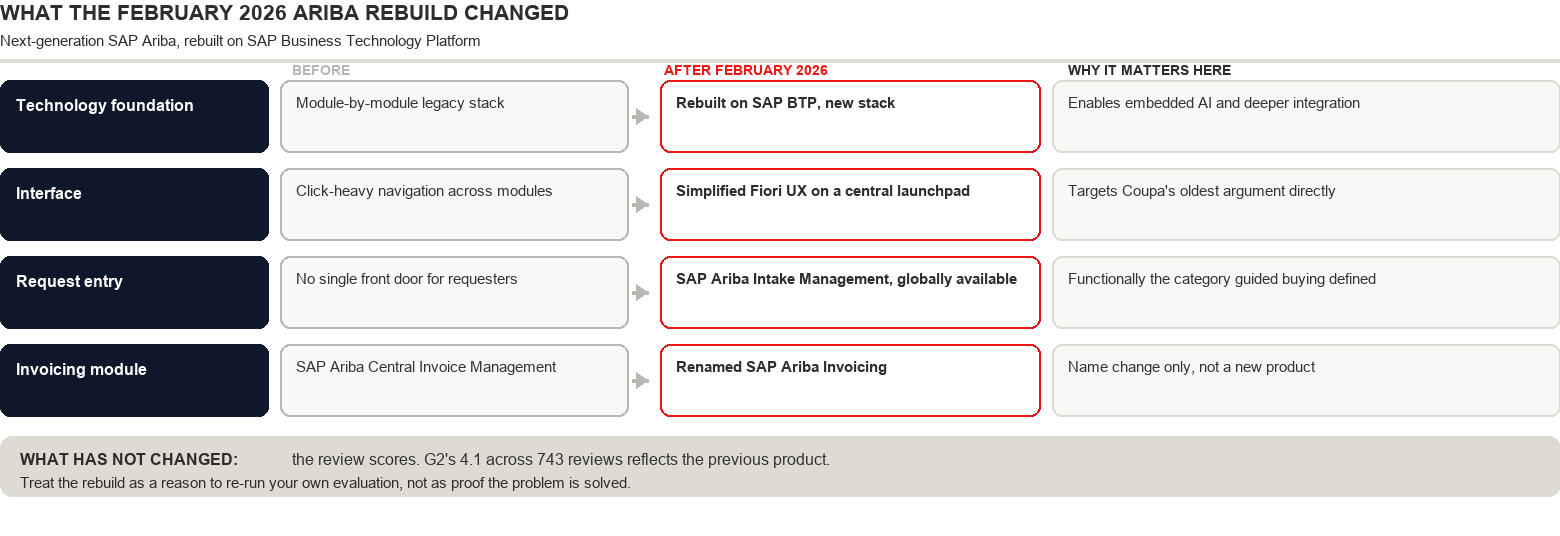 Figure 1. What the February 2026 rebuild changed, and which long-standing Coupa arguments it targets.
The foundation. Next-generation SAP Ariba is rebuilt on SAP Business Technology Platform with a new technology stack, which is what makes deeper integrations and embedded AI possible rather than bolted on.
The interface. A simplified Fiori-based experience delivered through a central launchpad, replacing the module-by-module navigation that generated most of the usability complaints in the review data.
The front door. SAP Ariba Intake Management is now globally available, giving requesters a single entry point for procurement requests. This is functionally the category Coupa's guided buying defined.
One rename to get right. From February 2026, SAP Ariba Central Invoice Management became SAP Ariba Invoicing. The platform is still called SAP Ariba and has not been renamed SAP Procurement.
What this does not change is the review data. G2's 4.1 across 743 reviews reflects years of experience with the previous product, and it will take time for post-rebuild sentiment to show up in the score.
So treat the rebuild as a reason to re-run your own evaluation rather than as proof the problem is solved. Ask for a demonstration on the new launchpad, not a recorded one from 2024.
Coupa vs SAP Ariba: the full comparison
Eleven dimensions, with a verdict on each and a note on what the verdict rests on. Where the honest answer is that neither wins, the table says so.
Dimension | Coupa | SAP Ariba | Verdict | Confidence |
|---|---|---|---|---|
SAP ERP integration | Certified connectors, integration layer to maintain | Native to S/4HANA master data and ledger | Ariba | Verified |
Multi-ERP estates | ERP-agnostic, one spend layer over many backends | Requires middleware and custom mapping | Coupa | Verified |
Direct materials | Improved via LLamasoft, less native at multi-tier | BOM routing, multi-tier collaboration, built for it | Ariba | Reported |
Indirect spend and expenses | Built for it; purchasing, travel, expenses, contingent labour | Functionally complete, historically cost by adoption | Coupa | Verified |
No joining or transaction fees, per Coupa's own docs | 0.155% to 0.35% above threshold, capped $20K per relationship | Coupa | Verified, both vendors | |
Supplier network size | 10M buyers and suppliers, $9.5tn cumulative | 4.5M companies, $6.5tn annually | Not comparable | Both claim largest |
Consumer-grade UI, guided buying, strongest adoption record | Fiori launchpad and Intake Management shipped Feb 2026 | Coupa, narrowing | Contested since Feb 2026 | |
Sourcing and contracts | Stronger on downstream contract price compliance | Stronger on complex direct-materials events | Close | Reported |
Analytics and benchmarking | Community benchmarking across $9.5tn of network spend | Structured reporting on the same model as SAP finance | Coupa | Verified |
Coupa Navi agents: Analytics, Operational Reporting, Knowledge | SAP Joule, reasoning across the wider SAP estate | Too close to call | Both shipped 2026 releases | |
Invoicing | AI three-way match across any ERP, plus Coupa Pay | Automated GL posting natively; now SAP Ariba Invoicing | Depends on your GL | Verified |
Implementation | 3-6 months P2P only; 9-18 months full suite | G2 average 6 months; 12-18 months full enterprise | Neither, scope decides | Contested claim corrected |
2025 Gartner MQ Leader, highest Ability to Execute | 2025 Gartner MQ Leader | Level | Verified | |
4.2 across 561 reviews | 4.1 across 743 reviews | Statistically level | Verified |
How to read the confidence column. Verified means both vendors publish it or an independent source confirms it. Reported means it comes from secondary research. Contested means the market repeats a claim the evidence does not support.
Where the two platforms have genuinely converged. Sourcing, contracts, invoicing and analytics are all close enough now that a feature-led evaluation will not separate them, which is why the scenario table matters more than the grid.
1. ERP fit: the dimension that usually decides it
This is the first question to answer because it removes one platform for a large share of readers before any feature is discussed.
If you run SAP ECC or S/4HANA. Ariba is native. Master data, ledger accounts and material management integrate out of the box, and you get a single-vendor roadmap with one support relationship.
Coupa's counter in SAP estates, and it is a real one. Pre-built certified connectors, chosen by SAP shops that want better adoption and cleaner data than they were getting from Ariba, accepting an integration layer as the price.
If you run Oracle, NetSuite or Dynamics. Coupa is the straightforward answer. It is ERP-agnostic by design with certified integrations, while connecting Ariba requires middleware and custom mapping you then maintain.
If you run several ERPs after acquisitions. Coupa wins clearly. It sits as one spend layer over disparate backends and aggregates everything into a single view, which is the hardest thing to retrofit into Ariba.
The question that settles it in a demonstration. Ask both vendors which objects sync bi-directionally, specifically vendor master, purchase order, goods receipt and invoice, and which are read-only.
Ask also who pays when your ERP is upgraded. On a native integration the answer is usually nobody. On a connector it is usually you.
2. Direct versus indirect spend: the split neither vendor volunteers
Both platforms handle both categories. They were built for different ones, and that origin still shows in the depth.
Ariba on direct materials. Built for it, with bill of materials routing, multi-tier supplier collaboration, inventory forecasting and quality tracking. For a manufacturer buying raw materials and components, this is the stronger platform.
Coupa on direct materials. Genuinely improved, largely through acquiring LLamasoft for supply chain design, but less native for highly complex multi-tier manufacturing supply chains than Ariba.
Coupa on indirect spend. Built for it and clearly ahead. Purchasing, corporate travel, employee expenses and contingent labour unify in one platform, which is why it dominates services and technology businesses.
Ariba on indirect spend. Functionally complete, but historically the interface cost it adoption, and low adoption on indirect spend is exactly how maverick buying happens. The 2026 rebuild targets this.
The practical test. Work out what share of your addressable spend is direct materials. Above roughly half, Ariba's depth is worth the trade. Below a third, Coupa's adoption advantage compounds faster.
3. Supplier economics: the one difference that has not narrowed
This is the most durable distinction between the two platforms, and both vendors publish the terms, so you can verify every figure yourself.
Who pays for the supplier network | Coupa | SAP Ariba |
|---|---|---|
Cost for a supplier to join | Free. No fee to join the Coupa Open Business Network | Free below five documents and the volume threshold |
Cost for a supplier to transact | No transaction fees through Coupa | 0.155% of transacted volume, per buyer relationship |
Services-related documents | No differential charge | 0.35% where service entry sheets are involved |
Annual ceiling | Not applicable | Capped at $20,000 per year, per buyer relationship |
Billing basis | Not applicable | Billed quarterly on prior-quarter transacted volume |
Who onboards suppliers | The buyer owns onboarding and adoption | The buyer onboards, and suppliers must also accept the fee |
What this does to onboarding | An administrative task | A commercial negotiation with each vendor above the threshold |
Coupa's own supplier documentation | SAP's own published supplier fee schedule |
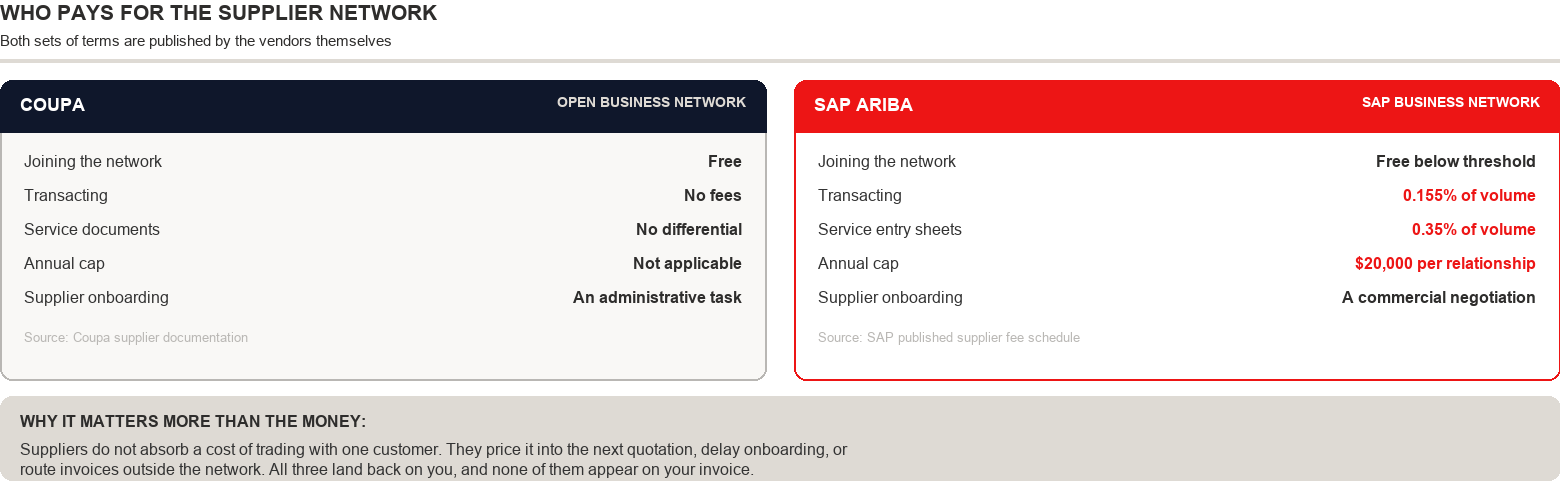 Figure 2. Who pays for the supplier network. Both sets of terms are published by the vendors themselves.
What Coupa publishes. The Coupa Supplier Portal is free for suppliers, and there are no fees to join the Coupa Open Business Network or for transactions processed through Coupa.
What SAP publishes. Suppliers transact free below five documents and a volume threshold. Above it, 0.155 per cent of transacted volume, or 0.35 per cent where service entry sheets are involved, billed quarterly and capped at $20,000 a year per buyer relationship.
Why the cap matters to your arithmetic. It protects your largest vendors, which means the total your supply base pays depends on how your spend is distributed rather than on how much of it there is.
The operational consequence, which matters more than the money. Onboarding a supplier to Coupa is an administrative task. Onboarding one to Ariba above the threshold is a commercial negotiation with a vendor who gains nothing from agreeing.
What suppliers do about it. They do not absorb a cost of trading with one customer. They price it into the next quotation, delay onboarding, or route invoices outside the network, and all three land back on you.
This is also why supplier enablement takes up so much of an Ariba implementation timeline. You are not configuring a system, you are persuading a vendor base.
One fair point in SAP's favour. If your suppliers are already onboarded and large enough to absorb the fee without repricing, this difference costs you nothing and the network depth is a genuine asset.
4. Network size: the comparison nobody can honestly make
Both vendors claim the largest network in the world. Both are right by their own measure, and neither measure lets you compare them.
Network claim | What the vendor actually says | Unit being counted |
|---|---|---|
Over 10 million buyers and suppliers, having conducted over $9.5 trillion of transactions | Participants including buyers. Spend is cumulative | |
A trading community of over 4.5 million companies, supporting more than $6.5 trillion in annual transactions | Companies. Spend is annual | |
Can these be compared? | No. Different units, and one spend figure is cumulative while the other is annual | Both vendors claim the largest network in the world |
What the captures claim | 10M+ suppliers via Coupa Pay against 6M+ via Ariba Network | WRONG on three counts. See the errors table |
The only question that settles it | How many of YOUR named suppliers already transact on each network | Ask both vendors to check your actual vendor list |
Why the numbers cannot be reconciled. SAP counts companies and reports annual transaction value. Coupa counts buyers and suppliers as participants and reports cumulative transaction value. Nothing in those two statements is comparable.
What you will see in other comparisons. A table showing 10 million against 6 million as though it were like for like. The 6 million figure does not match SAP's own published claim of 4.5 million companies.
The only question that settles it. Give both vendors your actual supplier list and ask how many are already transacting on their network today, with names.
Why that question is fair to ask. Network size only matters to you as onboarding effort avoided, and a network of ten million suppliers none of whom are yours saves you nothing at all.
5. Usability and adoption: Coupa's oldest advantage, now contested
For most of the last decade this was the clearest gap between the two, and it was the reason many SAP customers bought Coupa anyway.
Coupa's position, still strong. A consumer-grade interface that occasional requesters use without training, plus guided buying that steers them to contracted suppliers by default. Adoption is what turns a platform into usable spend data.
Ariba's historical problem, fairly stated. Click-heavy navigation across modules, a long learning curve, and reviewers describing invoices needing several attempts to enter. This is well documented across G2, Capterra and Software Advice.
What changed in February 2026. A Fiori-based interface on a central launchpad, and Intake Management as a single request entry point, which addresses the specific mechanics that generated the complaints.
What has not changed yet. The review scores. G2's 4.1 reflects the previous product, and post-rebuild sentiment will take time to appear, so you cannot use the score to judge the new interface either way.
How to actually test this, rather than trust either of us. Take three occasional requesters from your business, give them the same request to raise in both systems with no training, and time it.
That single exercise tells you more about your future adoption rate than any feature grid, and both vendors will agree to it if you insist.
6. Sourcing and contracts: closer than either sales team admits
This is the dimension where the two platforms have converged most, and where a feature-led evaluation will waste the most of your time.
Where Ariba is stronger. Complex direct-materials sourcing events and supplier collaboration through the network, particularly where you need multi-tier visibility during the event rather than after it.
Where Coupa is stronger. Contract compliance downstream, because contracted prices reach the buying catalogue and guided buying holds people to them, which is where negotiated savings usually leak.
What both now do competently. RFx events, e-auctions, punch-out to distributor catalogues, clause libraries, obligation tracking and AI contract term extraction. Neither is a reason to choose the other.
The question that separates them for your case. Ask each to run a multi-lot award on your own historical bid data with your real constraints, and compare what the optimiser produces.
7. Analytics and benchmarking: Coupa's clearest remaining edge
This is where Coupa has something structural that Ariba cannot replicate by rebuilding an interface, because it depends on aggregated data rather than software.
What Coupa has. Community benchmarking drawn from the aggregated spend of its customer base, reported at over $9.5 trillion cumulatively, surfacing price and terms comparisons a single organisation cannot see alone.
What Ariba has. Structured procurement reporting, risk dashboards and supplier scorecards, with the advantage that inside an SAP estate the analytics run on the same data model as your finance reporting.
The honest trade. Coupa tells you how your prices compare to other buyers. Ariba tells you how your spend reconciles to your ledger. Which is more valuable depends on whether your problem is negotiation or control.
One caution on benchmarking generally. Community data is anonymised and aggregated across industries, so treat it as directional evidence for a negotiation rather than as a target price.
8. AI agents: Coupa Navi against SAP Joule
Both vendors shipped significant AI releases through 2026, and the honest verdict here is that it is too close to call on published evidence.
Coupa's AI is Coupa Navi, not Compass. Navi is a family of agents including an Analytics Agent that Coupa reports accelerating spend analysis by up to 70 per cent, plus Operational Reporting and Knowledge agents.
Coupa's 2026 releases. Coupa Compose and Catalyst launched at Inspire 2026, and the September 2026 release added more than 250 updates across procurement, finance and supply chain, including autonomous payment, sourcing and supplier onboarding capability.
SAP's AI is Joule, the assistant that spans SAP's product estate. Its procurement advantage is context, because it can reason across the same data as your finance and supply chain systems rather than procurement alone.
What to discount entirely. Any comparison quoting precise classification accuracy figures such as 92 or 93 per cent for either platform. No source supports those numbers and they circulate without attribution.
How to evaluate AI claims from either vendor. Ask which agents are generally available today rather than announced, how many of their customers run each in production, and what happens when the agent is wrong.
9. Invoicing and accounts payable
Both platforms automate the transactional spine. The difference is where the invoice ends up and how much reconciliation you do afterwards.
Ariba's advantage inside SAP. Deep financial integration means automated general ledger posting without an interface, and from February 2026 the invoicing module is renamed SAP Ariba Invoicing following the Central Invoice Management rebrand.
Coupa's advantage everywhere else. AI-assisted three-way matching across whichever ERP you run, with exception routing rather than blocking, plus Coupa Pay as a separate payments product if you want the rail too.
What decides it. If your general ledger is SAP, Ariba removes a reconciliation step permanently. If it is anything else, Coupa removes an integration project.
What neither fixes on its own. Master data quality. Item, supplier and tax records that disagree between systems will generate exceptions faster than either matching engine clears them.
10. Implementation: scope decides this, not the vendor
This is the claim most comparison pages get wrong, including the ones ranking above this page today. The published evidence does not support a vendor-level difference.
Deployment scope | Coupa | SAP Ariba |
|---|---|---|
Procure-to-pay only, single ERP | 3 to 6 months | Rapid-deployment options exist for fixed, basic scope |
Typical reported deployment | 6 to 18 months | G2 reports an average of 6 months across all deployments |
Full source-to-pay suite | 9 to 18 months | 12 to 18 months for full enterprise rollouts |
What drives the difference | Scope, ERP count and data quality | Scope, plus supplier enablement onto the network |
The honest conclusion | Both run 9 to 18 months at full suite scope | Implementation time tracks scope, not vendor |
Where a real gap exists | Supplier onboarding is an administrative task | A share of the timeline is spent getting vendors registered and fee-accepting |
What the evidence shows. A Coupa procure-to-pay-only go-live runs 3 to 6 months. A full Coupa source-to-pay suite runs 9 to 18. Ariba's G2 average is 6 months, with full enterprise rollouts at 12 to 18.
Why the market believes otherwise. Comparisons routinely put a scoped Coupa P2P rollout next to a full Ariba S2P programme. Those are different projects, and the comparison is not valid.
Where a genuine difference does exist. Supplier enablement. On Ariba, a meaningful share of the timeline goes on getting your vendor base registered on the network, which the fee structure makes slower.
What to budget on either platform. Implementation at 50 to 150 per cent of the first-year subscription, plus half to one full-time equivalent of your own team through go-live.
The question to ask both vendors. What is the fixed price for my defined scope, what is explicitly excluded from it, and what does a workflow change cost after go-live.
11. Pricing: the anchor matters more than the number
Neither vendor publishes a rate card, so every figure below is a reported range rather than a quote. The structure of the pricing is the part you can actually act on.
What you are pricing | Coupa | SAP Ariba |
|---|---|---|
Published rate card | None | None |
Mid-market annual licence | $150,000 to $250,000 reported | $80,000 to $300,000 for core modules, reported |
Enterprise annual licence | $500,000 to $3M or more reported | $400,000 to $1.5M or more for a full suite, reported |
Pricing anchor | Spend under management, users and modules | Spend under management, users and modules |
Implementation | 50 to 150 per cent of year-one licence | 50 to 150 per cent of year-one licence |
Reported implementation at enterprise scale | $400,000 to $1.5M or more | Comparable, with supplier enablement a large share |
Multi-year discount | Three-year terms typically 15 to 25 per cent below annual | Negotiable, and bundlable into an SAP enterprise agreement |
Cost your suppliers carry | None | 0.155% to 0.35% above threshold, capped $20K per relationship |
Your own team | 0.5 to 1 FTE through go-live | 0.5 to 1 FTE through go-live, plus supplier enablement effort |
The anchor both share, and its consequence. Both price on spend under management alongside users and modules, which means the platform gets more expensive as it succeeds at bringing spend under management.
Why that is worth negotiating explicitly. Ask what happens if your spend under management grows 40 per cent, get the answer in the contract, and model year three rather than year one.
Where SAP has a commercial advantage. If you already hold an SAP enterprise agreement, SAP can bundle Ariba licences aggressively and beat Coupa on sticker price, independent of which product fits better.
The cost that sits outside both quotes. Implementation at 50 to 150 per cent of year one, plus your own team, plus in Ariba's case a fee your suppliers pay that returns to you through pricing.
One contradiction worth clearing up, because it circulates widely. Some comparisons state both platforms cost roughly $2 million a year while quoting mid-market figures ten times lower in the same article.
Both can be true at different scales, and neither is a useful planning number. Price your own modules, your own user count and your own spend under management, and treat every published range as a sanity check only.
Market share and who actually runs which
Readers search for market share on this comparison, so it is worth stating what can and cannot be established from public sources.
What is verifiable. Both are named Leaders in the 2025 Gartner Magic Quadrant for Source-to-Pay Suites, published March 2025 across twelve evaluated vendors, with Coupa positioned highest for Ability to Execute.
What the review volume suggests about installed base. Ariba carries 743 G2 reviews against Coupa's 561, which hints at a larger or longer-established base rather than a better product.
What cannot be established. A reliable revenue or seat-based market share split, because SAP does not report Ariba separately and Coupa has been privately held under Thoma Bravo since 2023.
What matters more than share anyway. Which of the two has more reference customers of your size, in your industry, who went live in the last eighteen months. Ask for names.
Where each platform wins, summarised
Dimension | Winner | Why, and how confident we are |
|---|---|---|
SAP ERP integration depth | SAP Ariba, clearly | Native to S/4HANA master data and ledger. Not disputed by anyone |
Multi-ERP and post-acquisition estates | Coupa, clearly | ERP-agnostic by design, acts as one spend layer over disparate backends |
Direct materials and multi-tier supply chain | SAP Ariba | Built for BOM routing and supplier collaboration. Coupa expanded here via LLamasoft |
Indirect spend and expenses | Coupa | Built for it, and unifies purchasing, travel, expenses and contingent labour |
Supplier economics | Coupa, decisively | Free for suppliers against Ariba's 0.155% to 0.35%. Both vendors' own terms |
Coupa, but narrowing | Ariba's Feb 2026 Fiori rebuild and Intake Management directly target this gap | |
Analytics and benchmarking | Coupa | Community benchmarking across $9.5tn of cumulative network spend has no equal |
AI agents | Too close to call | Coupa Navi agents against SAP Joule. Both shipped major 2026 releases |
Implementation speed | Neither | Tracks scope, not vendor. Both 9 to 18 months at full suite |
Independent review score | Statistically level | Coupa 4.2 on 561 reviews, Ariba 4.1 on 743. A 0.1 gap is not a differentiator |
Level | Both 2025 Gartner Magic Quadrant Leaders. Coupa highest for Ability to Execute | |
Running it for you | Neither | Both are licence-and-operate. This is where a managed model differs |
Read the confidence column before the verdict column. Two of the eleven dimensions are contested rather than settled, and one of those is the usability claim that most comparisons treat as decided.
Which one should you choose?
The decision comes down to a small number of scenarios, and in most of them one platform is clearly indicated.
Your situation | Coupa | SAP Ariba | Which to shortlist first |
|---|---|---|---|
SAP S/4HANA, direct materials above half of spend | Workable with a connector | Native and purpose-built | SAP Ariba |
SAP S/4HANA, mostly indirect spend, adoption is the problem | Strong fit | Re-test post-rebuild | Both, and run the requester test |
Multiple ERPs from acquisitions | Built for this | Heavy configuration and standardisation | Coupa |
Oracle, NetSuite or Dynamics estate | Certified integrations | Middleware and custom mapping | Coupa |
Large, fee-sensitive or fragmented supplier base | No supplier fees | Fees above threshold, onboarding friction | Coupa |
Supplier base already onboarded to SAP Business Network | You would re-onboard everyone | Zero onboarding cost, network depth retained | SAP Ariba |
Existing large SAP enterprise agreement | Compare on fit | Can be bundled aggressively on price | Price both before deciding |
Procurement team lacks capacity to operate a suite | Licence and operate | Licence and operate | Neither, consider a managed model |
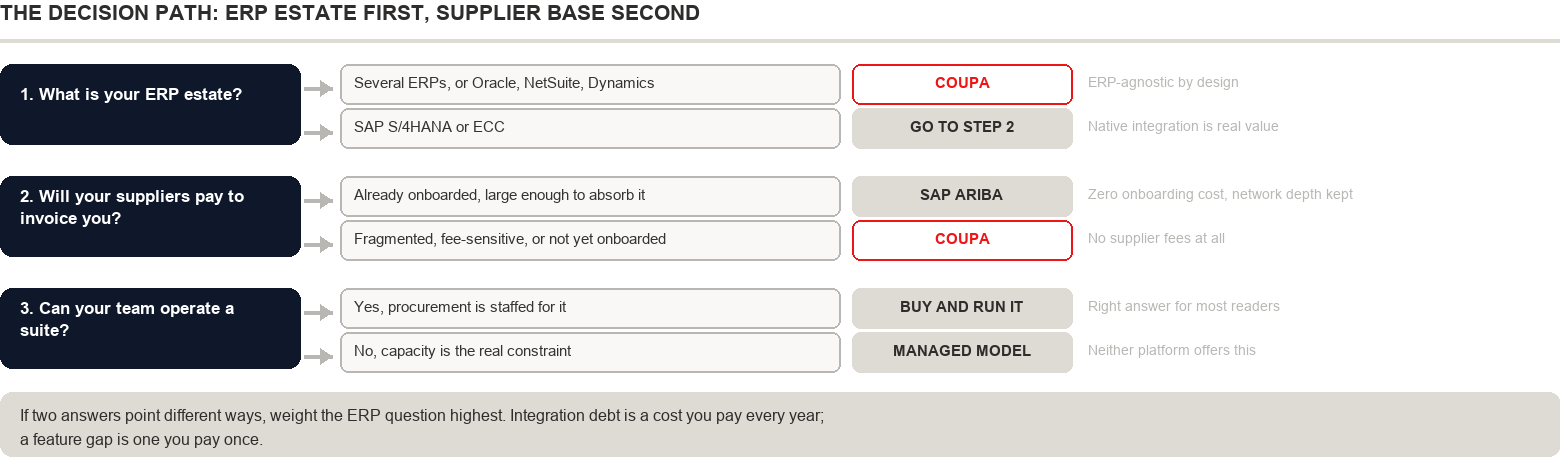 Figure 3. The decision path. ERP estate first, supplier base second, everything else after that.
The pattern across those rows. ERP estate and supplier base decide it. Feature depth almost never does, because the two platforms have converged too far for a feature grid to separate them.
If two rows apply and point different ways. Weight the ERP row highest, because integration debt is the cost you pay every year while a feature gap is one you pay once.
Beyond these two: where Coupa and Ariba sit in the wider market
Readers searching coupa ariba, ariba and coupa or coupa sap ariba as a bare pairing are often earlier in the process than they think, and a two-way comparison can narrow the field too soon.
If you have not yet ruled out the rest of the market. Ivalua, GEP SMART and Oracle Fusion Cloud Procurement are also 2025 Gartner Leaders, and an ivalua vs ariba vs coupa shortlist is a reasonable place to start.
If your sector is specialised. Jaggaer vs coupa is the comparison that matters in higher education, life sciences and public sector, where Jaggaer's vertical depth beats both platforms on this page.
If you are actually comparing expenses rather than procurement. Concur vs coupa is a different question entirely, because SAP Concur handles travel and expense while Ariba handles procurement, and the two get conflated constantly.
If you have already decided to leave SAP. Our SAP Ariba alternative guide covers ten platforms and the full ariba competitors landscape, including the migration sequence this page deliberately does not repeat.
The useful sequence is to run the wider ariba vs coupa comparison against a shortlist of four or five, then narrow to a head-to-head once your ERP and supplier answers are settled.
A third option, if neither answer fits
Some readers reach the end of a comparison like this and find that both answers are wrong for the same reason, so it is worth naming that case.
Both platforms are licence-and-operate. You buy the software and your team runs sourcing, onboarding, contracts and exceptions, which assumes you have the people to do it.
When that assumption breaks. Procurement is spread across entities, chronically stretched, and the honest constraint is capacity rather than capability. Another platform to administer makes that worse before it makes it better.
What Mindsprint Procuresprint does differently. It is a source-to-pay platform that Mindsprint will also operate for you against savings and cycle-time outcomes, rather than only licensing to you. Neither Coupa nor Ariba offers that.
The supplier point that applies here too. Procuresprint has no monetised supplier network, so like Coupa it charges your vendors nothing to transact with you.
What we cannot show you, stated plainly. No Gartner Magic Quadrant placement, no G2 profile, no published pricing, a far smaller supplier network than either platform on this page, and no public reference customers.
If you have the team and the ERP answer is clear, buy Coupa or Ariba and run it. That is genuinely the right advice for most readers of this page, and this section is not for them.
Where this comparison comes from
What we operate. Mindsprint runs procurement and supplier operations for a multi-entity global group with more than 3,000 suppliers digitally connected across several countries and tax regimes.
What that contributes here. The supplier enablement argument, the master data warning on invoice matching, and the observation that adoption rather than features decides whether a suite produces usable spend data.
How the facts were sourced. Supplier fee terms come from each vendor's own published documentation. The February 2026 rebuild comes from SAP's own newsroom and independent trade coverage. Analyst positioning comes from the 2025 Gartner Magic Quadrant.
What we removed during research. Classification accuracy figures of 92 to 93 per cent against 90 to 91 per cent, an auto-match rate of 92 per cent, and a supplier network comparison of 10 million against 6 million. None has a traceable source.
Our own position, declared. Mindsprint builds Procuresprint, which competes with both platforms on this page. It appears once, near the end, and is not included in any comparison table for that reason.
One limit worth stating. The February 2026 rebuild is recent enough that independent review data does not yet reflect it, so the usability verdict on this page is the least settled thing on it.
The bottom line on Coupa vs SAP Ariba
There is no winner, and a page claiming one is not reading its own evidence. Both are 2025 Gartner Leaders sitting a tenth of a point apart on G2.
Run S/4HANA with heavy direct materials and an already-onboarded supplier base, and Ariba is the answer. The native integration and the network depth are real advantages you would be paying to replace.
Run several ERPs, buy mostly indirect, or have a supplier base that will resist paying to invoice you, and Coupa is the answer. Multi-ERP consolidation and supplier economics are its two structural strengths.
Do not decide on usability alone in 2026. That gap was real, SAP has spent a rebuild closing it, and the honest position is that it has narrowed by an amount nobody can yet measure.
And test both on your own data. Three untrained requesters raising the same request in each system will tell you more than every comparison table ever published, including this one.