Platform | Best for | G2 rating | Real annual cost | Compliance type |
|---|---|---|---|---|
1. Icertis | Enterprise obligation compliance under audit | $150,000 - $500,000 | Obligation | |
2. Sirion | Supplier performance, service levels and credits | Quote only, enterprise band | Obligation | |
3. Mindsprint Procuresprint | Spend compliance across multiple entities | Not listed on G2 | Not published | Spend |
4. Agiloft | Configurable compliance workflow, regulated sectors | $40,000 - $110,000 | Obligation | |
5. DocuSign CLM | Audit ready evidence at signature scale | $40,000 - $100,000 | Obligation | |
6. LinkSquares | Obligation extraction from a legacy archive | $10,000 entry, $45,000 - $110,000 | Obligation | |
7. SpotDraft | Fast mid market compliance reporting | $20,000 - $100,000, median $25,278 | Obligation | |
8. Gatekeeper | Vendor and contract compliance, published pricing | $14,900 - $63,500 | Both, mid market |
Who buys contract compliance software, and the pain that drives it
Five roles buy in this category, and they are not buying the same thing. Find your row before you read the comparison, because the wrong platform for your role will look excellent in a demonstration.
Who buys it | The pain that drives it | What they need from the software |
|---|---|---|
General Counsel or legal operations lead | Cannot answer on demand which obligations across the portfolio are overdue. Renewals discovered after the notice window has closed. | Obligation extraction from executed contracts, owner assignment, and an audit trail that survives external review. |
Chief Procurement Officer | Negotiated savings that never reach the P&L. Buyers ordering off contract because the compliant route is slower than the workaround. | Contract prices loaded into the catalogue, and a price check between the purchase order and the contracted rate. |
CFO or financial controller | Signed off savings finance cannot see in the numbers, and no defensible answer when the auditor asks how contract compliance is monitored. | Realised savings against negotiated savings, a compliance rate per category, and evidence for the audit file. |
Contract manager | Tracking hundreds of obligations in a spreadsheet, chasing owners by email, and rebuilding the same report every quarter. | Automated alerting on milestones and renewals, one owner per obligation, and reporting that does not need rebuilding. |
Compliance or risk officer | Supplier insurance and certifications lapsing unnoticed, and no single place to prove contractual controls were operating. | Document expiry tracking, policy deviation flagging, and evidence linked to the clause it satisfies. |
A quick self qualifier. If your answer to who owns the missed obligation is nobody in particular, no platform on this list will fix that, and the routing further down matters more than the product comparison.
Contract compliance is a rate, not a status: measure yours before you buy
Almost every guide to this category skips the only number that matters. Contract compliance is measurable, and until you have measured it you cannot tell whether you have a software problem or a process problem.
The formula is simple. Contract compliance rate equals compliant spend divided by total addressable contracted spend, multiplied by one hundred.
Run it per category rather than across the whole business, because a single blended figure hides the categories that are leaking. Then compare the result against the published bands below.
Your contract compliance rate | What it means | What to do |
|---|---|---|
90% and above | The stated target. Controls are working. | Monitor and hold. Do not buy more software. |
80 to 90% | Best in class in practice. | Close specific category gaps. A mid market tool is enough. |
74.9% | World class benchmark (Ardent Partners, 2024). | This is the realistic ceiling, not 100%. |
59.5% | The average organisation (Ardent Partners, 2024). | Roughly 40% of negotiated value is unprotected. |
Below 80% | A systemic control gap, not an isolated failure. | Fix ownership and intake before selecting a platform. |
Below 70% | Control design problem. | Run a category level compliance programme. Software alone will not close this. |
That second figure is the most useful number in this article. World class is not 100 per cent. Any vendor promising total compliance is describing something no benchmarked organisation has achieved.
8.6 per cent. Average contract value erosion, per World Commerce and Contracting, rising to around 11 per cent in value leakage once a deal moves into delivery.
9.2 per cent. What the same association measured in 2014, the first time anyone put a number on it. Fifteen years of contract software has moved it very little.
3 against 20 per cent. The spread between best and worst performers. Every organisation in that range buys the same platforms from the same vendors at the same prices.
So the software is not the variable. The operating model is. The Hackett Group found in 2025 that world class teams recorded 60 per cent less savings leakage than their peers.
Those teams are distinguished by who owns each obligation and what happens when one is missed. Buy the software to make the control possible, not expecting the control to arrive with it.
The four numbers to measure, not just one
One rate tells you there is a problem. These four tell you where it is.
Contract compliance rate. Compliant spend against total contracted spend, calculated per category. This is the headline number, and the one to baseline before implementation begins.
Purchase order coverage. The share of spend that went through a purchase order at all. Spend with no purchase order cannot be checked against any contract, so this number caps how much compliance you can ever prove.
Price variance. What you paid against the contracted rate, line by line. This is where catalogue compliance failures stop being a process complaint and become money.
Realised savings against negotiated savings. The gap between what sourcing promised and what finance can see. Neutral benchmarking bodies such as APQC track the realised figure rather than the negotiated one, and so should you.
One practical consequence: capture your baseline rate before implementation begins. Almost nobody does, and it is the reason so few contract compliance projects can prove a return afterwards.
Obligation compliance versus spend compliance: the split that decides what you buy
This is the distinction that decides which half of the market you should be shopping in.
Obligation compliance asks a legal question. Did each party do what the agreement says? Service levels met, milestones delivered, insurance certificates current, reporting submitted, notice periods observed. Owned by legal, evidenced in the contract document.
Spend compliance asks a procurement question. Did we buy what we agreed, from the supplier we agreed, at the price we agreed? Owned by procurement and finance, evidenced in the requisition, purchase order, goods receipt and invoice, where three way matching happens.
That difference is architectural, not semantic. A platform that never sees a purchase order cannot tell you that a buyer ordered off contract, or that an invoice was paid at list price when a negotiated rate existed.
One leak sits outside that chain entirely. An auto renewal or evergreen clause that nobody diarised renews the contract on the supplier's terms, often at an uplift, and the notice window to stop it has usually closed before anyone notices.
Renewal and expiry alerting is the cheapest control in this category, and the one most often left switched off.
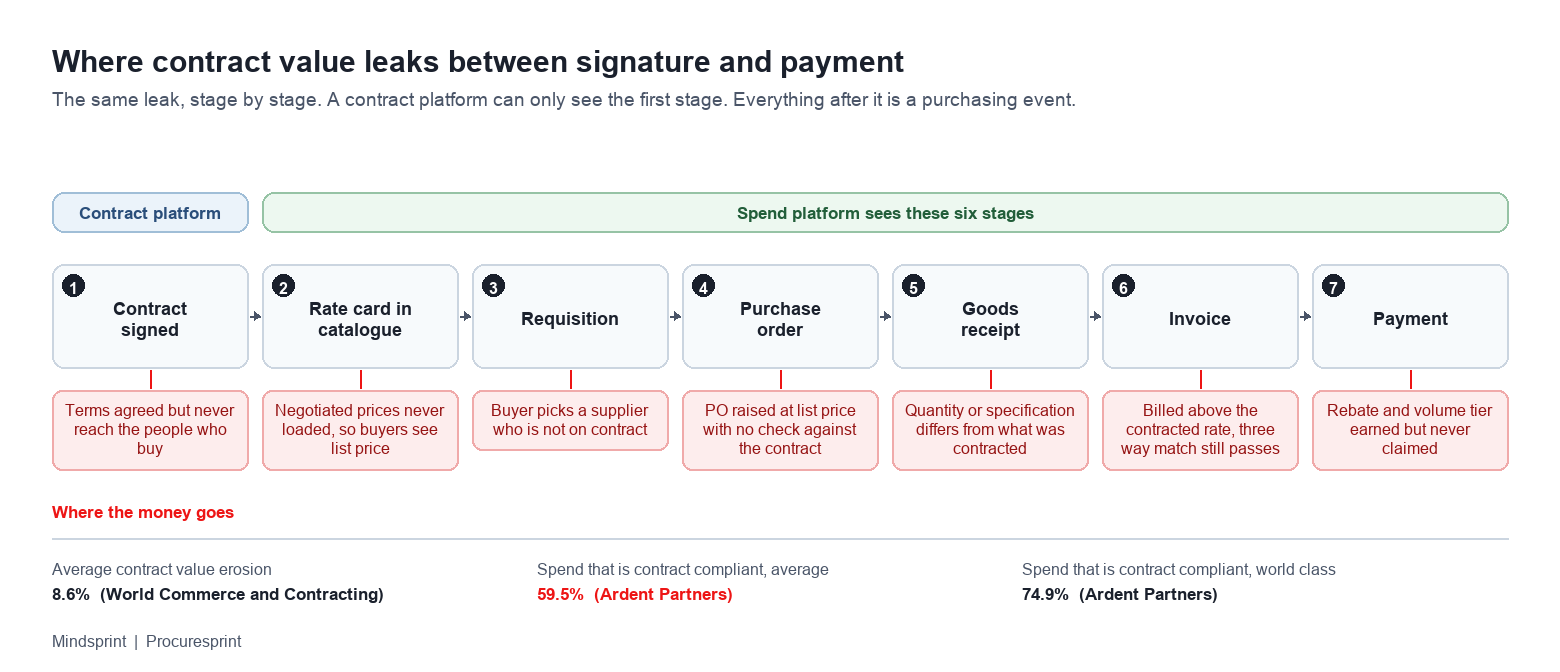 Where contract value leaks between signature and payment. A contract platform sees stage one. The remaining six stages are purchasing events.
Dimension | Obligation compliance | Spend compliance |
|---|---|---|
The question it answers | Did the counterparty do what the contract says? | Did we buy at the price and from the supplier we agreed? |
Who owns it | Legal and contract operations | Procurement and finance |
Where the evidence lives | The contract document and its obligation record | The requisition, purchase order, goods receipt and invoice |
What failure looks like | Missed service levels, lapsed insurance, unclaimed credits | Off contract buying, list price paid, rebates never captured |
How you measure it | Obligations met against obligations due | Compliant spend against total contracted spend |
Software that does it | Icertis, Sirion, Agiloft, DocuSign CLM, LinkSquares, SpotDraft | Procuresprint, Zycus, SAP Ariba, Coupa, Ivalua |
The structural limit | Cannot see the purchase order, so cannot verify price paid | Lighter on clause drafting, negotiation and legal risk analysis |
30 per cent. Typical maverick spend, meaning off contract buying, where controls are weak. Best in class teams hold it just under 10 per cent.
10 to 50 per cent. The share of negotiated savings commonly forfeited on a category when buyers go outside approved contracts. It is why spend under management is the first metric finance asks about.
Neither type is more important. But a legal team buying a CLM to fix price leakage, or a procurement team expecting a spend control to manage insurance certificates, will both conclude the software failed. It did not. It answered the other question.
If both problems are real, and in most enterprises they are, you will run two systems with a defined handoff or accept depth in one and adequacy in the other.
Contract, contractor, regulatory or spend: which compliance software you need
Four unrelated software markets rank on this search term. Before comparing products, confirm you are in the right market. The routing below takes about thirty seconds and saves a wasted evaluation cycle.
What you are trying to control | The category you need | Representative tools |
|---|---|---|
Whether contract obligations were met, with audit evidence | Contract lifecycle management | Icertis, Sirion, Agiloft, DocuSign CLM, LinkSquares |
Whether purchases match contracted prices and suppliers | Procurement and spend compliance | Procuresprint, Zycus, SAP Ariba, Coupa |
Whether contractors and site workers hold valid credentials | Contractor and workforce compliance | Avetta, ISNetworld, contractorcompliance.io |
Whether the enterprise complies with regulation and policy | Governance, risk and compliance | LogicGate, ncontracts, Quickbase |
Whether employment contracts meet local labour law | Employment and global hiring compliance | Deel, Rippling |
One more boundary. United States federal contractors usually need DCAA compliant accounting, which governs how costs are recorded and audited under government contracts. No platform below satisfies that alone.
How we evaluated these platforms
This comparison was built by a team that has run procurement and contract operations inside a multi entity global group, across more than 3,000 suppliers and several countries, rather than by scoring feature checklists. Three things shaped it.
What we evaluated against: whether the platform answers the obligation question, the spend question or both; the depth of its obligation model rather than the presence of alerts; analyst placement in Gartner and Forrester; and what buyers transact at, not list price.
What we fact checked: every benchmark comes from a neutral body, Ardent Partners, the Hackett Group or World Commerce and Contracting, never from vendor marketing. Vendor sourced figures are labelled. Pricing comes from observed transactions and published tiers.
What we deliberately excluded: contractor and workforce compliance platforms, governance and risk platforms, and employment contract tools. All three rank on this keyword and none manages commercial contract compliance.
Two limits on this analysis, stated plainly. Review ratings are point in time and move each quarter, so treat them as a signal of user sentiment rather than a score.
And Mindsprint, which publishes this guide, makes one of the eight platforms below.
It sits at number three because two competitors are stronger on obligation compliance, and its weaknesses are listed in the same detail as everyone else's.
The 8 best contract compliance management software platforms
Ranked by the compliance problem each one solves best, not by size. Every entry states what it costs, what it does badly, and who should not buy it.
1. Icertis: the reference standard for enterprise obligation compliance
Icertis is the platform other vendors are measured against when the requirement is proving, to an auditor or a regulator, that a contractual obligation was met.
It is a Leader in the Gartner Magic Quadrant for Contract Life Cycle Management, and a Leader in the 2025 Forrester Wave for contract lifecycle management platforms.
Its differentiator is the depth of the obligation model. It converts clauses into structured obligations with a named owner, a due condition and an evidence record, which is what survives an external audit.
Its G2 rating of 4.2 across 82 reviews is the lowest here, because Icertis is deployed on the hardest contract estates in the market.
Best for
Large regulated enterprises in healthcare, financial services, life sciences and manufacturing with thousands of contracts and a genuine audit obligation.
Real cost
Roughly 150,000 to 500,000 dollars a year. Icertis publishes no pricing. Expect implementation and systems integration to add materially on top, and expect a multi year term.
Pros
Deepest obligation model in the category, including obligation ownership and evidence capture rather than alerts alone.
Strongest fit for regulated industries where the compliance output has to survive external audit.
Enterprise grade integration with SAP and Salesforce, which is what lets contract terms reach the systems where transactions happen.
Cons
The most expensive option here by a wide margin, and the hardest to justify below a few thousand active contracts.
Implementation is a programme, not a project. Budget for a dedicated internal owner.
Configuration depth requires ongoing administration. Organisations without that capacity underuse what they bought.
Key features
Clause to obligation mapping with assigned owners and due conditions.
Compliance rule engine that tests contracts against internal policy and external regulation.
Audit ready evidence trails on every obligation and approval.
AI detection of non standard language and clause deviation against an approved library.
Deep ERP and CRM integration, plus contract intelligence reporting across the portfolio.
Bottom line
If the consequence of a missed obligation is a regulator, buy Icertis. If it is an awkward internal conversation, you are overbuying.
2. Sirion: strongest post signature obligation and supplier performance compliance
Sirion is the closest thing in the market to a platform built specifically for what happens after signature.
It originated in the governance of large outsourcing contracts, where commercial value depends on tracking whether a supplier hit its service levels.
It is a Leader in the Gartner Magic Quadrant and holds a 4.5 to 4.6 rating across roughly 65 G2 reviews.
It states it manages over 7 million contracts governing 800 billion dollars of deal value, its own figure.
The capability that separates it from a general CLM is invoice verification. Sirion checks what a supplier billed against what the contract permits, the closest any legal side platform gets to spend compliance.
Best for
Enterprises with large services, outsourcing or managed service contracts where service levels, credits and supplier performance carry real money.
Real cost
Quote only. Sirion publishes nothing, and it sits in the enterprise band alongside Icertis. Assume a six figure annual commitment and a multi year term.
Pros
The deepest post signature capability here, covering obligations, service levels, credits and supplier performance in one place.
Invoice verification against contract terms, which catches overbilling that a document centric CLM cannot see.
Strong dispute and remediation workflow, so a detected breach has a path to resolution rather than a dashboard entry.
Cons
No published pricing at all, which makes early budgeting difficult.
Pre signature authoring and self service templating are lighter than Ironclad or LinkSquares.
Enterprise oriented. A mid market team with a few hundred contracts will find it heavier than the problem requires.
Key features
AI obligation extraction from executed contracts, including legacy documents.
Service level tracking with automatic credit and liquidated damages calculation.
Supplier performance scoring tied back to contracted commitments.
Invoice to contract verification for billing accuracy.
Structured dispute, claim and remediation workflow with an evidence record.
Bottom line
The right choice when your contracts promise performance rather than just goods, and when nobody is currently claiming the credits you are owed.
3. Mindsprint Procuresprint: best for spend side contract compliance across multiple entities
Procuresprint is not a legal contract lifecycle platform and should not be evaluated as one. It is a source to pay platform with a contract lifecycle management module.
Its compliance advantage is architectural. Because the contract, the requisition, the purchase order and the goods receipt sit in one system, it can compare what was contracted against what was bought.
That is the spend compliance question, and the one a standalone CLM structurally cannot answer, because it never sees the purchase order.
Mindsprint publishes its own figures: go live in two to three months, up to 15 per cent more cost savings, and 30 to 50 per cent faster procurement cycle time.
It also claims up to 40 per cent lower operational cost and up to 70 per cent faster onboarding. Treat all of these as vendor figures until validated in your own environment.
Best for
Mid market to large enterprises operating across multiple legal entities and countries, whose leakage is happening in purchasing behaviour rather than in contract drafting, and who want the operation run for them rather than tooled.
Real cost
Not published. This is a genuine weakness on this shortlist, because the direct competitor set now includes vendors printing their tiers openly.
Expect a custom quote and expect to ask directly whether managed operations are included or priced separately.
Pros
Contract to goods receipt price checking, which detects buying at list price when a negotiated rate exists.
Optional managed procurement service, so the compliance control is operated rather than just installed. Given that the Hackett Group attributes lower leakage to operating discipline rather than tooling, this is the more defensible part of the proposition.
Built for multi entity, multi country operation, with ERP integration that syncs goods receipt updates back to the system of record.
Cons
No published pricing, and no analyst placement in either the Gartner Magic Quadrant or the Forrester Wave for contract lifecycle management. On this shortlist that gap matters more than usual, because five competitors have it.
Not yet listed on G2, so there is no independent user rating to weigh against the vendor's own claims.
No named reference customer outside the Olam group, where the platform was built and proven. The operational scale is real, including 3,000 plus suppliers digitally connected and 300,000 plus farmers onboarded. It proves capability inside one agri heavy group, not across industries.
Pre signature legal drafting, clause libraries and negotiation workflow are thinner than a dedicated CLM. If your problem is contract authoring, this is the wrong tool.
Key features
Contract lifecycle management module linked to catalogues, requisitions and purchase orders.
Requisition to purchase order and purchase order to goods receipt automation with price validation against contracted rates.
Supplier management with performance scorecards tied to contracted commitments.
ERP integration that synchronises purchase orders and goods receipt updates.
Optional managed procurement operations covering the control itself, not only the software.
Bottom line
Choose it when your compliance gap is people buying outside the contract, not lawyers drafting it badly. Do not choose it if you need analyst validated legal contract depth today.
4. Agiloft: best for configurable compliance workflows in regulated industries
Agiloft has been a Leader in the Gartner Magic Quadrant for contract lifecycle management for six consecutive years, and a Leader in the 2025 Forrester Wave.
Its position rests on one thing: a no code configuration engine deep enough to model compliance rules other platforms would need custom development to support.
In practice an obligation does not have to fit a predefined template. You can turn it into a compliance case with your own conditions, owners, escalation path and evidence requirements.
That is why it recurs in regulated sectors with unusual contractual regimes. It holds 4.5 on G2 across roughly 100 reviews, with observed transactions around 67,132 dollars a year.
Best for
Compliance heavy organisations with non standard processes that need to be modelled precisely, and that have an internal administrator who can own the configuration.
Real cost
Roughly 40,000 to 110,000 dollars a year, with a median around 67,132.
Implementation effort tends to be higher than peers while ongoing platform fees run lower, so compare on three year total rather than year one.
Pros
The deepest no code configurability in the category, which removes the usual choice between fitting the tool and paying for development.
Sustained analyst recognition across both Gartner and Forrester, which de risks the shortlist decision.
Lower ongoing platform fees than comparable enterprise options, which improves the multi year position.
Cons
Configurability invites sprawl. Without a strong administrator, organisations accumulate workflows nobody can explain within two years.
Higher implementation effort than the mid market tools, so time to first value is longer.
The interface feels dated next to newer entrants, which affects adoption outside legal teams.
Key features
No code rule and workflow builder with conditional logic.
Conversion of contractual obligations into tracked compliance cases with owners and escalation.
Configurable approval chains mapped to delegation of authority.
Clause library with deviation detection and full audit trails.
Integrations across ERP, CRM and document systems.
Bottom line
The strongest choice when your compliance process is genuinely unusual. The wrong choice if you need it live next month with nobody assigned to own it.
5. DocuSign CLM: best for audit ready evidence at signature scale
DocuSign CLM carries the largest independent review base in this comparison, 4.3 on G2 across 486 reviews, and it is a Leader in the Gartner Magic Quadrant.
Its compliance strength is evidence. It links clauses to responsible parties and maintains an audit trail that most auditors already recognise.
The practical case is usually continuity. If you already run DocuSign for signature, the contract repository and the signature record sit in one vendor relationship, which removes a reconciliation problem.
Be clear that CLM is a separate product from DocuSign eSignature. It needs its own implementation, licences and configuration, and buyers who assume otherwise are surprised by the cost and the effort.
Best for
Contract operations teams that need defensible audit trails at high signature volume, particularly where DocuSign is already the signature standard.
Real cost
Roughly 40,000 to 100,000 dollars a year for a comparable scope, with reported ranges of 20,000 to 60,000 for smaller deployments of ten to twenty five users.
Envelope based pricing components make the total harder to forecast than a flat per seat model.
Pros
The largest install base and review base here, which lowers the risk of an unproven deployment.
Strong audit trail and clause to owner accountability, which is exactly what compliance evidence requires.
Natural continuity with an existing DocuSign signature estate.
Cons
Envelope based pricing makes budgets unpredictable as volume grows.
The obligation model is shallower than Icertis or Sirion. It records accountability well and manages performance less well.
CLM is a distinct implementation from eSignature, so the assumed head start is smaller than buyers expect.
Key features
Clause to responsible party linking with compliance evidence trails.
Workflow automation for review, approval and renewal.
Central repository with metadata search across the portfolio.
Salesforce and broader system integration.
Reporting on obligations, expiries and approval history.
Bottom line
Buy it for evidence and continuity. Do not buy it expecting supplier performance management.
6. LinkSquares: best for post signature obligation extraction in mid market legal
LinkSquares holds the highest user rating in this comparison, 4.7 on G2 across more than 430 reviews, and it is a Leader in the G2 Grid for contract lifecycle management.
Its strength is the least glamorous and most commonly needed capability here: getting obligations out of contracts signed before anyone thought about tracking them.
Its post signature AI extracts obligations, metadata and renewal dates from legacy documents without manual tagging.
That is the difference between a compliance programme that starts today and one that starts whenever somebody finishes abstracting four thousand PDFs.
Pricing starts around 10,000 dollars at entry, with mid market deployments quoted between 45,000 and 110,000. AI is bundled into the base rather than sold as a premium module.
AI capability is bundled into the base rather than sold as a premium module, which is unusual and works in the buyer's favour.
Best for
Mid market legal and contract operations teams inheriting a large back catalogue of executed contracts with no structured obligation data.
Real cost
From roughly 10,000 dollars a year at entry, with 45,000 to 110,000 typical as volume and users grow. AI features are included in base pricing.
Pros
The best rated platform here by its own users, across a large and current review base.
Strongest ingestion of legacy executed contracts, which shortens time to a usable obligation register.
AI included in the base price rather than upsold as a separate module.
Cons
Built around the legal team. It is weak on procurement spend controls and does not see purchase orders.
Pricing climbs quickly with contract volume and seat count, so the entry figure is misleading at scale.
Less configurable than Agiloft when a compliance process does not fit standard patterns.
Key features
AI extraction of obligations, metadata and key dates from executed and legacy contracts.
Renewal and expiry alerting with owner assignment.
Full text and clause level search across the whole portfolio.
Reporting dashboards on obligations and portfolio risk.
Native e-signature and integration with common business systems.
Bottom line
The most efficient way to turn an unstructured contract archive into something you can actually monitor. Not the answer for price compliance.
7. SpotDraft: best for fast deploying mid market compliance reporting
SpotDraft occupies the position most mid market buyers need: obligation extraction with evidence linked variance reporting, deployable in weeks rather than quarters. It holds 4.5 on G2 across roughly 171 reviews.
Its useful distinctive is variance reporting. Rather than only reporting what is due, it reports where performance has diverged from the contracted position.
That is the form compliance information has to be in before anyone will act on it.
Observed transactions put the median at about 25,278 dollars a year within a 20,000 to 100,000 range, so a mid sized company can predict its own cost with reasonable confidence.
That makes it one of the few platforms here where a mid sized company can predict its own cost with reasonable confidence.
Best for
Mid sized companies that want measurable compliance signals quickly, with limited legal operations headcount to run the system.
Real cost
Roughly 20,000 to 100,000 dollars a year, with a median around 25,278. Quote based, but the observed range is narrow enough to plan against.
Pros
Fast implementation with minimal training, so time to first compliance report is short.
Evidence linked variance reporting, which turns tracking into something a manager can act on.
Predictable mid market cost relative to the enterprise field.
Cons
No placement in the Gartner Magic Quadrant or the Forrester Wave, which matters if your shortlist has to survive procurement governance.
Advanced risk analytics are lighter than the enterprise platforms.
Obligation modelling at genuine enterprise scale, across thousands of contracts and many entities, is where it runs out of room.
Key features
AI obligation and metadata extraction from executed contracts.
Variance reporting against contracted terms with linked evidence.
Renewal, expiry and milestone tracking with reminders.
Approval workflows with traceable sign off.
Integrations with common CRM, storage and signature tools.
Bottom line
The best value on this list for a mid market team that needs a working compliance signal this quarter.
8. Gatekeeper: best for vendor and contract compliance with pricing you can read
Gatekeeper does something almost no one else in this category does. It publishes its prices.
Tiers are listed at 1,245, 2,995 and 5,295 dollars a month billed annually, roughly 14,900 to 63,500 a year, which makes it the most efficient starting point for a budget conversation.
Its functional distinctive is scope. Gatekeeper manages the supplier record and the contract together, so insurance certificates, certifications and compliance documents sit alongside contract obligations and renewal dates.
It holds 4.5 on G2 across roughly 91 reviews, with no Gartner Magic Quadrant placement, a fair reflection of where it competes: mid market breadth rather than enterprise contract depth.
Best for
Mid market organisations that need vendor compliance and contract compliance in one system, and that want to know the price before booking a call.
Real cost
Roughly 14,900 to 63,500 dollars a year across three published tiers at 1,245, 2,995 and 5,295 dollars a month billed annually. The only platform here where you can budget without a sales conversation.
Pros
Publishes pricing openly, which removes weeks from the evaluation and signals confidence in the value.
Vendor records and contract obligations in one place, including supplier insurance and certification expiry.
Strong renewal and expiry control, which is where most avoidable contract cost sits.
Cons
AI extraction and clause analysis are lighter than Icertis, Sirion or LinkSquares.
No Gartner Magic Quadrant or Forrester Wave placement.
Ceilings out at upper mid market. Large multi entity contract estates will outgrow it.
Key features
Combined vendor and contract repository with linked records.
Obligation, renewal and expiry alerting with assigned owners.
Supplier compliance document tracking, including insurance and certification validity.
Configurable workflow engine for approvals and reviews.
Spend visibility against contracted suppliers.
Bottom line
The pragmatic mid market choice, and the fastest route to a defensible budget number.
Also named in this category, and where they fit
These platforms appear in comparison lists and AI answers for this term. They did not make the eight, and the reason in each case is specific.
Ironclad. A Gartner and Forrester Leader with 4.4 on G2 across 285 reviews, and the strongest workflow design in the market. Its centre of gravity is pre signature velocity, not post signature compliance. Costs run from a 15,000 dollar floor to 120,000.
Zycus. Converts clauses into owner assigned deliverables with escalation, inside a procurement suite. A reasonable route to spend compliance if you are already committed to Zycus for source to pay, but not a standalone contract compliance choice.
Juro. 4.6 on G2 across 181 reviews, from about 500 dollars a month. Excellent clause linked tracking for small and lean legal teams, with limited depth once contract volumes and entity counts rise.
Concord. 499 dollars a month flat, or 49 to 79 dollars per user. The most affordable structured tracking here, and the right answer for a small business that needs control rather than analytics.
ContractWorks. 4.6 on G2 across 95 reviews, from 399 dollars a month including five signature licences. A secure repository with straightforward tracking. Note that additional signature licences are sold separately at around 1,200 dollars a year per pack of five.
CobbleStone and ContractPodAi. Both credible in regulated industries and both quote only. Worth adding to a long list if your sector is unusual, but neither displaces the eight above on obligation depth or price transparency.
Complinity. An India focused regulatory and contract compliance platform that appears in AI answers for this category. Relevant if your requirement is Indian statutory compliance alongside contracts, which the global platforms handle thinly.
The pattern across all of them matches the pattern across the eight. Almost every product in this market is strong on either the legal side or the procurement side of compliance.
Very few are credible on both, and none is excellent at both.
What contract compliance management software costs
Most of this market quotes rather than publishes, which is why so few comparison pages carry numbers. The figures below come from observed transactions and published tiers.
Platform | Published pricing | Real annual cost | Notes |
|---|---|---|---|
Gatekeeper | Yes, three tiers | $14,900 - $63,500 | $1,245 / $2,995 / $5,295 per month billed annually. |
Concord | Yes | $5,988 flat, or $49 - $79 per user | $499 per month flat for the base plan. |
Mindsprint Procuresprint | No | Not published | Ask whether managed operations are included or priced separately. |
ContractWorks | Yes | From $4,788 | $399 per month, five signature licences included. |
Juro | Partly | From about $6,000 | Around $500 per month for small teams. |
SpotDraft | No | $20,000 - $100,000 | Observed median about $25,278. |
LinkSquares | No | $10,000 entry, $45,000 - $110,000 | AI features bundled into base pricing. |
Ironclad | No | $30,000 - $120,000 | $15,000 floor. Observed median about $39,700. |
Agiloft | No | $40,000 - $110,000 | Observed median about $67,132. Higher implementation, lower platform fee. |
DocuSign CLM | No | $40,000 - $100,000 | $20,000 - $60,000 for 10 to 25 users. Envelope pricing adds variance. |
Icertis | No | $150,000 - $500,000 | Enterprise only. Multi year terms standard. |
Sirion | No | Quote only | Enterprise band. No public figures available. |
SAP Ariba CLM | No | From about $200,000 | Enterprise entry point within the wider suite. |
The licence is rarely the largest number in the first year. Five cost lines sit outside the platform fee and routinely surprise buyers.
Integration. Connecting a contract platform to Salesforce commonly runs around 15,000 dollars, and to SAP between 25,000 and 45,000. Without that connection the contract terms never reach the systems where transactions actually happen, so this is not an optional line.
Signature licences. Several platforms price the contract repository separately from the ability to sign. ContractWorks includes five signature licences and sells further packs at around 1,200 dollars a year per five. Check the signature entitlement before comparing headline prices.
Support and environments. Support tiers are commonly priced at around 20 per cent of licence cost, and sandbox or test environments frequently appear as separate line items. Single sign on is charged as a premium by some vendors.
Exit. Data export fees on leaving a platform have been reported in the 25,000 to 45,000 dollar range. Ask what it costs to get your own contract data out, in a usable format, before you sign the entry contract.
Geography. Reported premiums include 15 to 20 per cent for European data residency, 25 to 30 per cent for Asian language support and up to 40 per cent for multi region deployment. These come from a vendor analysis, so treat them as directional.
One reference point worth doing the arithmetic on. Proprietary contract platforms commonly list between 40 and 150 dollars per user per month.
A hundred user deployment at a mid range 75 dollars is about 90,000 dollars a year in licence alone, before any of the five lines above.
And one negotiation fact worth more than any feature comparison. Multi year commitments and competitive evaluations commonly land 20 to 30 per cent below the opening quote.
One documented enterprise negotiation moved from 95,000 dollars to 68,000. Run at least two vendors to a final proposal, and tell them you are doing it.
What to do when a contract is out of compliance
Detection without a response is a report, not a control. The contract compliance process does not end at the alert, and this is where the return on the software is either realised or lost.
Start by classifying the breach, because the three types have entirely different remedies.
Obligation breach. The counterparty missed a service level, a milestone, a reporting duty or an insurance renewal. The remedy is contractual: service credits, liquidated damages, a cure period or termination rights.
Price or rate variance. You paid more than the contract allows, or bought from a non contracted supplier. The remedy is financial: recovery of the overpayment, a credit note, or redirection of future volume to the contracted supplier.
Documentation gap. The obligation may have been met, but no evidence exists to prove it. The remedy is procedural, and until it is fixed the first two categories cannot be enforced at all.
Quantify before you escalate. A breach expressed as a number, with the clause reference and the evidence attached, gets resolved. The same breach expressed as a complaint gets negotiated away.
Claim what you are owed. Service level credits, usually written as SLA credits, and liquidated damages are contractual entitlements, but they are only claimable with an evidence trail and usually only inside a notice window.
Fix the control, not just the incident. If a buyer purchased off contract, ask why the compliant route was harder than the non compliant one. That is normally a catalogue gap, a slow approval or an unclear preferred supplier list.
Feed the outcome back into your compliance rate. A remediation programme that has not moved the percentage within two quarters is not working, which is a more honest measure of success than a count of alerts closed.
Most companies discover their credits were claimable only after the window closed. That is the single clearest financial argument for buying software in this category at all.
A remediation programme that does not move that percentage within two quarters is not working, and that is a far more honest measure of success than a count of alerts closed.
When contract compliance software is the wrong purchase
Four situations where this category will not solve the problem, stated plainly because no vendor will tell you.
You have fewer than about two hundred active contracts. A structured spreadsheet, a shared calendar and one named owner works at that scale. It fails completely somewhere around two hundred contracts, which is the point to buy, not before.
You do not have a contract repository yet. If executed contracts are spread across inboxes, drives and filing cabinets, the first project is collection and abstraction, not platform selection. Buying a compliance engine before you have the documents produces an expensive empty system.
Your real problem is that buying compliantly is harder than buying non compliantly. If people go around the contract because the catalogue is incomplete or approval takes nine days, monitoring will document the behaviour without changing it. Fix intake and catalogue coverage first.
Your requirement is regulatory rather than contractual. If what you actually need is evidence of compliance with a regulation or an internal policy across the business, that is a governance, risk and compliance platform. Contracts are one input to it, not the system of record.
How to choose the right contract compliance management software
A decision sequence, in the order that removes the most options with the least effort.
Answer the split first. Obligation compliance, spend compliance, or both. This eliminates most of the market in one step and is the question buyers most often skip.
Calculate your compliance rate per category. If it is above 80 per cent your problem is likely specific and narrow, and a mid market tool will do. Below 70 per cent you have a control design problem that software alone will not fix.
Set the analyst bar deliberately. If your governance process requires independent validation, five platforms carry Gartner Magic Quadrant or Forrester Wave placement and the rest do not. Gartner Peer Insights carries buyer reviews for most of the field.
Test obligation extraction on your own worst contracts. Every vendor demonstrates on clean documents. Give them ten of your oldest scanned agreements and compare what comes back. This single test separates the field faster than any feature matrix.
Price the three year total, not year one. Include integration, signature licences, support at around 20 per cent of licence, environments and the exit fee. The cheapest year one is frequently not the cheapest three years.
Match the budget band to what it buys. Under 5,000 dollars a year buys a searchable repository, not a compliance engine. 5,000 to 25,000 buys mid market tracking and alerting. 25,000 to 100,000 buys real obligation extraction and variance reporting. Above 150,000 buys enterprise obligation compliance with audit grade evidence.
Match the platform to your size. Under 100 employees, Concord or ContractWorks. Between 100 and 999, SpotDraft, Juro or Gatekeeper. At 1,000 plus employees across multiple entities, Icertis, Sirion, Agiloft, or a procurement platform that can see the purchase order.
Confirm the certifications your own auditors will ask about, typically SOC 2 Type II and ISO 27001. Ask for the current report, not the badge on the website.
Match the regulatory scope to your own exposure. GDPR and CCPA for personal data, HIPAA in healthcare, SOX for financial controls, FCPA for anti bribery clauses, and ISO 37301 if you are formalising a compliance management system.
Check the integrations you will actually depend on. Vendor contract management needs the ERP, whether that is SAP, Oracle, NetSuite or Microsoft Dynamics. Sales contract compliance needs the CRM, usually Salesforce or HubSpot. Employment obligations need the HRIS, typically Workday.
Name the obligation owners before go live. A platform can route an obligation to a person. It cannot decide who that person should be, and projects that leave this until after implementation are the ones that stall.
The bottom line on contract compliance management software
If the consequence of a missed obligation is a regulator. Icertis is the reference standard, and Sirion is the strongest post signature alternative.
If your contracts promise performance and nobody is claiming your credits. Sirion first, because invoice verification against contract terms is where the money sits.
If your leakage is in purchasing behaviour rather than drafting. You need a platform that sees the purchase order, which is where Mindsprint Procuresprint and the procurement suites sit, and where the legal platforms structurally cannot reach.
If you are a mid market team. LinkSquares turns an unstructured archive into an obligation register fastest, SpotDraft gives the best value working signal, and Gatekeeper is the only one you can budget without a sales call.
And the limit worth keeping in view. World class contract compliance is 74.9 per cent, not 100.
The gap between the best and worst performers on value erosion is 3 per cent against more than 20, and every one of those organisations has access to the same software.
Buy the platform to make the control possible, then do the unglamorous work of assigning owners and claiming what you are owed. That is what moves the number.
Treat every ranking, including this one, with healthy scepticism. Verify the current ratings and prices yourself before you commit, because both move every quarter.
See what contract compliance looks like when the platform can see the purchase order
Most of this category answers the legal question well and the procurement question barely at all. Mindsprint has run procurement and contract operations for a multi entity global group, which is where Procuresprint came from.
The design point was straightforward: keep the contract, the requisition, the purchase order and the goods receipt in one place, so the platform can compare what was agreed against what was bought.
If your compliance rate is sitting near the 59.5 per cent average, the useful next step is not a software demonstration. It is measuring your own rate by category and finding where the leakage sits.
That determines whether you need a legal platform, a spend control, or a change to how people buy. Talk to the Procuresprint team about running that assessment on your own contract and spend data.
If the answer is that you need a legal contract platform rather than a procurement one, we will tell you that.