Which problem are you solving: contract creation, contract review, or contract enforcement?
Answer this before reading any comparison. It decides whether the twelve platforms below are relevant to you at all.
You need contracts produced and governed faster. Drafting from templates, approval routing, a searchable repository, obligation tracking. You need a CLM suite, and this guide is written for you.
You only need incoming third-party paper reviewed. You already have a repository and a signature tool, and the bottleneck is legal reading other people's contracts. You need an AI review point tool, which is cheaper and faster to deploy.
You need agreed prices and terms actually enforced. Your contracts are fine and your invoices do not match them. That is not a contract platform problem at all, and the enforcement section near the end is written for you.
Most people searching this term are in the first group and a surprising number are in the third. The tell is simple.
If your problem is that contracts take too long to produce or you cannot find what you signed, you need software from this list. If your problem is that you are paying prices you did not agree, no platform here will fix it.
The 12 best AI contract management software platforms at a glance
Ratings link through to G2 so you can check them live, because review scores move weekly. Prices are researched ranges, since only the low-volume tier publishes anything.
Platform | Best for | G2 rating | Published price |
|---|---|---|---|
1. Agiloft | Contract processes you cannot simplify | None; ~$65-150 per user monthly reported | |
2. Docusign CLM | Estates already signing with Docusign | None; $50K-250K annually reported | |
3. Icertis | Obligations you must prove you met | None, custom quote | |
4. Sirion | Supplier contracts and performance | None, custom quote | |
5. Workday CLM | Search across a large repository | Not sourced | None; quoted via Workday licensing |
6. Ironclad | Contract workflow tied to a CRM | Not sourced | None, custom quote |
7. Malbek | Mid-market legal operations | Not sourced | None; mid-market band $15K-50K |
8. LinkSquares | Analytics a CFO will actually read | From ~$10K annually; ~$31K median | |
9. Juro | Fast deployment, collaborative drafting | ~$34.5K average; $18K-35K typical | |
10. SpotDraft | Legal and sales collaboration, India | From ~$10K annually, per seat | |
11. Luminance | High-volume review, autonomous negotiation | Not sourced | None published at all |
12. Leah | Agentic workflows with published pricing | Not sourced | Published transparently by the vendor |
On the missing ratings. G2 blocks automated access, so every score here comes from a published secondary source and should be click-tested before you quote it internally. Where no score was sourced, the cell says so rather than guessing.
On the two acquisitions. Lexion appears inside Docusign CLM and Evisort appears as Workday CLM. Any list still showing them as independent options has not been updated since 2024. This category is also searched as contract management ai, ai for contract management and ai contract software, while generic clm software and contract lifecycle management tools lists cover the same platforms without separating the AI capability.
How we evaluated these platforms, and why you should question any ranking
Almost every comparison ranking for this term is written by a vendor in the category, and most of them rank themselves at or near the top. That is worth knowing before you trust any list, including this one.
Separated the three products before comparing anything. A CLM suite, an AI review tool and an e-signature platform are not competitors, and platforms are only ranked within the category they belong to.
Grounded positioning in the analyst record. Where a platform appears in the October 2025 Gartner Magic Quadrant for Contract Life Cycle Management, we say so. Where a Leader claim appears only on the vendor's own site, we label it that way.
Researched real prices instead of writing contact sales. Where a vendor publishes nothing, we sourced reported ranges from procurement benchmarking sites and label them as reported rather than published.
Used deployment data rather than feature lists for maturity. Icertis measured what organisations actually run in production, which separates capabilities that work from capabilities that demonstrate well.
Judged every platform on the same twelve criteria, set out below before any platform is discussed, so the comparison is not shaped around whoever we like.
Declared our own position. Mindsprint builds Procuresprint, which is deliberately not in the twelve because it is not a CLM. It gets its own section, with its limits stated.
We also bring an operator's bias and you should know it. Mindsprint ran procurement and contract administration inside a global food and agri business for two decades before it sold software.
That shows up in what this guide weighs. Post-signature obligations, price-term enforcement and legacy paper get more attention here than a feature grid would give them, because those are what actually leak money.
CLM suite, AI review tool or e-signature: the difference that decides what you buy
This fork explains why searches for this term return such an odd mix of results. Three unrelated categories answer to the same name.
A CLM suite runs the whole lifecycle. Request, draft, negotiate, approve, sign, store, track obligations, renew. The suppliers and counterparties are already yours and the problem it solves is governance at scale.
An AI review point tool only reads. It takes incoming third-party paper, compares it against your playbook and flags deviation. It does not store your portfolio, route approvals or track obligations after signature.
An e-signature platform only executes. It gets a document validly signed and stores the executed copy. It has no view of what the contract obliges you to do afterwards.
One capability bridges the first two and is worth understanding before any demonstration. Playbook comparison is the feature both a suite and a point tool advertise, and the depth differs enormously.
A point tool compares against a document you upload. A suite compares against clause positions maintained centrally, versioned, and tied to who is allowed to approve a deviation. If several people own your standard positions, that difference decides the purchase.
Who buys AI contract management software, and the pain that drives it
This is a legal purchase in most organisations and a procurement or finance purchase in a growing number. The pain sits across a committee rather than with one person.
Who buys | Their pain | What they need | Why it matters |
|---|---|---|---|
General Counsel or Head of Legal | Cannot say what the company is contractually exposed to without a manual review | Portfolio search, clause deviation flagging, obligation register | Exposure becomes answerable in minutes rather than weeks |
Legal Operations Manager | The team is the bottleneck on every deal and headcount is not coming | Playbook automation, self-serve templates, exception-only review | Legal reviews the 20 per cent that need judgement, not all of it |
CPO or Head of Procurement | Negotiated prices and service levels are not applied after signature | Obligation tracking, price-term extraction, supplier performance | Recovers the post-signature leakage the negotiation created |
Contract Manager | Renewals and notice windows are tracked in a spreadsheet nobody owns | Automated date extraction, alerting with named owners | Auto-renewals stop happening by accident |
CFO or Finance Director | Cannot forecast committed spend or prove savings were realised | Portfolio dashboards, obligation status, price compliance reporting | The savings story survives an audit |
Sales or Revenue leader | Deals stall in legal review at quarter end | CRM-integrated drafting, fast third-party paper review | Contract cycle time stops costing revenue |
One pattern is worth naming. The person who feels the pain most acutely is rarely the person who signs the cheque, which is why business cases built on legal efficiency lose to ones built on leakage and risk.
What to look for in AI contract management software
Every platform looks similar on a feature grid, by design. These are the twelve dimensions that actually separate them, and the ones every platform below is judged against.
Extraction accuracy on your documents. Not on the vendor's demo set. Accuracy on scanned, amended, badly formatted legacy paper is the single strongest predictor of whether the deployment produces anything usable.
Playbook depth and governance. Are standard clause positions maintained centrally, versioned, and tied to who may approve a deviation, or is it a document somebody uploads?
Obligation tracking after signature. Does the system know what you owe and what you are owed, with an owner attached, or does it stop at storing the document?
Repository completeness and search. Can you ask a plain-language question across every executed agreement, including the ones that predate the system, and trust the answer?
Renewal and notice window alerting. How far ahead, to whom, through which channel, and what happens when the named owner leaves the company?
Drafting and template control. Can business teams self-serve a standard agreement without legal, and is the template they get guaranteed to be the current one?
Redlining and negotiation support. Judge this hardest, because it is the least deployed capability in the category and the gap between demonstration and production is widest here.
Integration depth, and specifically direction. Which objects sync, and does the platform write back to your CRM, ERP and procurement systems or only read from them?
Price-term reach. Does an extracted price or discount term reach the systems where money actually moves, or does it stop at the obligation record?
Legacy migration and OCR. Who does it, what is the accuracy commitment on scanned documents, and is it inside the implementation price or a separate engagement?
Data handling and model training. Are your agreements used to train shared models, is the model isolated, and is the answer written into the contract rather than said in a meeting?
Compliance and jurisdiction. E-signature validity, stamp duty obligations, data residency and sector rules in every country you contract in, which is where an otherwise strong platform gets disqualified.
Why contract AI matters: 11 per cent of contract value leaks after signature
Contract value leakage is the number that justifies the budget, and this one is newer than the figure most comparison pages quote. WorldCC published it with Ironclad in January 2026.
Where value leaks after signature | Share of contract value | Can AI stop it today? | What it needs from you |
|---|---|---|---|
Missed savings from poor negotiation | 2 to 3 per cent | Partly. AI benchmarks and drafts, a person negotiates | Historical pricing the model can learn from |
Unauthorised or unrecorded changes | 2 to 3 per cent | Yes. Version comparison and change detection are mature | One repository holding every executed version |
Renewal costs from poor forward planning | 2 to 3 per cent | Yes. Date extraction and alerting is the most reliable capability | A named owner who acts on the alert |
Unmanaged clauses | 1 to 2 per cent | Yes. Clause extraction against a playbook is production-ready | A written playbook to compare against |
Overpayment from untracked price adjustments | 1 to 2 per cent | Only partly. The CLM knows the term; enforcement is downstream | A link into your catalogue and invoice matching |
Penalties and disputes from missed obligations | 1 to 2 per cent | Partly. AI surfaces the obligation, a person must act | Obligation ownership assigned by name |
Relationship damage and lost innovation | 1 to 2 per cent | No. This is not a software problem | Supplier management, not a platform |
Total | 11 per cent | WorldCC models 2-3% recoverable in year one, 5-10% over three years | Source: WorldCC with Ironclad, January 2026 |
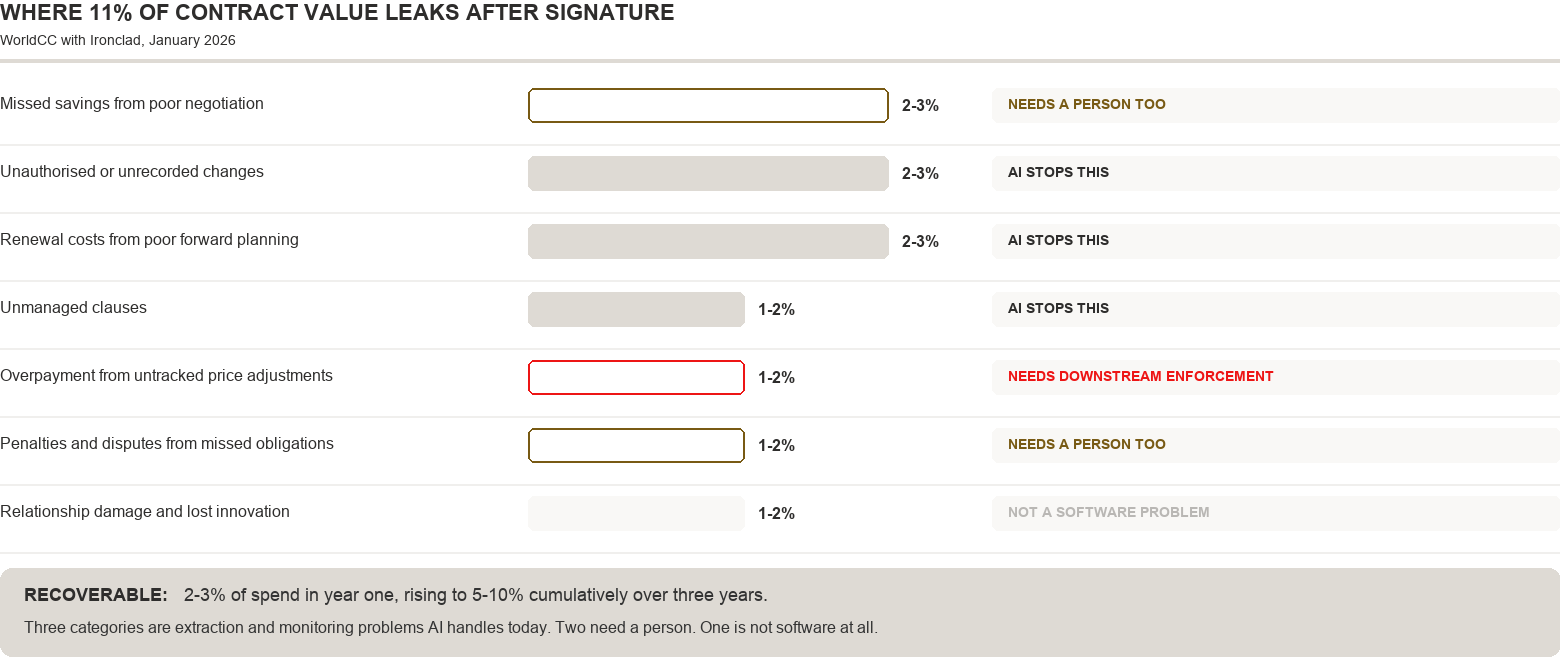 Figure 1. Where contract value leaks after signature, and which losses AI can genuinely stop today.
Why this beats the usual statistic. Most pages still quote a 9.2 per cent figure traceable to research from 2017 to 2019. The 11 per cent number is January 2026 and specifically covers the post-signature period.
Where software genuinely wins. Auto-renewal dates, unmanaged clauses and unrecorded changes total roughly 5 to 8 per cent of contract value, and all three are extraction and monitoring problems AI handles reliably.
Where software will not help. Relationship damage and lost innovation is a category no platform fixes, and poor negotiation still needs a person. Two of the seven categories are not a software purchase.
The honest recovery number. WorldCC models 2 to 3 per cent of spend recoverable in year one, rising to a cumulative 5 to 10 per cent over three years, rather than a single headline saving.
One caveat to state plainly. WorldCC notes the true figure is probably higher because most organisations never formally track leakage, and the report was produced with Ironclad, a vendor in this category.
What AI does reliably in contracts today, and where it is still supervised
Artificial intelligence in contract lifecycle management gets sold as one capability. The useful maturity signal is what organisations actually put into production, and Icertis measured exactly that.
Contract task | What the deployment data shows | Your position |
|---|---|---|
Extracting clauses, dates and obligations | Contract review deployed at 44 per cent, the highest in the category | Trust it, spot-check the fields |
Searching a repository in plain language | Mature across every platform here | Trust it once the repository is complete |
Flagging deviation from your playbook | Production-ready, and the fastest payback of any feature | Trust the flag, keep the decision |
Alerting on renewals and notice windows | The single most reliable capability in contract AI | Trust it, and name who acts on the alert |
Drafting from templates and clause libraries | Widely available, quality tracks your template hygiene | Draft only, a person approves |
Redlining and rewriting contract language | Deployed at 20 per cent, under half the review rate | Draft only, a lawyer signs every change |
Negotiating routine agreements autonomously | One vendor claims full autonomy; the rest do not | Pilot on low-value paper with hard guardrails |
Committing the business without human review | 56 per cent of executives are very concerned about this | Require an approval threshold, always |
Reading scanned legacy paper accurately | 55 per cent name data output quality as their barrier | Budget an OCR and cleanup workstream |
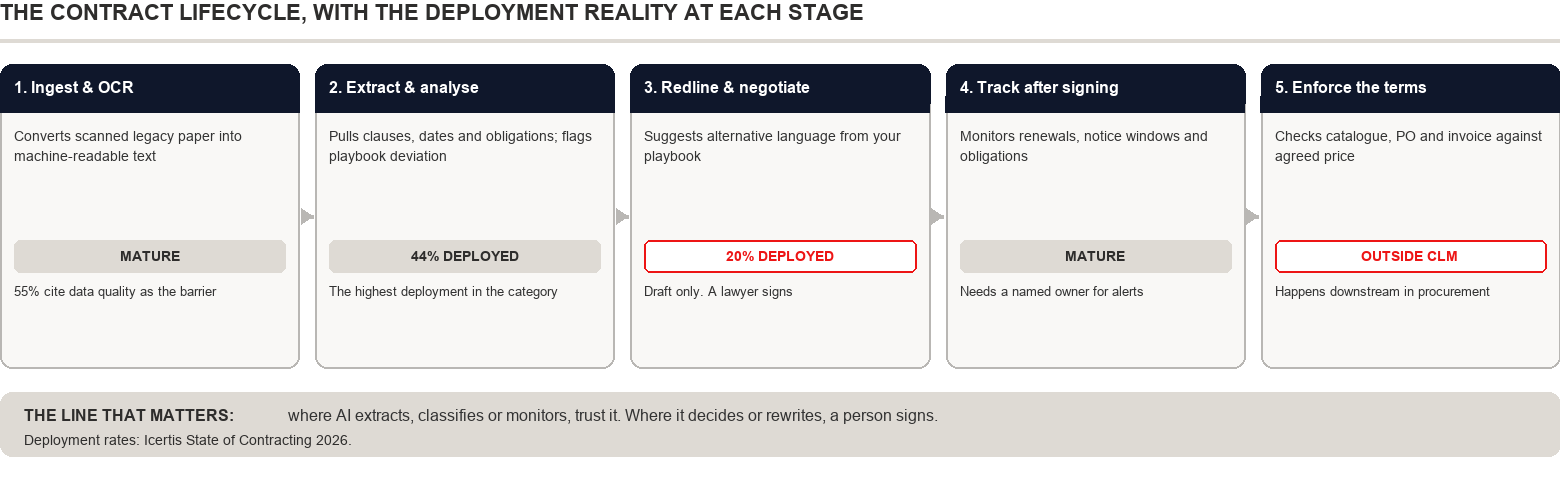 Figure 2. The AI contract lifecycle management stages, with the deployment reality at each one rather than the demo version.
The single comparison to remember. Contract review is deployed at 44 per cent, redlining at 20 per cent. Reading a document is extraction, changing it is judgement, and that gap is the whole story.
Where the market is heading, and how fast. Icertis found 42 per cent of organisations implementing AI in contracting, up from 30 per cent a year earlier, so this is moving rather than plateauing.
The claim to test hardest in a demonstration. Autonomous negotiation. Luminance states it has the only fully autonomous agent-to-agent contract negotiation in the market, which is a specific claim you can ask others to match.
What buyers themselves say. Icertis surveyed 1,000 executives and found 56 per cent very concerned about granting agents autonomy without guardrails, and 44 per cent lacking trust in autonomous execution.
Enterprise AI contract management platforms: above 400 contracts a month
At this volume you need obligation management, multi-entity governance, real integration depth and a migration plan for tens of thousands of legacy agreements.
1. Agiloft: best for contract processes you cannot simplify
A Gartner Magic Quadrant Leader for the sixth consecutive year, and the platform large organisations reach for when their contracting genuinely does not fit a standard template.
Its defining asset is configurability. Approval structures, clause libraries, entity rules and workflow logic are all shaped by you rather than chosen from a menu, which is rare at this tier.
That same strength is its main risk. Configurability has to be paid for in time and internal capability, and Agiloft rewards mature legal operations teams while punishing thin ones.
Best for: enterprises whose contract process is shaped by regulation, entity variation or legacy commitments, and cannot bend to packaged software.
Real cost: quote based, with per-user pricing reported in the region of $65 to $150 monthly. That is one of the few enterprise options with a published shape, which makes early modelling possible.
Pros
Six consecutive years as a Magic Quadrant Leader, the most consistent analyst record in this category
Configuration depth with genuinely no equal among the platforms here, including unusual approval and entity structures
Around 4.3 on G2 across more than 590 reviews, one of the larger independent review bases in the category
Strong clause library governance, with standard positions maintained centrally rather than uploaded per deal
No forced tier upgrade to reach the AI features, unlike several suites here
Cons
Configurability lengthens implementation and needs a named internal owner for design decisions
Time to first value is longer than any packaged tool on this list
Smaller implementation partner ecosystem than Docusign or Icertis
Interface is functional rather than modern, and reviewers say so consistently
Key features: configurable contract lifecycle workflows, central clause library with version control, AI clause and metadata extraction, playbook deviation flagging, obligation and renewal tracking, legacy contract import, multi-entity approval hierarchies, reporting and audit trails, and ERP and CRM integration.
Bottom line: the right answer where the process is non-negotiable and you can staff a proper design phase. The wrong answer if you need something live this quarter.
2. Docusign CLM: best if your agreements already run through Docusign
A Magic Quadrant Leader for six years running, and since 2024 the home of Lexion, the AI contract startup Docusign bought for $165 million.
Its defining asset is the signature footprint. Almost everyone you contract with has used Docusign, which removes the adoption resistance that sinks so many CLM rollouts before they produce data.
The Lexion acquisition closed the gap that used to disqualify it. Docusign was strong on execution and weak on intelligence, and buying an AI-native CLM addressed exactly that.
Best for: organisations already standardised on Docusign for signature, where introducing a second agreement system would create more problems than it solves.
Real cost: quote based at enterprise scale, commonly reported between $50,000 and $250,000 annually depending on volume and modules. Lexion's own AI capability now sits inside that rather than as a separate purchase.
Pros
The widest signature footprint in the market, which materially lowers counterparty adoption friction
Six consecutive years as a Magic Quadrant Leader, confirmed in the published record
Lexion's AI now native, covering drafting, obligation extraction and review acceleration
Around 4.3 on G2, with a large review base built over many years
Mature compliance and e-signature validity coverage across jurisdictions, including India's IT Act requirements
Cons
Owning signature is not the same as being the best CLM, and the two decisions get conflated
Post-acquisition integration of Lexion is still maturing, so ask what is native today
Module gating means capabilities shown in a demonstration may sit outside your quote
Weaker than Icertis or Sirion on deep obligation-to-evidence workflows
Key features: agreement lifecycle workflows, Lexion AI drafting and review, obligation extraction, clause and metadata capture, repository search, renewal alerting, e-signature with jurisdictional compliance, template governance, and integration across CRM and ERP systems.
Bottom line: shortlist it first if you are a Docusign estate, and make competitors prove they add something signature integration does not.
3. Icertis: best for obligations you have to prove you met
The platform most associated with the post-signature half of the lifecycle, and the vendor publishing the research that the rest of this market cites, including the deployment data used throughout this guide.
Its defining asset is the obligation-to-evidence workflow. It does not merely record what you promised, it maps each promise to a control, tracks whether it was met and holds the evidence an auditor will ask for.
That depth is also why it is the wrong answer for many buyers. Icertis assumes contract compliance is a governed process with owners, and organisations without that structure buy capability they cannot operate.
Best for: regulated enterprises that must demonstrate to an auditor which obligation was met, when, and with what evidence attached.
Real cost: quote based, enterprise scale, commonly cited in the $50,000 to $250,000 annual band and above. Implementation length is driven almost entirely by how disorganised your existing repository is.
Pros
The deepest obligation and compliance rule engine of any platform here, mapping terms to controls
Publishes the most transparent research in the category, which is unusual and genuinely useful in evaluation
Strong multi-entity and multi-jurisdiction governance for global contracting
Contract review capability with the highest reported production deployment in the market at 44 per cent
Cons
Its 2025 Magic Quadrant Leader position is stated on its own site and we could not independently confirm it
Around 4.2 on G2 from roughly 80 reviews, a smaller independent base than Agiloft or Docusign
Reviewers report extraction errors on messy documents taking significant time to correct
Genuine overkill below a few thousand agreements, and priced accordingly
Key features: obligation extraction and tracking with named owners, compliance rule engines mapping terms to controls, clause deviation detection, contract intelligence across the portfolio, multi-entity governance, audit evidence trails, renewal management, and enterprise ERP integration.
Bottom line: the strongest answer where compliance evidence is the actual requirement. Too heavy if you simply want faster contract turnaround.
4. Sirion: best for supplier-side contracts and performance
Built around the supplier relationship rather than the sales cycle, which makes it the closest of the enterprise platforms to a procurement problem rather than a legal one.
Its defining asset is that it treats a contract as a performance instrument. Service levels, price terms and delivery commitments are tracked against what the supplier actually did, not just stored as text.
That orientation is unusual. Most CLM platforms were designed for the paper a company sends out and were later pointed at the paper it receives, and the difference shows in the supplier reporting.
Best for: organisations managing large supplier bases where service levels, price terms and performance against contract are the reason you need the system at all.
Real cost: quote based, enterprise scale, with pricing scaled on contract volume and the number of supplier relationships under management rather than on user seats.
Pros
Genuinely supplier-oriented rather than repurposed from sales contracting, which shows in the reporting
Strong on the post-award half of the lifecycle, which is exactly where the 11 per cent leakage sits
Around 4.5 on G2, the joint highest enterprise score among the platforms compared here
Service level and performance tracking tied directly to contract terms rather than managed separately
Cons
Its Magic Quadrant position was not confirmed in the sources we were able to verify
Heavier than most mid-market legal teams need, and priced for enterprise scale
Publishes extensive comparison content about competitors, so treat its own material as vendor marketing
Less strong than Ironclad or Juro where the requirement is fast sales-side contract production
Key features: obligation extraction with supplier performance tracking, service level monitoring against contract terms, supplier risk scoring across tiers, price and discount term management, contract repository with intelligence, dispute and claim management, and ERP integration.
Bottom line: the best enterprise fit for a procurement-led buyer, and worth putting head to head with Icertis specifically on obligation depth.
5. Workday CLM, formerly Evisort: best for search across a large repository
Evisort was an AI-native contract intelligence platform until Workday acquired it in 2024. It became generally available through Workday from March 2025, and Workday added a contract AI library in October 2025.
Its defining asset is extraction quality across messy historical documents. It was built AI-first rather than adding AI to a workflow engine, and that architectural difference is real rather than marketing.
The acquisition changed who should consider it. What was a flexible best-of-breed choice is now effectively a Workday module, which is excellent inside a Workday estate and awkward outside one.
Best for: Workday customers, and organisations whose primary pain is finding terms buried across thousands of historical agreements rather than producing new ones.
Real cost: quote based through Workday licensing. The standalone monthly pricing quoted in older comparison articles, commonly $1,000 to $2,500, no longer reflects how it is sold.
Pros
Genuinely AI-native architecture rather than AI layered onto a legacy workflow tool
Among the strongest extraction and semantic search across large, messy legacy repositories
Native connection to Workday finance and HR data, which no independent CLM can match
Contract AI library added in late 2025, extending prebuilt extraction models
Cons
Effectively requires a Workday relationship, so buyers wanting best-of-breed have lost that option
No independent G2 score was sourced under the Workday branding, making review diligence harder
Lighter than Icertis or Sirion on obligation-to-evidence and supplier performance workflows
Product roadmap now follows Workday's priorities rather than the CLM market's
Key features: AI-native contract intelligence, high-accuracy extraction across legacy and scanned documents, semantic search over large repositories, prebuilt contract AI models, obligation and renewal tracking, and native integration with Workday financial and human capital data.
Bottom line: compelling inside a Workday estate and hard to justify outside one. If you are not a Workday customer, this is no longer the flexible option it was.
Mid-market AI contract management platforms: 50 to 400 contracts a month
Below the enterprise tier the job changes. You are not proving obligations to a regulator, you are trying to stop contracts sitting in inboxes and renewals passing unnoticed.
6. Ironclad: best for contract workflow tied to a CRM
Workflow automation first with AI layered on top, and the platform most often chosen by legal teams supporting a fast-moving sales organisation.
Its defining asset is the workflow builder. Contracts originate inside Salesforce, route by rules the business can see, and reach signature without legal touching the routine ones at all.
It also co-published the January 2026 WorldCC leakage research used throughout this guide, which is a genuine contribution to a category that mostly publishes marketing.
Best for: companies where legal review is the bottleneck in the revenue cycle and contracts need to originate inside a CRM rather than a legal system.
Real cost: quote based, typically priced on workflow complexity and contract volume rather than seats alone. Expect the upper end of the mid-market band and into enterprise pricing at scale.
Pros
The strongest workflow builder here for business-visible approval routing
Deep CRM integration, so contracts start where the deal already lives
AI drafting from approved templates plus one-click playbook redlining on third-party paper
Co-published the 2026 WorldCC leakage research, unusual transparency for a vendor
Cons
Its 2025 Magic Quadrant Leader position is stated on its own site rather than in sources we verified
Materially weaker on supplier-side obligations than Sirion or Icertis
No G2 score was sourced in our research, so check the profile directly
Pricing frequently lands above its mid-market positioning once volume is factored in
Key features: configurable contract workflows, AI drafting from template libraries, third-party paper review, one-click playbook redlining, repository search, approval routing by policy, renewal tracking, and native CRM and ERP integration.
Bottom line: excellent for sales-side velocity. Look elsewhere if your problem is supplier obligations and price terms after signature.
7. Malbek: best mid-market CLM for legal operations teams
A 2025 Magic Quadrant Leader positioned deliberately at mid-market rather than chasing the largest enterprise deployments, which is a rarer combination than it sounds.
Its defining asset is that Leader-grade capability arrives without an enterprise implementation programme. You get proper lifecycle management on a mid-market budget and timeline.
The trade-off is ecosystem. Fewer implementation partners and a smaller community than the platforms above it, which matters when you need help with something unusual.
Best for: mid-market companies with a small in-house legal function that needs real lifecycle management without a multi-quarter rollout.
Real cost: quote based, and expect it in the mid-market band of roughly $15,000 to $50,000 annually rather than six figures.
Pros
Magic Quadrant Leader positioning at genuine mid-market pricing, rare in this category
Lighter implementation burden than any enterprise suite here
Scores among the highest on user satisfaction for mid-market legal teams
Clause and metadata extraction plus playbook comparison included rather than tier-gated
Cons
Less configurable than Agiloft and shallower on obligations than Icertis
Smaller implementation partner network and user community
No G2 score was sourced in our research despite strong satisfaction commentary
Not built for multi-entity global governance at enterprise scale
Key features: contract lifecycle workflows, clause and metadata extraction, playbook comparison on incoming paper, obligation and renewal tracking, template governance, legal operations reporting, and CRM and finance system integration.
Bottom line: the value pick among Magic Quadrant Leaders, and the sensible first shortlist entry for a mid-market legal team.
8. LinkSquares: best for contract analytics a CFO will actually read
Positioned around analytics and reporting rather than contract production, which makes it a finance and operations tool as much as a legal one.
Its defining asset is the dashboard layer. Portfolio-level exposure, renewal pipeline and obligation status presented for an audience that has never opened a contract.
Its published architecture is agentic, using AI to identify terms across legacy contracts for obligation tracking rather than requiring anyone to tag them first.
Best for: finance and operations leaders who need portfolio reporting on obligations, renewals and exposure rather than faster contract creation.
Real cost: reported from around $10,000 annually with a reported median near $31,000 for mid-market buyers, making it one of the better documented prices here.
Pros
Around 4.7 on G2, the highest score among the twelve platforms compared here
Dashboards genuinely built for a non-legal audience rather than adapted for one
Pricing better documented publicly than almost anything else in this category
Agentic extraction across legacy contracts without manual tagging first
Cons
Reviewers name inaccurate AI among their top dislikes, which matters most on messy legacy paper
Weaker on drafting and negotiation workflow than Ironclad or Juro
Analytics quality is only as good as extraction accuracy, so the two criticisms compound
Not a Magic Quadrant Leader, so less analyst validation than Malbek at similar pricing
Key features: agentic term extraction from legacy contracts, portfolio dashboards and reporting, obligation and renewal tracking, natural language repository search, template-based drafting, approval workflows, and finance system integration.
Bottom line: the right choice when the requirement is visibility and reporting. Test extraction accuracy on your worst documents before you commit.
9. Juro: best for fast deployment and collaborative drafting
Browser-based collaborative contract automation aimed at scaling companies that need something working in weeks rather than quarters.
Its defining asset is the editing experience. Sales, legal and operations work on the same document in a browser, which removes the version chaos of emailed attachments.
Its positioning is the one thing to be careful about. Juro markets to smaller teams but the reported pricing sits firmly in mid-market territory.
Best for: fast-growing companies where sales, legal and operations all touch the same agreements and the current process is email plus attachments.
Real cost: reported averaging about $34,500 annually with typical deals between $18,000 and $35,000, and per-user rates from around $25 monthly. Budget mid-market, not SMB.
Pros
Around 4.6 on G2, among the highest scores in this comparison
Among the fastest platforms here to get live, measured in weeks
The editing and collaboration experience draws consistently the fewest complaints
Generative drafting and AI summarisation of stored agreements included
Cons
Priced well above what its small-business positioning implies
Lighter than the enterprise suites on obligation depth and compliance evidence
Not a Magic Quadrant Leader, so less independent validation at its price point
Not designed for multi-entity governance across jurisdictions
Key features: browser-based collaborative editing, generative drafting assistance, AI summarisation of stored agreements, clause-linked renewal monitoring, automated data capture at creation, approval workflows, e-signature, and CRM integration.
Bottom line: strong for speed and usability. Check the real annual figure early, because the SMB framing understates it considerably.
10. SpotDraft: best for legal and sales collaboration, and for Indian teams
Built for in-house teams supporting commercial velocity, with an AI assistant that answers plain-language questions about stored agreements rather than requiring a search syntax.
Its defining asset for readers in India is origin. SpotDraft has genuine Indian presence and local implementation support, which shows in search demand where India volume exceeds the United States.
Adoption friction is its other strength. Non-legal users pick it up without training, and at mid-market scale adoption is what decides whether you get usable contract data at all.
Best for: growth-stage companies needing fast adoption across non-legal users, and the strongest option here for teams operating primarily in India.
Real cost: reported from around $10,000 annually on per-seat licensing, well above the few hundred dollars monthly that older comparison articles claim.
Pros
Around 4.5 on G2 across more than 170 reviews, a solid independent base
Plain-language AI assistant that non-legal users actually use
Meaningful India presence and local implementation support, unusual in this category
Low adoption friction, which is the strongest predictor of usable contract data
Cons
Not a Magic Quadrant Leader, with less analyst validation than Malbek
Lighter on post-signature obligation depth than the enterprise suites
Pricing considerably higher than its small-business positioning implies
Narrower multi-jurisdiction compliance coverage than Docusign
Key features: AI assistant answering agreement questions in plain language, contract summarisation, template-driven drafting, approval workflows, renewal and obligation reminders, repository search, e-signature, and CRM integration.
Bottom line: a sensible mid-market pick where adoption speed matters more than compliance depth, and the natural first look for Indian teams.
AI-native specialists: platforms built for review rather than lifecycle
These two belong in a different group. Both built the AI first and the workflow second, which makes them stronger on reading contracts and lighter on governing them.
11. Luminance: best for high-volume routine review and autonomous negotiation
Built from scratch by machine learning researchers out of Cambridge, and the only vendor in this market claiming fully autonomous agent-to-agent contract negotiation with no human involved.
Its defining asset is that autonomy claim, and it is specific enough to test. Recent releases also expose the reasoning behind each decision rather than only the output.
Its limit is scope. This is a review and negotiation engine rather than a lifecycle platform, so it sits alongside your repository rather than replacing it.
Best for: teams drowning in routine agreements such as NDAs and standard vendor paper, where volume is high and commercial variation is low.
Real cost: quote based with nothing published, which competitors point to directly as a weakness in a market drifting toward transparency.
Pros
The autonomous negotiation capability is a specific, testable claim no competitor currently matches
Playbook-driven review at volume, with exception routing to lawyers only where needed
Built AI-first by machine learning researchers rather than layered onto legacy workflow
Recent releases surface the reasoning behind each decision, not just the conclusion
Cons
The autonomy claim is the vendor's own and no independent verification exists
Narrower than a full lifecycle platform, so it supplements rather than replaces a CLM
No published pricing at all, and no G2 score was sourced in our research
Stronger on review than on post-signature obligation management
Key features: playbook-driven automated review, clause deviation flagging with exception routing, autonomous end-to-end negotiation on routine agreements, due diligence review at volume, decision reasoning transparency, and repository analysis.
Bottom line: buy it for routine review volume. Ask for a live negotiation demonstration on your own paper rather than a rehearsed one.
12. Leah: best for agentic workflows with published pricing
Positioned by Gartner as a Visionary in the 2025 Magic Quadrant, and one of very few vendors in this market that publishes its pricing openly.
Its defining asset is agentic execution. Drafting, review, routing and negotiation run as a sequence the software plans, rather than as steps a person triggers one at a time.
Pricing transparency is the other real advantage, and it is a practical one. You can build a business case before entering a sales process, which almost nothing else here allows.
Best for: teams that want AI to execute multi-step contract work end to end, and want a price before booking a demonstration.
Real cost: published transparently by the vendor, which is genuinely unusual in this category and shortens evaluation considerably.
Pros
Transparent published pricing, rare enough here to be a differentiator in itself
Agentic execution across drafting, review, routing and negotiation as one sequence
Gartner Visionary placement for a fifth consecutive year, confirmed in the published record
Named enterprise references including KPMG and Pinsent Masons support the agentic claim
Cons
Visionary rather than Leader, so less proven at scale than the established suites
Its own competitor comparison content is unavoidably self-serving, so read it as marketing
No G2 score was sourced in our research
Agentic autonomy runs directly into the governance concerns 56 per cent of executives report
Key features: agentic multi-step contract execution, clause interpretation and risk detection, playbook-driven review, drafting and routing automation, negotiation support, enterprise integrations, and published pricing tiers.
Bottom line: a strong shortlist candidate if agentic execution is the requirement, and the easiest platform here to budget for.
Low-volume options: under 50 contracts a month
Below 50 contracts monthly the AI is not the point. You need a searchable repository, working approvals and reliable renewal alerts at a price that does not need a business case.
Concord. End-to-end lifecycle at the genuinely low-cost end, in the region of $30 to $100 per user monthly, with quick review cycles and collaborative editing rather than deep AI.
Zoho Contracts. Clear per-user pricing and the obvious choice if you already run Zoho, with basic metadata extraction and document type sorting rather than playbook intelligence.
Genie AI. Built on a patent-pending architecture the vendor calls Eidetic Intelligence, designed to retain negotiated positions across documents so precedent compounds instead of being rediscovered.
What to skip at this volume. Obligation-to-evidence engines, supplier performance scoring and autonomous negotiation. None of them pay back below a few hundred agreements a year.
AI contract review: the capability almost every team buys first
Contract review ai is searched more than the software category itself, and for good reason. It is the capability with the clearest payback and the least risk attached to it.
What artificial intelligence contract review actually does. It reads incoming third-party paper, locates the clauses that matter, and flags where the language deviates from your standard positions.
Why it goes first. Icertis found review deployed at 44 per cent, the highest of any contract AI capability, because the output is a flag for a person rather than an automated change to an agreement.
What ai contract analysis adds on top. The stronger ai contract review tools give portfolio views of where risk concentrates, which clauses you concede most often, and which counterparties push the same terms.
How to evaluate ai contract review software properly. Send three of your own messiest agreements, including a scanned one, and compare extraction accuracy rather than watching a demonstration on clean paper.
Where the contract review ai tools split. Luminance and Leah lead on autonomous handling of routine paper, DocJuris on playbook redlining, and Ironclad and Juro where review sits in a sales workflow.
The honest limit. Best ai contract review software lists rarely mention that accuracy tracks document quality far more than model quality, which is why 55 per cent of contract managers name data output as their barrier.
How to choose the right AI contract management software
Contract volume narrows the field. Your single biggest priority usually picks the winner from what is left.
Your goal | AI capability that actually matters | Integration that matters | Look at these first |
|---|---|---|---|
Speed up sales and revenue cycles | Third-party paper review, CRM-integrated drafting, one-click playbook redlining | Salesforce or HubSpot | Ironclad, Juro, SpotDraft |
Audit and migrate legacy contracts | Bulk OCR accuracy, automated metadata extraction, semantic search | SharePoint, Google Drive, Box | Workday CLM, LinkSquares |
Control procurement and vendor risk | Obligation extraction, deadline alerting, supplier performance and tier scoring | SAP, Workday, your P2P layer | Sirion, Icertis, Ncontracts |
Cut in-house legal overhead | Playbook automation on routine paper, exception routing, risk scoring | Microsoft Word and Outlook | Luminance, Leah, Malbek |
Enforce agreed prices where money moves | Price-term validation against catalogue, PO and invoice | Your ERP and AP systems | Procuresprint, or a CLM-to-P2P integration |
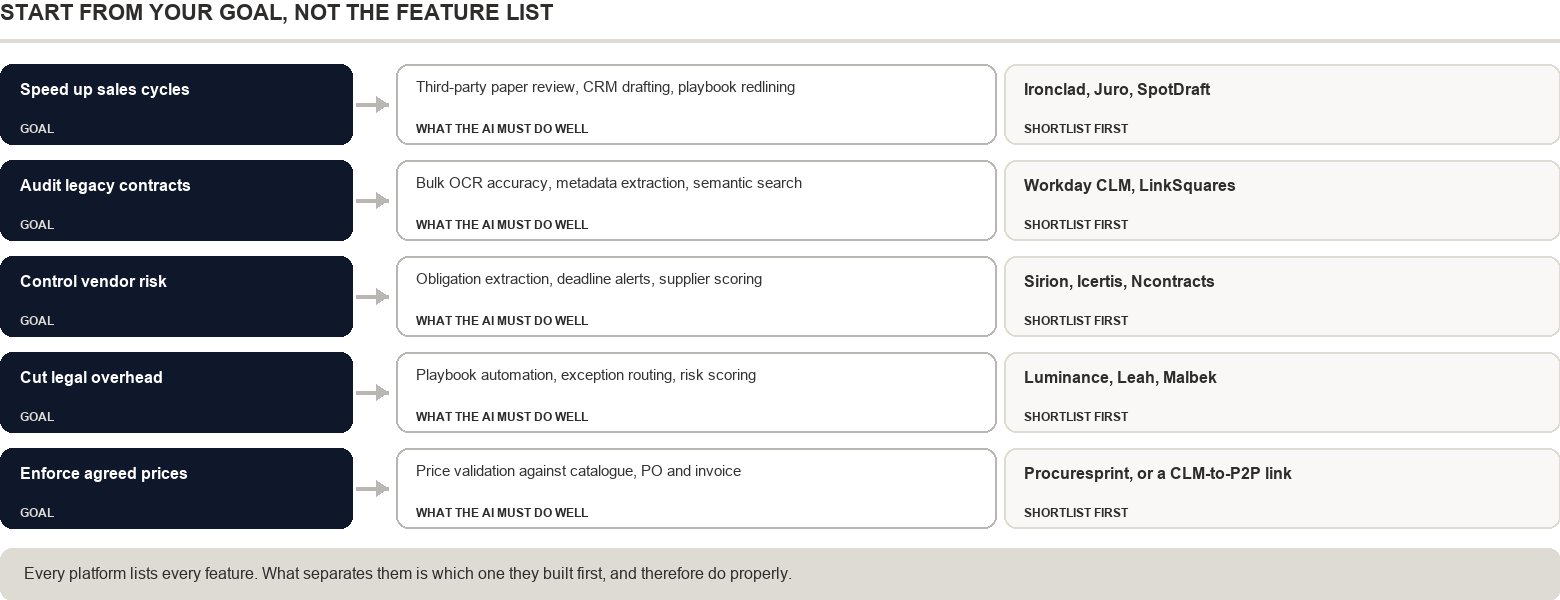 Figure 3. Four goals, the AI capability each one actually needs, and where to look first.
Why goal beats feature comparison. Every platform here lists clause extraction and obligation tracking. What separates them is which of those they built first and therefore do properly.
The integration question that decides the shortlist. Ask whether the platform writes back to the system where the work happens, because a CLM that only reads produces reports while one that writes removes work.
What AI contract management software actually costs
Automated contract management software is quoted, not priced. Only the low-volume tier publishes a rate card, which is why so many business cases in this category are wrong before the first invoice arrives.
Contract volume | What you should budget | What you get at this level | Setup time |
|---|---|---|---|
Under 50 a month | $30 to $100 per user monthly | Repository, e-signature, metadata extraction, searchable PDFs | 1 to 2 weeks |
50 to 400 a month | $15,000 to $50,000 annually | Playbook automation, deviation flagging, CRM sync, obligation tracking | 1 to 3 months |
Over 400 a month | Six figures annually, commonly $50,000 to $250,000 | Bulk legacy audit, custom models, compliance rule engines, multi-entity governance | 6 to 12+ months |
Any volume, per-user model | Agiloft reported at $65 to $150 per user monthly | A different pricing shape worth modelling separately | Varies |
Legacy migration and OCR | Frequently exceeds the year-one licence | Your existing portfolio made searchable and extractable | Often the critical path |
Your own team | ~0.5 FTE through implementation | Nothing. It is a cost, not a capability | Duration of the project |
Read that table with three things in mind.
Legacy migration is the largest hidden line and it is covered in full below. On a portfolio of any age it regularly exceeds the first year subscription, and it almost never appears in the initial quote.
Modules gate the capability you assumed was included. Obligation management, analytics and advanced review are frequently separate lines, so price the bundle you will need in year two rather than year one.
Your own team is a real cost. Half a full-time equivalent through implementation is normal for a mid-market rollout, and more where legacy paper has to be reviewed by someone who understands it.
Two more costs sit outside the quote entirely. Change requests after go-live are chargeable on most enterprise suites, so ask what a workflow or clause library change costs and how long it takes.
The second is renewal uplift. Ask what the increase is capped at, because a platform priced on contract volume gets more expensive precisely as your contracting grows.
The cost that never appears in your quote: legacy contract migration
This is the line item that surprises buyers most, because the vendor has no reason to raise it and the buyer has no way to size it in advance.
Every platform here works from a repository. If your executed agreements sit across shared drives, inboxes and filing cabinets, building that repository is the project and the software is the easy part.
Why scanned paper is the specific problem. Nearly 40 per cent of the executives Icertis surveyed had signed a paper contract in the past year, so optical character recognition, or OCR, is not a legacy edge case.
Why accuracy degrades exactly where it matters. Extraction is least reliable on old, amended, hand-annotated and scanned documents, which are also the agreements most likely to contain a forgotten obligation.
Why 55 per cent name data output quality as the barrier. It is not model weakness. It is that the model is reading documents nobody would ask a person to read either, and the output reflects the input.
What to negotiate before signature. A stated accuracy commitment on your own sample, whether migration is fixed price or time and materials, and who reviews the exceptions the extraction cannot resolve.
Do the arithmetic on your own numbers. Ten thousand legacy agreements at even a few minutes of human verification each is several months of somebody's year, and that resource is rarely named in a business case.
Ask every vendor three questions directly. What is your extraction accuracy on my worst hundred documents, what does migration cost as a fixed price, and who owns the exceptions.
Total cost of ownership: a worked example at 3,000 contracts
Take a 700-person business with 3,000 live agreements and about 150 new contracts a month, buying a mid-market platform at a quoted $35,000 a year.
Line item | Year 1 | Years 2 and 3, each | Note |
|---|---|---|---|
Subscription (illustrative quote) | $35,000 | $37,000 | Nobody in the mid-market tier publishes one |
Legacy migration and OCR, 3,000 agreements | $25,000 to $60,000 | Nil | Fixed price against a defined sample, or it drifts |
Implementation and configuration | $15,000 to $35,000 | Nil | Ask what a later workflow change costs |
Internal effort, ~0.5 FTE through go-live | $30,000 | $10,000 | Almost never in a business case |
Module additions in year two | Nil | $8,000 to $20,000 | Obligations and analytics are often separate lines |
Indicative total | $105,000 to $160,000 | $55,000 to $67,000 | Three-year range roughly $215,000 to $294,000 |
Against the opportunity | 2 per cent recovered on $200M contracted spend | $4,000,000 a year | The software is not the risk. An incomplete migration is |
Three things fall out of that table.
Year one costs roughly double the subscription you were quoted. This is the most common business case error in the category and it is entirely avoidable by asking about migration early.
The migration cost is one-off but it is also the gate. Skip it and the platform holds only new contracts, which means the 11 per cent leakage on your existing portfolio continues untouched.
Against a three-year cost near $215,000, recovering even 2 per cent of value on $200 million of contracted spend is $4 million a year. The software is not the risk. Not completing the migration is.
Why contract AI implementations fail, and how to prevent it
Only 42 per cent of organisations are implementing AI in contracting at all, and the reasons the rest stall are consistent enough to plan against.
Data output quality, named by 55 per cent of contract managers. This is the top cause and it is a document problem rather than a software problem, which means the fix happens before go-live.
An incomplete repository. Contract AI pointed at a partial set of agreements returns a confident answer about the part it can see, which is more dangerous than no answer at all.
No written playbook. Deviation flagging compares incoming paper against your standard positions, so if those positions live in a senior lawyer's head there is nothing to compare against.
Unowned alerts. Renewal and obligation alerts create work, and a stream nobody owns becomes background noise inside a month while the leakage continues unchanged.
Trust withheld from the output. Forty four per cent of executives say they lack trust in autonomous execution, and a flag nobody acts on has exactly the same value as no flag.
None of these are model problems. They are document, ownership and process problems, and every one is knowable before you sign anything.
Two defences that work. Migrate and go live on one contract type first, because a narrow deployment that works beats a portfolio-wide one that stalls.
And define success as a percentage of your portfolio searchable with obligations owned by a date, rather than as a go-live.
How the contract lifecycle works, from request to enforcement
If you are building the business case internally, you need to describe the whole cycle on one page. This is what a platform automates, in the order it happens.
Request and intake. Someone in the business needs an agreement. The request captures what kind, with whom, for how much and against which standard template, before any drafting begins.
Drafting. The agreement is assembled from an approved template and clause library, so the starting position is the one legal actually sanctioned rather than last quarter's copy.
Review of incoming paper. Where the counterparty sends their own contract, it is read against your playbook and every deviation is flagged with its risk level attached.
Negotiation and redlining. Positions are exchanged and changes tracked. This is the least automated stage in practice, deployed at only 20 per cent, and it is where a person still signs off.
Approval. The agreement routes by policy to whoever is authorised to accept the remaining deviations, with the authority level tied to the value and the risk rather than to who is available.
Execution. The document is validly signed and stored, which in some jurisdictions including India involves a separate stamp duty obligation covered further below.
Obligation tracking. What each side promised becomes a monitored commitment with a named owner, a due date and evidence attached when it is met.
Enforcement. The agreed prices, discounts and service levels are applied where money actually moves, in the catalogue, the purchase order and the invoice match.
The strategic point is that these steps are owned by different teams on different systems. Legal owns drafting, the business owns requests, procurement and finance own the last step.
A platform is valuable to the extent that it removes the handoffs. That last stage is also the one no CLM completes, which the next section covers.
The layer most contract AI comparisons leave out
Look again at the leakage table. One category, overpayment from untracked price adjustments, cannot be fixed inside a contract platform at all.
Supplier contract management tools extract the agreed price term perfectly. Preventing overpayment needs that term enforced where money moves, which is the catalogue, the purchase order and the invoice match.
Why the gap exists. Vendor contract management software is mostly built for legal and sales workflows, so it ends at the obligation record. Enforcement happens downstream in procurement and accounts payable.
What this means for a procurement buyer. A CLM tells you the negotiated price. It will not stop a business unit paying a different one, which is exactly where that leakage sits.
What to ask any CLM vendor. How an extracted price indexing term reaches the buying catalogue and the invoice matching engine, and whether that is native or an integration project.
The related categories. Missed obligations and unrecorded changes have the same shape. AI surfaces them reliably, and something downstream still has to act before the value is recovered.
Platforms outside this list, and where they fit
Several platforms appear in AI answers and comparison lists for this term. Here is why each sits outside the main twelve, so you can rule them in or out quickly.
DocJuris. Narrow and genuinely good at one thing, which is third-party paper redlining against a playbook. It ranks on this keyword because that focus is clear rather than because it is a full CLM.
Ncontracts. Aimed specifically at vendor contract management for regulated financial institutions, and the only platform ranking here that leads with the supplier angle rather than the legal one.
ContractSafe and Contracts365. Repository-led tools with lighter AI, sensible where the requirement is finding what you signed rather than governing how new agreements get made.
Conga and Agiloft's legacy competitors. Credible CLM options with long histories, excluded here because their AI capability is less differentiated than the twelve above.
Volody. An India-founded CLM with real local search demand, worth a look for Indian teams alongside SpotDraft, particularly where stamp duty and local compliance are the binding constraint.
HyperStart, Aline and CloudEagle. Newer entrants that rank well on this term through their own comparison content. Thinner independent review bases than the platforms listed above.
Ten questions that expose a poor fit during evaluation
Vendor demonstrations are rehearsed against clean data. These questions are not, and the hesitation in the answer tells you as much as the answer does.
What is your extraction accuracy on my worst hundred documents, including the scanned and hand-amended ones, and will you commit to a number?
Is legacy migration fixed price or time and materials, what is included, and who reviews the exceptions the extraction cannot resolve?
Show me a playbook deviation being flagged right now, on a contract I supply, that your team has never seen before.
Which capabilities shown in this demonstration sit outside the quote I am being given, and what do they each cost?
After go-live, what does a clause library or workflow change cost, and how long does it take to make?
Are my agreements used to train shared models, and will you put the answer in the contract rather than in an email?
Which objects sync bi-directionally with my CRM and ERP, and which are read-only?
How does an extracted price or discount term reach my buying catalogue and invoice matching, natively or through integration?
What is my renewal uplift capped at, given your pricing scales with contract volume?
Give me a reference customer of my size, in my industry, who completed a legacy migration in the last 18 months.
That last one is the most revealing question on the list, and it is fair to ask it of every vendor here, including us.
AI contract management in India: stamp duty, e-signature validity and data residency
India is a significant market for this category and it has requirements that will disqualify an otherwise strong platform. Search demand reflects it, with several terms showing India at or above United States volume.
If any part of your operation contracts in India, check these before shortlisting anything.
E-signature validity is settled, within limits. Section 10A of the Information Technology Act 2000 recognises electronic contracts, and platforms including Docusign, Adobe Sign and eMudhra Aadhaar eSign qualify.
Some documents still cannot be executed electronically. Negotiable instruments, powers of attorney, trust deeds and wills are excluded, so confirm your contract types are not among them before you automate.
E-signing does not pay stamp duty, and this is the trap. Stamp duty is paid separately through SHCIL or the relevant state e-stamping system, and an agreement is only enforceable where duly stamped.
The penalty is material. Failure to pay can attract up to ten times the deficient amount, so ask specifically whether the platform tracks stamping status as a field or leaves it outside the system.
State variation matters. Maharashtra, Karnataka and Delhi have digitised stamp duty through SHCIL-managed portals, and rates differ by state, so a single national workflow will not hold.
Data residency under the DPDP Act 2023. Certain personal data must be stored in India, so confirm an Indian region genuinely exists rather than sitting on a roadmap.
This is not theoretical. A platform that handles United States and European execution beautifully can still leave your Indian entity tracking stamping in a spreadsheet, and that gap appears after signature rather than during the demonstration.
AI governance for contract work: what 1,000 executives actually said
This is the counterweight to every autonomy claim above, and it comes from buyers rather than from vendors.
Governance question | The minimum answer to have in place |
|---|---|
Who reviews AI-suggested contract language? | A named lawyer signs every wording change, because generative drafting still invents plausible clauses |
What can an agent do without approval? | Extraction, alerting and search only. Anything that commits the business needs a threshold and a reviewer |
Are our agreements used to train shared models? | Get the answer written into the contract, not given in a sales conversation |
Who owns the renewal and obligation alerts? | One named person per contract portfolio, or the alerts become noise and the leakage continues |
How do we evidence a decision to an auditor? | A register of which AI system touched which contract, what it changed, and who approved it |
The number that should shape your rollout. Icertis found 56 per cent of executives very concerned about granting agents autonomous decision-making without guardrails, and 44 per cent lacking trust in autonomous execution.
The barrier actually blocking adoption. Fifty five per cent of contract managers cite data output quality, which is a repository and extraction accuracy problem rather than a model problem.
The hallucination rule that has not changed. Generative AI can still invent plausible legal language, so a human reviews every change to contract wording regardless of how good the suggestion looks.
Where the direction of travel points. Fifty three per cent of executives expect AI agents to be negotiating deals within twelve months, so the governance you write now will be tested sooner than you think.
Buy a CLM, or add AI review to what you already have
Underneath every comparison above sits one choice that matters more than any feature. You can replace your contract process with a platform, or add AI review to the process you already run.
Replace it with a suite. You get one governed lifecycle, obligations with owners, and a single repository. You also get a migration project, a change programme and a multi-year commitment.
Add review to what you have. A point tool reads incoming paper against your playbook for a fraction of the cost and deploys in weeks. You keep your existing repository, and your obligations stay untracked.
The honest test is where your pain actually is. If you cannot find what you signed, you need a suite. If legal is simply drowning in other people's paper, a review tool solves it far cheaper.
The sequencing that works for most teams. Review tool first because it pays back fastest, repository and migration second, obligation management third once someone owns the alerts.
Neither is universally better, and any vendor telling you otherwise is selling. A point tool sold as a lifecycle solution and a suite sold for a review problem fail for opposite reasons.
Where Procuresprint fits, and where it does not
Mindsprint builds Procuresprint, and it is deliberately absent from the twelve platforms above because it is not a contract lifecycle management system.
What it actually does. It operates downstream of your CLM, validating that catalogue prices, purchase orders and invoices match the agreed contract terms, and routing the exceptions when they do not.
Which leakage category that addresses. Overpayment from untracked price adjustments, plus part of unrecorded changes, together roughly 3 to 5 per cent of contract value in the WorldCC breakdown.
Who it fits. Multi-entity groups where the same contracted item is bought by several business units and the negotiated price quietly fails to apply consistently across all of them.
What it explicitly does not do. Contract drafting, clause libraries, redlining, negotiation, legal workflow or obligation authoring. For any of those, the twelve platforms above are the right shortlist.
What we cannot show you. No published price list, no Gartner Magic Quadrant placement and no G2 profile, so evaluation runs on your own contract and invoice data rather than third-party validation.
If your problem is contract production speed or legal review capacity, this section is not relevant to you and the comparison above is. We would rather say that than stretch the claim.
The bottom line on choosing AI contract management software
There is no single best AI contract management software. There is only the best fit for your contract volume, your existing systems, and whether your problem is producing contracts or enforcing them.
Best contract management software lists are mostly written by vendors in the category. Treat every ranking, including this one, with scepticism, and test extraction accuracy on your own worst documents.
Check first which of the three products you actually need. Buying a lifecycle suite to solve a review problem is the most expensive error in this category.
Above 400 contracts a month, Agiloft suits complex process, Docusign CLM suits Docusign estates, Icertis suits regulated obligation evidence and Sirion suits supplier-side performance.
Between 50 and 400, Malbek is the value pick among analyst Leaders, Ironclad wins on sales workflow, LinkSquares on reporting, and Juro and SpotDraft on speed of adoption.
For review volume rather than lifecycle, Luminance and Leah are the specialists, and Leah is the one that will tell you the price before a demonstration.
And if your contracts are fine but your invoices do not match them, none of the twelve is your answer. That is an enforcement problem, and it is the one we built for.